When people talk about the financial markets, stocks usually steal the spotlight. But quietly humming in the background is the bond market—a massive, multitrillion-dollar engine that has a far bigger day-to-day impact on your financial life than you might realize.
What Exactly Is a Bond?
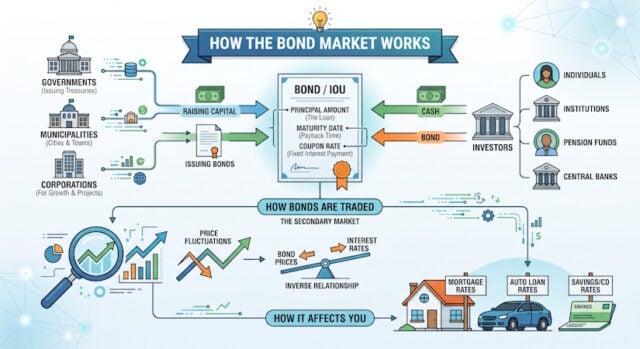
At its simplest, a bond is a formalized IOU. When a government, municipality, or corporation needs to raise money for major initiatives—such as building bridges, modernizing infrastructure, or funding operations—they issue bonds to investors.
Instead of buying partial ownership (as you do when buying company stock), purchasing a bond means you act as a lender. In exchange for your capital, the borrower promises two core things: regular interest payments (called coupon payments) and the full return of your original loan amount (the face value) once the bond matures.

From Mortgages To Stocks, How Higher Government Bond Yields Hit Wider Markets
The Seesaw: Prices vs. Yields
After issuance, bonds trade continuously on secondary markets. Their prices fluctuate in an inverse relationship with interest rates:
- When interest rates rise: Newly issued bonds offer higher payouts. Older bonds carrying lower rates become less appealing, causing their market prices to fall.
- When interest rates drop: Older bonds with higher fixed payments become valuable commodities, driving their market prices up.
A bond’s yield is the effective annual return an investor receives relative to its current market price. When bond prices sink, yields climb; when bond prices rally, yields fall.
How the Bond Market Shapes Your Daily Life
Even if you have never bought an individual bond, market shifts directly influence your personal bottom line:
- Mortgages and Auto Loans: Lenders tie long-term borrowing costs—especially 30-year fixed mortgages—to benchmark debt like the 10-year U.S. Treasury note. When Treasury yields climb, home loan rates rise in lockstep, increasing your monthly housing payments.
- Retirement Portfolios: Most 401(k) plans, target-date funds, and mutual funds hold bonds to temper stock market volatility. Healthy yields provide steady passive income and capital preservation as you build long-term wealth.
- Savings and Economic Signals: When benchmark yields rise, commercial banks typically increase the annual percentage yield (APY) on high-yield savings accounts and certificates of deposit. Furthermore, bond yield patterns serve as an early warning indicator for broader economic expansions or upcoming recessions.
By watching bond market yields, you gain a forward-looking view into borrowing costs, savings returns, and broader financial conditions before major economic shifts occur.
For a visual breakdown of the foundational mechanics behind fixed-income investing, watch Investopedia’s Guide to Bonds 101. This tutorial walks through basic bond structures, primary issuers, and how fixed-income assets generate steady returns while preserving your initial capital.
Sources Used
Disclaimer
Artificial Intelligence Disclosure & Legal Disclaimer
AI Content Policy.
To provide our readers with timely and comprehensive coverage, South Florida Reporter uses artificial intelligence (AI) to assist in producing certain articles and visual content.
Articles: AI may be used to assist in research, structural drafting, or data analysis. All AI-assisted text is reviewed and edited by our team to ensure accuracy and adherence to our editorial standards.
Images: Any imagery generated or significantly altered by AI is clearly marked with a disclaimer or watermark to distinguish it from traditional photography or editorial illustrations.
General Disclaimer
The information contained in South Florida Reporter is for general information purposes only.
South Florida Reporter assumes no responsibility for errors or omissions in the contents of the Service. In no event shall South Florida Reporter be liable for any special, direct, indirect, consequential, or incidental damages or any damages whatsoever, whether in an action of contract, negligence or other tort, arising out of or in connection with the use of the Service or the contents of the Service.
The Company reserves the right to make additions, deletions, or modifications to the contents of the Service at any time without prior notice. The Company does not warrant that the Service is free of viruses or other harmful components.