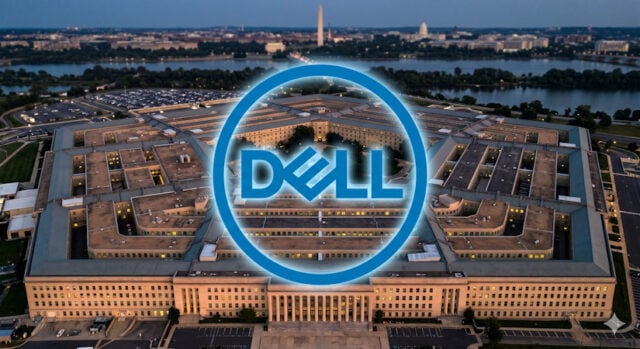
WASHINGTON, D.C. — The U.S. Department of War (historically known as the Department of Defense) has formally awarded a single-award, five-year blanket purchase agreement valued at $9.7 billion to Dell Federal Systems, a subsidiary of Dell Technologies Inc. The massive infrastructure contract, designated as the Core Enterprise Technology Agreement (CETA), is designed to consolidate, standardize, and streamline Microsoft software licensing, advanced cloud subscriptions, and enterprise services across all military branches, the intelligence community, and the U.S. Coast Guard.
While defense and technology officials have heavily emphasized that the landmark procurement represents a major milestone toward fiscal efficiency and modern military data integration, the multi-billion-dollar deal has rapidly ignited an intense ethical and political firestorm across Washington. The award lands only weeks after President Donald Trump publicly used a White House platform to enthusiastically endorse Dell products, and just months after the President personally acquired millions of dollars in Dell equity. Compounding the political fallout are recent multi-billion-dollar philanthropic contributions made by Dell’s billionaire founder to policy initiatives explicitly tied to the Trump administration.
The $9.7 Billion Contract: Consolidating the Military’s Cloud
According to official briefings from senior defense personnel at the Pentagon, the CETA is the largest single software licensing vehicle managed by the military to date. The contract is scheduled to take effect on June 1, 2026, and will operate under a firm-fixed-price structure.
Rather than injecting entirely new funding into the defense budget, the agreement acts as a centralized administrative umbrella. It effectively sweeps dozens of disparate, fragmented IT procurement pipelines previously managed independently by various military service branches into a singular, highly structured conduit overseen directly by the Department of the Navy.

The software and services integrated under this five-year deal are vast, establishing what top tech officers call the core “digital connective tissue” of modern American defensive networks. The procurement includes:
- Tiered Microsoft 365 enterprise licenses for both classified and unclassified operations.
- The Windows Enterprise Operating System and the full Office Professional Plus productivity suite.
- Advanced hybrid-cloud capabilities and highly specialized software bundles, including the “Disconnected No Cloud Access” license designed specifically for remote, high-security, or active combat zones where continuous web connectivity is impossible.
- Targeted, limited deployments of Microsoft Azure are designed to seamlessly transition specialized military workloads toward the overarching $9 billion multi-vendor Joint Warfighting Cloud Capability (JWCC) framework.
Department of War Chief Information Officer Kirsten A. Davies defended the transaction as a necessary operational leap forward to ensure American strategic readiness in an era defined by rapid technological acceleration.
“The Department of War is taking a definitive step forward to advance our digital infrastructure to deter near-peer adversaries,” Davies told reporters at a Pentagon press briefing. “This ensures our warfighters have the tools for just-in-time data sharing, supports our pivot to artificial intelligence and data analytics, and undergirds uninterrupted operational continuity for our most sensitive and disconnected environments.”
Furthermore, defense officials noted that the consolidation is modeled directly on the structural successes and operational data logged by the Pentagon over the last five consecutive years. Barry Tanner, who is currently performing the duties of Chief Information Officer for the Department of the Navy, emphasized that the contract was awarded following an exhaustive, highly competitive bidding process.
According to Tanner, all competing vendors were rigorously evaluated based on baseline federal pricing metrics, market transparency, GSA schedule comparisons, and the holistic value of the supply chain. Dell Federal Systems ultimately outmaneuvered several rival technology firms by presenting an optimal value matrix.
Financial analysts inside the administration project that by wiping out redundant procurement overhead and leveraging unprecedented enterprise scale, the consolidated contract will save American taxpayers an initial $422 million annually. Defense officials expect that annual savings figure to climb significantly as fragmented legacy IT networks across the armed forces are systematically retired.
Ethical Questions Clouding the Deal: Trump’s Stock Trades and Speeches
Despite the glowing financial and operational projections offered by the Pentagon, the timing of the award has drawn sharp, bipartisan scrutiny from ethics watchdogs, legal scholars, and political adversaries, who point to a highly synchronized timeline of stock purchases, public praise, and federal spending.
According to mandatory federal financial disclosure forms cataloging executive asset changes, President Donald Trump executed a series of active stock trades during a frenetic burst of trading over the first three months of the year. On February 10, 2026, Trump purchased between $1 million and $5 million worth of individual equity in Dell Technologies Inc. At the time of the President’s purchase, Dell stock was trading at approximately $126 per share.
Months later, on May 8, 2026, during an official White House Mother’s Day event, President Trump leveraged his public platform to explicitly promote Dell’s hardware products while showering praise upon the company’s founder. In his remarks, Trump detailed conversations he had shared with Michael Dell regarding the company’s history and exhorted the assembled crowd and television audience to purchase the company’s devices.
“They’ve done such a job, such a job on that… He started making computers on his bed in college and selling them because they were better than other computers,” Trump stated during the event. “And he just—I said, ‘How did you do that?’ He said, ‘Well, I did it and I just never stopped.’ He just kept going. So, go out and buy a Dell, they’re great.”
The impact of the President’s public endorsement was immediate and mathematically profound. Following the White House event, Dell’s share price surged 14.6% in a single day, briefly touching an all-time high of just under $264. By late May, following the formal announcement of the $9.7 billion Department of War contract, Dell’s equity continued its upward trajectory, rallying another 7% to cross $325 per share.
In total, Dell’s stock price has climbed by roughly 155% since the President’s initial investment in February. This dramatic market appreciation means Trump holds massive unrealized capital gains on his personal investment, with roughly half of those gains accumulating directly in the weeks following his public promotional comments and the subsequent awarding of the Pentagon contract.
Timeline of Events (2026):
Feb 10: Trump purchases $1M–$5M in Dell stock (~$126/share)
May 08: Trump tells White House crowd to "go out and buy a Dell"
May 27: Pentagon awards $9.7B defense contract to Dell Federal Systems
May 28: Dell shares rally past $325 ahead of Q1 earnings report
Spokespersons for the Trump Organization and the White House have aggressively pushed back against allegations of impropriety, asserting that the President’s trades are entirely insulated from his official executive duties or administrative decisions. In an official statement, a Trump Organization representative insisted that the President’s personal investment portfolios are overseen strictly by external professionals.
“President Trump’s investment holdings are maintained exclusively through fully discretionary accounts independently managed by third-party financial institutions with sole and exclusive authority over all investment decisions,” the spokesperson stated. “Trades are executed and portfolios are balanced through automated investment processes and systems administered by those institutions.”
However, government accountability groups have pointed out that multiple financial disclosures from early 2026 include transactions explicitly marked as “UNSOLICITED.” In standard financial compliance terminology, an unsolicited trade indicates a transaction that was directly initiated by the client rather than an automated system or a broker’s independent recommendation. Critics argue that these filings complicate the administration’s narrative of a completely blind, hands-off portfolio management structure.
The Billion-Dollar Philanthropic Connection
The intersection of federal procurement and executive personal wealth is further complicated by unprecedented geopolitical philanthropy originating from the highest echelons of Dell Technologies.
Late last year, Dell founder and Chief Executive Officer Michael Dell, alongside his wife Susan, committed a historic $6.25 billion in funding to seed and fully capitalize “Trump Accounts” for children across the United States. The massive, multi-billion-dollar private donation was designed to provide automated financial head starts and long-term investment accounts for American minors, tying a substantial portion of the Dell family’s private fortune directly to a signature social and economic policy agenda championed by the Trump administration.
At the time, the Dell family described the $6.25 billion commitment as the largest single philanthropic gift they had ever executed. President Trump openly acknowledged this massive financial backing during his May 8 address, explicitly reminding the public that the Dell family had “put up a lot of money” for the administration’s youth account initiatives.
While the Dell family and the university systems receiving separate auxiliary grants—such as a recent $750 million donation to the University of Texas at Austin for an AI-focused medical center—maintain that their actions are purely philanthropic, political opposition leaders have characterized the sequential flow of money as highly troubling.
Tommy Vietor, a former National Security Council staffer under the Obama administration and current political commentator, publicly criticized the arrangement on social media, characterizing the multi-billion-dollar contract vehicle as an egregious example of institutional conflict of interest. “Every day there’s another example of insider trading and corruption by Trump himself,” Vietor asserted, pointing to the rapid succession of the personal stock buys, public promotional speeches, corporate political donations, and the multi-billion-dollar defense award.
Market Implications and the AI Boom
As Capitol Hill prepares for potential committee inquiries into executive trading practices and federal procurement guardrails, Wall Street remains intensely focused on Dell’s blockbuster financial performance. The technology giant’s stock surge is occurring against the backdrop of an unprecedented corporate spending boom on artificial intelligence infrastructure.
Dell has emerged as one of the premier beneficiaries of global AI capital expenditure, with its stock skyrocketing more than 140% since the opening of the fiscal year. The company concluded its prior fiscal year boasting a historic $43 billion backlog specifically dedicated to AI-optimized server orders, carved out of $64 billion in total institutional commitments.
The $9.7 billion Department of War contract provides Dell with an extraordinarily stable, high-margin revenue anchor that complements its highly volatile commercial AI hardware business. Because the contract establishes a single-award blanket purchase agreement for the entire military apparatus, it effectively insulates Dell’s federal systems division from market fluctuations over the next half-decade.
With consensus Wall Street estimates projecting eye-popping year-over-year revenue leaps for the company’s upcoming quarterly reports, the massive defense contract guarantees that the intersection of high tech, federal defense infrastructure, and executive branch economics will remain a focal point of intense national debate.
Sources and Links:
- Livemint: Dell shares rally around 7% on $9.7 billion Pentagon deal, Q1 earnings in focus
- U.S. Department of War / Department of Defense Official News: War Department Signs $9.7B Technology Deal With Dell for Microsoft Services
- Breaking Defense: Pentagon awards Dell $9.7 billion contract to consolidate software licenses
- Common Dreams: Dell Scores Major Pentagon Contract Weeks After Trump Promoted Company
- Mother Jones: Trump Has Been Investing in Companies and Then Pumping Them in His Speeches
- Times of India: Months after Dell CEO Michael Dell donated $6.25 billion to Trump Accounts, company gets $9.7 billion Pentagon deal
- MeriTalk: Pentagon Inks $9.7B Software Deal With Dell Technologies – MeriTalk
- TradingKey Financial Analysis: Three Major Index Futures Fall, PCE Data in Focus, Snowflake Surges 38% Pre-Market
- Pluang Market News: Pentagon signs $9.7B deal with Dell for Microsoft software over five years
Disclaimer
Artificial Intelligence Disclosure & Legal Disclaimer
AI Content Policy.
To provide our readers with timely and comprehensive coverage, South Florida Reporter uses artificial intelligence (AI) to assist in producing certain articles and visual content.
Articles: AI may be used to assist in research, structural drafting, or data analysis. All AI-assisted text is reviewed and edited by our team to ensure accuracy and adherence to our editorial standards.
Images: Any imagery generated or significantly altered by AI is clearly marked with a disclaimer or watermark to distinguish it from traditional photography or editorial illustrations.
General Disclaimer
The information contained in South Florida Reporter is for general information purposes only.
South Florida Reporter assumes no responsibility for errors or omissions in the contents of the Service. In no event shall South Florida Reporter be liable for any special, direct, indirect, consequential, or incidental damages or any damages whatsoever, whether in an action of contract, negligence or other tort, arising out of or in connection with the use of the Service or the contents of the Service.
The Company reserves the right to make additions, deletions, or modifications to the contents of the Service at any time without prior notice. The Company does not warrant that the Service is free of viruses or other harmful components.