A fragile peace in the Middle East was shattered entirely Sunday as the United States and Iran engaged in a ferocious, multiphase exchange of military strikes across the Persian Gulf. The rapid escalation has effectively neutralized a hard-fought interim ceasefire agreement signed less than a month ago, pushing the region back to the brink of full-scale warfare. Throughout Sunday, waves of American cruise missiles and airstrikes pounded Iranian coastal fortifications, while Tehran responded by launching sprawling drone and missile salvos at U.S. military bases and neighboring Arab states.
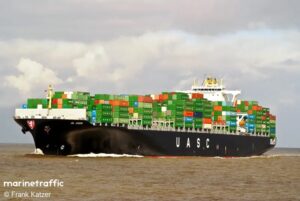
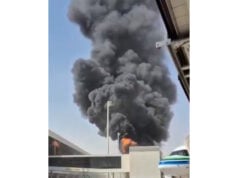
She is a large container ship (304m) Flagged under Cyprus/Marshall Islands, owned by Frendale Navigation Co Ltd, managed by GFS Ship Management FZE out of Dubai (Jebel Ali Free Zone). GFS Ship Management runs a fleet of about 35 vessels with roots back to 1992 in the Gulf shipping industry. (Open Source Intel
The immediate catalyst for the renewed hostilities occurred on Saturday, when an Iranian drone struck a Cyprus-flagged commercial container ship transiting the strategic Strait of Hormuz. The vessel was set ablaze, forcing its crew—including eleven Indian nationals—to abandon ship into the volatile waters east of Oman. The unprovoked maritime assault instantly derailed highly sensitive, indirect diplomatic negotiations taking place in Oman. Speaking via telephone on Sunday, U.S. President Donald Trump expressed profound frustration over the sudden collapse of diplomacy, noting that the two nations had been remarkably close to finalizing a comprehensive deal on Saturday afternoon. According to the President, Iranian officials were on the verge of significant concessions before authorizing the attack on the civilian vessel just two hours later, an action he characterized as evidence of a deeper, systemic hostility within Tehran’s command structure.
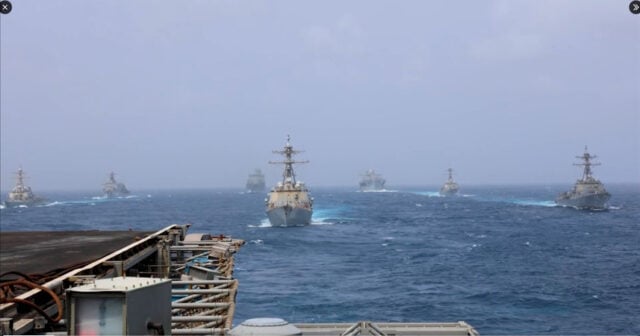
In direct response to the maritime strike, President Trump authorized U.S. Central Command (CENTCOM) to unleash a massive, punitive air campaign designed to severely degrade Iran’s offensive capabilities. Operating under direct orders from the Commander-in-Chief, American forces systematically targeted Iranian military installations running along the country’s strategic coastline. Initial assessments indicate that U.S. forces struck approximately 140 distinct targets over the weekend, extending an offensive that began earlier in the week. This operation followed a previous round of strikes executed on July 7 and 8, where CENTCOM forces neutralized over 60 IRGC small fast-attack boats along the coastline. Pentagon officials confirmed that the current wave of deployments heavily involved multi-role strike fighters launched from regional bases alongside Tomahawk cruise missiles launched from naval assets stationed in the North Arabian Sea, dealing a substantial blow to the structural integrity of Iran’s coastal defenses. Sunday’s early-morning and late-evening waves focused heavily on missile storage sites, coastal surveillance assets, advanced air defense grids, and logistical infrastructure.
Iranian state media, including the state-run IRNA news agency, confirmed heavy explosions rocking the strategic island of Qeshm, located directly inside the narrowest point of the Strait of Hormuz. Local officials acknowledged that between ten and eleven enemy projectiles struck targeted military compounds on the island, though they claimed no civilian casualties had occurred. Further inland, explosions reverberated through the critical shipping hub of Bandar Abbas, as well as the northern city of Hajiabad, where U.S. precision-guided munitions reportedly struck mobile missile launch platforms and paramilitary Islamic Revolutionary Guard Corps (IRGC) fast-attack craft.

BREAKING: Fresh, massive strikes reported near Bandar Abbas, Iran.
Multiple explosions are rocking Iran’s most critical naval port on the Strait of Hormuz right now. The pressure on the IRGC isn’t stopping. pic.twitter.com/Mp3BOUQXaI
— سيف الدرعي| Saif alderei (@saif_aldareei) July 12, 2026
Iran’s Strait of Hormuz Authority: Transit Through Strategic Waterway Not Possible https://t.co/byTzuQ7YTA pic.twitter.com/UFzIQotEzH
— Fars News Agency (@EnglishFars) July 12, 2026
Refusing to back down, Tehran immediately activated its network of regional deterrents, launching a coordinated, multi-front counteroffensive that dramatically widened the geographical scope of the conflict. Iranian ballistic missiles and loitering munitions targeted American military infrastructure and U.S. allies across the Gulf. Sirens pierced the night in Bahrain, home to the sprawling headquarters of the U.S. Navy’s Fifth Fleet, forcing military personnel into hardened shelters as air defense systems engaged incoming threats. The emergency protocols in Manama disrupted normal operations for thousands of active-duty service members. Iranian military commanders defended the retaliatory strikes as a necessary response to preserve their territorial dominance, warning that any country providing airspace or logistical support to American forces would be treated as an active combatant in the expanding conflict.
Simultaneously, the militaries of Kuwait, Qatar, Jordan, and Oman reported active engagements with hostile drones and projectiles crossing their airspace. Kuwaiti defense forces confirmed they were actively intercepting multiple incoming targets, while regional governments swiftly issued statements condemning the Iranian barrages as a dangerous, systemic escalation that threatens the sovereignty of the entire Arabian Peninsula.
The military flare-up has instantly paralyzed global energy markets and choked off maritime trade through the world’s most critical energy transit corridor. Following the exchange of fire, Iran declared the Strait of Hormuz closed to international traffic, a claim the Pentagon sharply contested, asserting that the United States military would continue to enforce the freedom of navigation in international waters. Despite the American declarations, commercial shipping has effectively ground to a halt out of safety concerns. Industry analysts report that global energy prices surged immediately following the news of the strikes. More critically, the sudden freeze in maritime transit has left roughly 6,000 international seafarers stranded aboard scores of commercial vessels anchored outside the strait, unable to safely exit the volatile theater.
The rapid unraveling of the mid-June memorandum of understanding comes at a particularly fragile moment, precisely near the midway mark of a planned 60-day interim cooling-off period meant to pave the way for a permanent end to the war that originally erupted on February 28. With the diplomatic framework now in tatters, the international community has reacted with profound alarm. United Nations Secretary-General António Guterres issued a stark public appeal on Sunday, expressing deep concern over the severe escalation and pleading with both Washington and Tehran to exercise maximum restraint. Speaking through his spokesperson, Stéphane Dujarric, the UN chief urged both combatants to immediately halt all hostile operations and urgently resume diplomatic channels, warning that a slide back into all-out, uninhibited warfare would yield catastrophic economic and humanitarian consequences globally. As night fell over the Gulf, both sides continued to exchange fiery rhetoric and military maneuvers, leaving the prospects for a diplomatic exit looking increasingly remote by midnight.
Sources and Links:
- U.S. Central Command (CENTCOM): Official Public Release Statements
- The Guardian: US Launches Strikes on Iran for a Second Day
- CBS News: Live Updates: Trump Orders New Round of Strikes
- Al Jazeera: US Launches New Wave of Strikes Against Iran Aimed at ‘Degrading’ Military
- UN News: UN Chief Urges Iran and US to ‘Urgently Resume Negotiations’
- PBS NewsHour: U.S. Launches More Strikes on Iran as Standoff Escalates
- The Hindu / AFP: West Asia War Updates: Projectiles Hit Iran’s Gulf Island of Qeshm
Disclaimer
Artificial Intelligence Disclosure & Legal Disclaimer
AI Content Policy.
To provide our readers with timely and comprehensive coverage, South Florida Reporter uses artificial intelligence (AI) to assist in producing certain articles and visual content.
Articles: AI may be used to assist in research, structural drafting, or data analysis. All AI-assisted text is reviewed and edited by our team to ensure accuracy and adherence to our editorial standards.
Images: Any imagery generated or significantly altered by AI is clearly marked with a disclaimer or watermark to distinguish it from traditional photography or editorial illustrations.
General Disclaimer
The information contained in South Florida Reporter is for general information purposes only.
South Florida Reporter assumes no responsibility for errors or omissions in the contents of the Service. In no event shall South Florida Reporter be liable for any special, direct, indirect, consequential, or incidental damages or any damages whatsoever, whether in an action of contract, negligence or other tort, arising out of or in connection with the use of the Service or the contents of the Service.
The Company reserves the right to make additions, deletions, or modifications to the contents of the Service at any time without prior notice. The Company does not warrant that the Service is free of viruses or other harmful components.