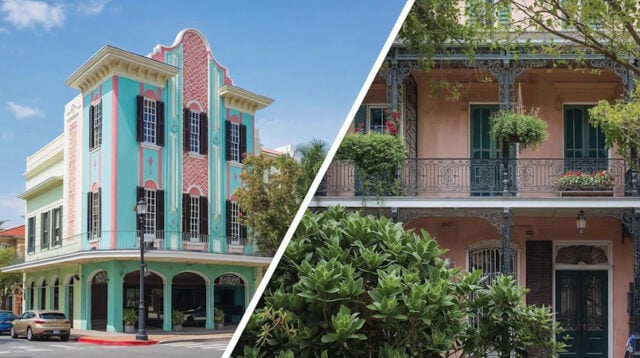
One property is an oceanfront Art Deco hotel on Collins Avenue in South Beach, restored to preserve original 1940s-era details. The other is a brand-new boutique hotel in New Orleans’ Garden District, built from scratch on higher ground in a city shaped by flood risk. Both belong to Robert Balzebre, a Miami-based developer whose portfolio spans condominium conversions, luxury residential projects, and mixed-use developments across Florida, Louisiana, and Texas.
The contrast between these two properties reflects a reality that the hotel industry is grappling with at scale: no single development model works everywhere.
“Unlike the one in Miami Beach, which is a historical renovation of an old Art Deco hotel, we worked with the city to restore it to all its unique features,” Balzebre said. His New Orleans property, by contrast, is “ground up, brand new construction.”
Working Within a Building’s Bones
Balzebre’s Miami Beach hotel sits in one of the most architecturally regulated corridors in the country. The renovation preserved original facade elements and period details while upgrading mechanical systems, guest rooms, and common areas. He partnered with a nationally recognized boutique management brand, and the property has earned multiple design awards and ranked consistently among the top-performing hotels in Miami Beach.

The hospitality industry calls this approach adaptive reuse. JLL Hotels & Hospitality Group reported that average ground-up development costs for an urban full-service hotel reached $742,000 per key in 2023, up 32% from 2019. Converting an existing building can significantly reduce that figure while commanding premium rates, because original architecture provides character that new builds cannot replicate.
The tradeoff is unpredictability. Historic renovations uncover problems new construction avoids: outdated wiring behind original plaster, load-bearing members doubling as window headers, plumbing that predates modern code. Lodging Magazine noted that these unknowns reduce a developer’s control over timelines and budgets.
Balzebre’s track record in this discipline extends beyond hospitality. His six Art Deco condominium conversions in South Beach required the same approach: preserve what makes a building distinctive, modernize what the market demands, and let the structure dictate the scope.
New Construction: Starting From Elevation
Balzebre’s New Orleans hotel occupies different terrain, physically and regulatorily. Built from the foundation up in the Garden District on higher ground, the property had no existing structure to work around, and every dimension was purpose-designed. Balzebre opened the hotel in 2025, separate from his Miami operations but informed by the same focus on construction quality.
New Orleans’ hospitality market supports this approach. Convention bookings for 2026 reached 98% of the 2017-2019 average, and hotel companies like Gencom, Omni, and Nobu have made major investments in a city Forbes Travel Guide named a top destination for 2025. That demand made a clear case for ground-up development.
Geography also mattered. Balzebre has called New Orleans “the poster child for big disasters after Hurricane Katrina.” Choosing higher ground in a city that sits below sea level reflects a site selection discipline he applies across all three of his primary markets.
“If something is just blatantly too risky or obviously not geographically set for the long run in the right way, then I would choose not to do that development,” he said.
Where the Two Playbooks Overlap
Despite their differences, both projects share principles Balzebre has maintained throughout his career. Each property met or exceeded building codes, and each used materials chosen for durability over short-term savings. Each was designed with the expectation that Balzebre would hold the asset long-term.
That holding mindset is common in hospitality rhetoric but rare in practice, and it produces different construction logic depending on project type:
- In a historic renovation, holding long-term means over-investing in mechanical systems that visitors never see. Original plumbing, electrical, and HVAC are the first components to fail in an aging building, and a developer who plans to exit in five years can defer those upgrades to the next owner. A developer who plans to operate the property absorbs that cost upfront because deferred maintenance compounds faster in historic structures than in new ones.
- In ground-up construction, holding long-term means specifying materials above the prevailing standard at time of build. Code requirements reflect past conditions, not future ones. A new hotel in a flood-prone market built to current minimums may satisfy today’s inspectors but underperform against tightening insurance requirements and rising base flood elevations within a decade.
- In both cases, holding reshapes the relationship with the management brand. A developer planning to sell transfers brand compliance responsibility to the buyer. A developer planning to operate must ensure the property’s physical plant can support brand standards for the duration of the management agreement, which often runs 15 to 20 years.
“I am a true believer in doing things well for the art of doing them well and doing them right for the art of doing them right,” Balzebre said. “And that in the end is actually a money saver.”
What the Industry Data Confirms
The broader hotel industry is pursuing both strategies at once. Adaptive reuse produced more than 9,100 converted units in 2024, up over 50% from the prior year, with hotels as the leading source category. Marriott, Hilton, and Hyatt have each cited conversions as a growth priority.
New construction remains essential where no suitable structure exists. Balzebre’s New Orleans property shows that ground-up development makes sense when parcel, elevation, and demand conditions align, as New Orleans demonstrated heading into 2026 with convention bookings near pre-pandemic levels and limited available inventory.
The federal Historic Tax Credit provides a 20% credit on qualified rehabilitation expenses, underwriting many prominent adaptive reuse hotel projects. That incentive does not apply to new construction, creating a cost gap that developers running both types of projects must factor into their budgets.
Letting the Site Decide
The choice between renovation and new construction is often framed as a philosophy. Balzebre’s two hotels suggest it is closer to diagnosis.
Miami Beach offered a significant Art Deco building on the ocean in a district where preservation boards shape every facade change. New Orleans offered a higher-elevation parcel with strong convention demand and nothing worth preserving on site.
“It happens sometimes, being a developer in the real estate business, it’s almost like being in the movie business,” Balzebre has observed. “These projects start as an idea. It brings together a lot of different people, architects, builders, bankers, partners, and we work as a team until the project is finished.”
The developers who succeed across both models share one trait: they read what the site requires rather than imposing a preferred method onto every parcel they acquire.
Disclaimer
Artificial Intelligence Disclosure & Legal Disclaimer
AI Content Policy.
To provide our readers with timely and comprehensive coverage, South Florida Reporter uses artificial intelligence (AI) to assist in producing certain articles and visual content.
Articles: AI may be used to assist in research, structural drafting, or data analysis. All AI-assisted text is reviewed and edited by our team to ensure accuracy and adherence to our editorial standards.
Images: Any imagery generated or significantly altered by AI is clearly marked with a disclaimer or watermark to distinguish it from traditional photography or editorial illustrations.
General Disclaimer
The information contained in South Florida Reporter is for general information purposes only.
South Florida Reporter assumes no responsibility for errors or omissions in the contents of the Service. In no event shall South Florida Reporter be liable for any special, direct, indirect, consequential, or incidental damages or any damages whatsoever, whether in an action of contract, negligence or other tort, arising out of or in connection with the use of the Service or the contents of the Service.
The Company reserves the right to make additions, deletions, or modifications to the contents of the Service at any time without prior notice. The Company does not warrant that the Service is free of viruses or other harmful components.