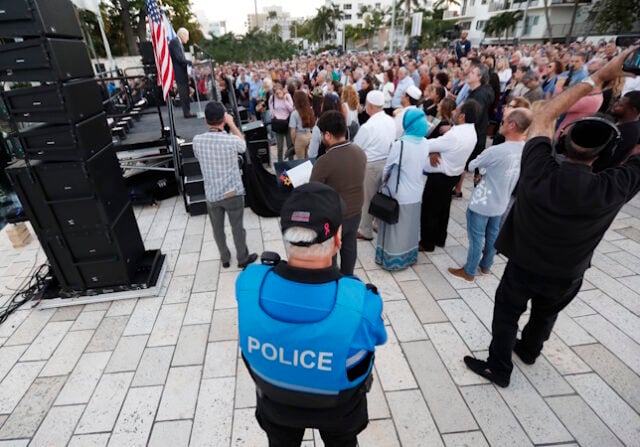
Churches, synagogues and mosques can rely on armed volunteers instead of hiring private security guards starting July 1 under a new measure signed by Gov. Ron DeSantis.
DeSantis signed SB 52 this week with little fanfare and no news conference. The legislation exempts the armed unpaid church volunteers from the same license rules that security guards face. Paid security guards must hold a Class D security officer license and Class G firearm license. The class D license alone requires 40 hours of training.
Places of worship also still have the right to ban weapons on their premises.

The measure was part of nine bills DeSantis signed Thursday.
The new law comes after nearly 400 violent incidents have happened at U.S. places of worship, leading to nearly 500 deaths and 200 injuries, between 2000 to 2024, according to Senate staff analysis.

“It’s unfortunate that we have seen an increase in violence in our houses of worship. Many churches have paid security on site that many can’t afford to provide for these paid services,” said Inverness Republican Rep. J.J. Grow, who co-sponsored the House version of the bill, said on the House floor last month.
“The purpose of the bill was simple: to improve safety for congregations, reduce financial burdens on churches, and provide clear statutory authority so these volunteers operate responsibly and not informally.”
The lone vote against the bill on the House floor was Rep. Christine Hunschofsky, the former Parkland Mayor at the time of the 2018 school shooting.
Hunschofsky did not join the debate on the House floor to elaborate on her SB 52 opposition before the House’s final March 11 vote. The Parkland Democrat has been outspoken against weakening the state’s gun laws, including lowering the minimum age to buy a gun.
Five Representatives did not vote at all: Democratic Reps. Bruce Antone, Dotie Joseph and Debra Tendrich and Republican Reps. Susan Plasencia and Dana Trabulsy.

The Senate passed the Sen. Don Gaetz-sponsored SB 52 with a unanimous vote in February.
Disclaimer
Artificial Intelligence Disclosure & Legal Disclaimer
AI Content Policy.
To provide our readers with timely and comprehensive coverage, South Florida Reporter uses artificial intelligence (AI) to assist in producing certain articles and visual content.
Articles: AI may be used to assist in research, structural drafting, or data analysis. All AI-assisted text is reviewed and edited by our team to ensure accuracy and adherence to our editorial standards.
Images: Any imagery generated or significantly altered by AI is clearly marked with a disclaimer or watermark to distinguish it from traditional photography or editorial illustrations.
General Disclaimer
The information contained in South Florida Reporter is for general information purposes only.
South Florida Reporter assumes no responsibility for errors or omissions in the contents of the Service. In no event shall South Florida Reporter be liable for any special, direct, indirect, consequential, or incidental damages or any damages whatsoever, whether in an action of contract, negligence or other tort, arising out of or in connection with the use of the Service or the contents of the Service.
The Company reserves the right to make additions, deletions, or modifications to the contents of the Service at any time without prior notice. The Company does not warrant that the Service is free of viruses or other harmful components.