The 2026 severe weather season is projected to undergo a significant shift in character, compared to last year’s historic volatility. While the total number of tornadoes is expected to trend lower, the risk of destructive straight-line winds and life-threatening flash floods is on the rise. According to the latest long-range forecast from AccuWeather, the United States is moving away from the tornado-dominant pattern of 2025 and into a season defined by massive, slow-moving storm complexes capable of delivering catastrophic rainfall and widespread wind damage.
The Shift in Severe Weather Hazards
In 2025, the U.S. witnessed an exceptionally active spring, with preliminary reports totaling 1,544 tornadoes—a figure well above the historical annual average of 1,225. For 2026, AccuWeather long-range experts predict a decline, forecasting between 1,050 and 1,250 tornadoes. This represents a 20 to 30 percent reduction from the previous year.
However, meteorologists are quick to caution that a lower tornado count does not equate to a “quiet” season. “There may be fewer tornadoes reported compared to last year, but that does not mean this will be a quiet severe weather season,” explained AccuWeather Meteorologist Alex Duffus. “There is an increased likelihood of severe thunderstorms packing damaging wind gusts and heavy downpours.”
The primary concern for 2026 is a transition toward “linear” storm systems—organized lines of thunderstorms that can span hundreds of miles. While these systems produce fewer tornadoes than isolated “supercell” storms, they often cause more widespread damage through straight-line winds that can reach hurricane-force speeds, downing trees, destroying power grids, and damaging homes across multiple states simultaneously.

Flooding: The Season’s Most Dangerous Threat
While tornadoes capture headlines, AccuWeather identifies flooding as the most significant hazard of the 2026 spring season. The forecast indicates that shifting precipitation patterns are significantly increasing the odds of extreme rainfall events.
AccuWeather climate experts have noted a startling trend: while average annual rainfall in the contiguous U.S. has dipped slightly since the mid-1990s, the frequency of “extreme” rainfall events—defined as more than 4 inches of rain in 24 hours—has surged by 70%.
“Flash flooding is a big concern this year,” Duffus warned. “Flash floods and damaging wind gusts can be just as destructive as tornadoes and often impact a much larger area.”
The risk is particularly acute in the nation’s midsection. AccuWeather Lead Long-Range Expert Paul Pastelok pointed out that the combination of melting snowpacks in the north and heavier spring rainfall in the south creates a “perfect storm” for river and flash flooding. “The combination of melting snow and heavier spring rainfall raises the risk for river and flash flooding across the Mississippi and Ohio valleys,” Pastelok said. He compared the upcoming setup to major flooding years like 2013 and 2023.
Regional Breakdown: Who is at Risk?
The severe weather threat will migrate across the country as the season progresses, influenced by a jet stream expected to behave differently than in 2025.
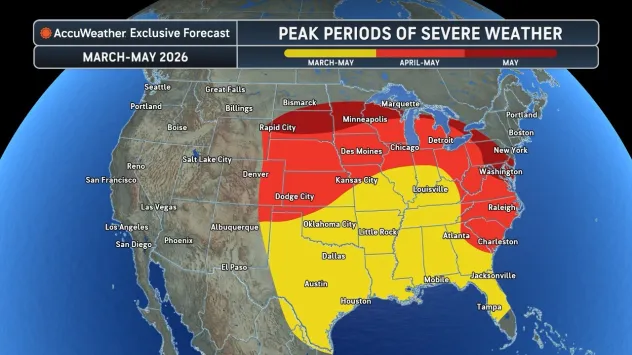
The Mississippi and Ohio Valleys: This region is the “bullseye” for flooding and damaging winds during March and April. States including Illinois, Indiana, Ohio, Kentucky, Tennessee, and Missouri are expected to face multiple rounds of severe weather. The risk here is driven by the clash of lingering cold air from the north and surging moisture from the Gulf of Mexico.
The Plains and “Tornado Alley”: March and April may see a slower start to tornado activity in the northern Plains due to cooler-than-average temperatures. However, AccuWeather predicts an “uptick” in tornadoes later in May as the heat builds and the risk zone shifts westward into the traditional Tornado Alley of Texas, Oklahoma, and Kansas.
The Gulf Coast: Exceptionally warm waters in the Gulf of Mexico remain a major factor. These warm waters act as high-octane fuel for any storm system that moves through the region. While this can intensify storm outbreaks, the atmospheric setup this year may favor heavy, drenching rains along the coast rather than the tornadic supercells seen last year.
The Northeast and Great Lakes: A slower transition to spring warmth is forecast for these regions. While this may delay the onset of severe summer storms, the “clash of seasons” could still trigger intense wind events and late-season snowmelt flooding.
Atmospheric Drivers: Why 2026 is Different
The shift in weather patterns is largely attributed to the evolving state of the jet stream and sea-surface temperatures. Last year’s pattern featured a highly energetic atmosphere that was conducive to the formation of discrete, rotating storms—the kind that produce violent tornadoes.
In contrast, the 2026 pattern is expected to feature a slower-moving jet stream. This “sluggish” movement often leads to the development of upper-level low-pressure areas that park themselves over a region for days. This results in “training” storms—where one storm follows another over the same area—leading to astronomical rainfall totals and “damaging flooding downpours,” as Pastelok described.
“The slower pace of the jet stream could lead to a higher frequency of upper-level low pressure areas, producing heavier rainfall amounts, resulting in storms that are more disruptive and impactful,” Pastelok explained.
Fire and Drought: The Silent Threat
While much of the country prepares for rain and wind, other regions are facing the opposite extreme. AccuWeather warns of an elevated wildfire threat across Florida, the Southeast, and the Mid-Atlantic.
Current data shows that drought conditions cover nearly 40% of the country. In the Southwest and the High Plains, drought is expected to persist and even expand. This creates a dangerous dichotomy: while the Mississippi Valley fights off floods, areas just a few hundred miles away may be bracing for “explosive” wildfire conditions. Florida, in particular, could see an early-season fire risk before the arrival of consistent summer rains.
Preparation: “Do Not Let Your Guard Down”
The overarching message from AccuWeather is one of vigilance. The forecast for fewer tornadoes can lead to a false sense of security, but the statistics of a “quieter” year do not protect individual communities from disaster.
“It only takes one storm striking a densely populated or vulnerable community to make this a devastating season,” Duffus said.
AccuWeather expert meteorologists are urging families and business owners to take the following steps immediately:
- Review Insurance Coverage: Ensure that your policy covers wind and, crucially, flood damage, as standard homeowners’ insurance often excludes flooding.
- Restock Emergency Supplies: Confirm that your “go-bag” has fresh water, non-perishable food, batteries, and medical supplies.
- Secure Safe Spaces: Ensure that storm shelters or designated interior rooms are cleared of clutter and accessible to all family members, including pets.
- Stay Informed: In a season defined by “straight-line” winds and flash floods, warnings can be issued with very little lead time. Having a reliable way to receive alerts—such as the AccuWeather app or a NOAA weather radio—is essential.
Climate Context
The 2026 forecast also highlights the long-term impacts of climate change on seasonal weather. The 70% increase in extreme rainfall events over the last few decades serves as a backdrop to this year’s flood-heavy prediction. As the atmosphere warms, it holds more moisture, meaning that when it does rain, the potential for “flooding downpours” is significantly higher than in previous generations.
This “intensification” of the water cycle means that even in years with fewer tornadoes, the economic and human toll of severe weather can remain high. Damaging winds and floods often cover much larger geographic areas than the narrow path of a tornado, affecting millions of people and causing widespread infrastructure failure.
Conclusion
As the U.S. moves into the heart of the 2026 spring season, the threat landscape is evolving. The transition from a tornado-heavy 2025 to a wind-and-flood-heavy 2026 presents new challenges for emergency management and public safety.
By focusing on the “main hazards” of damaging winds and flooding, AccuWeather aims to provide the foresight necessary for Americans to protect their lives and property. Whether it is the slow-moving low-pressure systems in the Ohio Valley or the late-season tornado potential in the Plains, the 2026 season promises to be “markedly different,” yet equally demanding of our attention and preparation.
As Paul Pastelok summarized, “This spring has the potential for high-impact weather, even though we expect fewer tornadoes. Flooding and damaging winds will be the main hazards this spring.”
The message is clear: the weather may be changing its tactics, but the need for readiness remains as vital as ever.
Source: AccuWeather
Disclaimer
Artificial Intelligence Disclosure & Legal Disclaimer
AI Content Policy.
To provide our readers with timely and comprehensive coverage, South Florida Reporter uses artificial intelligence (AI) to assist in producing certain articles and visual content.
Articles: AI may be used to assist in research, structural drafting, or data analysis. All AI-assisted text is reviewed and edited by our team to ensure accuracy and adherence to our editorial standards.
Images: Any imagery generated or significantly altered by AI is clearly marked with a disclaimer or watermark to distinguish it from traditional photography or editorial illustrations.
General Disclaimer
The information contained in South Florida Reporter is for general information purposes only.
South Florida Reporter assumes no responsibility for errors or omissions in the contents of the Service. In no event shall South Florida Reporter be liable for any special, direct, indirect, consequential, or incidental damages or any damages whatsoever, whether in an action of contract, negligence or other tort, arising out of or in connection with the use of the Service or the contents of the Service.
The Company reserves the right to make additions, deletions, or modifications to the contents of the Service at any time without prior notice. The Company does not warrant that the Service is free of viruses or other harmful components.