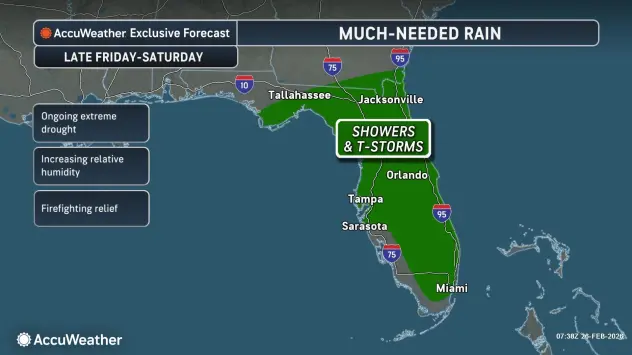
The Southeastern United States, particularly Florida, has been gripped by a worsening drought that has turned the landscape into a tinderbox. However, relief is on the horizon. According to AccuWeather long-range experts, a shift in the weather pattern is expected to bring a period of rain to the region, providing a critical, albeit temporary, reprieve from the escalating fire risk.
The Immediate Threat: A Region Under Siege
For weeks, much of Florida and the surrounding Southeast have battled “Red Flag” conditions. The combination of low relative humidity, unusually high temperatures, and gusty winds has created an environment where even a small spark can ignite a massive blaze. In late February 2026, meteorologists noted that the state was facing some of its most dangerous fire conditions in recent memory.
“Florida and portions of the Southeast are expected to face the highest wildfire risk across the region due to ongoing drought and the climatological tendency for dry stretches prior to the onset of the summer rainy season,” explained AccuWeather Meteorologist Brandon Buckingham.
The risk has been compounded by severe to extreme drought conditions. In Northeast and Central Florida, rainfall deficits have left vegetation brittle. This dry brush serves as “fuel” for fires. Forestry officials often categorize these fuels by how long it takes them to dry out enough to burn after a rain event; currently, even “thousand-hour fuels”—large logs and deep organic soil layers—are dry enough to ignite, a signal of how deep the moisture deficit has become.

The Coming Relief: Rain on the Horizon
The forecasted rain is part of a slow-moving storm system and a shifting jet stream. While the early part of the spring season was dominated by dry, continental air, AccuWeather’s 2026 Spring Forecast suggests a transition toward more frequent moisture-laden systems moving in from the Gulf of Mexico.
“The slower pace of the jet stream could lead to a higher frequency of upper-level low-pressure areas, producing heavier rainfall amounts,” said AccuWeather Lead Long-Range Meteorologist Paul Pastelok. These slower-moving storms are exactly what the region needs to penetrate the dry soil, though they carry their own risk of localized flooding.
The expected rainfall is anticipated to dampen the fine fuels—such as grasses and pine needles—that are responsible for the rapid spread of brush fires. This moisture will allow emergency services and the Florida Forest Service a moment to breathe, as the probability of “spot fires” and uncontrollable spread drops significantly during periods of high humidity and precipitation.
The “Temporary” Catch
While the rain is a welcome sight, AccuWeather experts warn that it is not a permanent solution. The Southeast is entering its traditional “fire season,” which typically runs from late winter through the start of the summer rainy season in June.
One of the primary concerns is the sheer volume of “fuel” on the ground. Beyond the living vegetation dried out by drought, the region is still dealing with the remnants of past storms. “Downed trees and storm debris left behind from Helene are still a concern in the mountains of North Carolina and Tennessee,” Pastelok noted. “That additional fuel on the ground can dry out quickly during warmer and breezy periods, increasing the risk for wildfires.”
In Florida, the “green-up” caused by spring rain can actually be a double-edged sword. While the rain helps in the short term, it also encourages the growth of new grasses and weeds. If the rain stops and a heatwave follows—as is common in April and May—that new growth quickly dies and dries out, adding even more fuel to the fire landscape.
The National Context: No More “Off-Season”
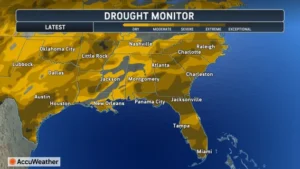 The situation in Florida is a microcosm of a larger national trend identified by AccuWeather. The distinction between “fire season” and the rest of the year is vanishing. Expanding drought conditions now cover more than 45 percent of the contiguous United States, and shifting precipitation trends are making the landscape more volatile.
“There is no true wildfire season in America anymore,” Buckingham warned. “If vegetation dries out and winds are strong, fires can ignite and spread rapidly regardless of the month on the calendar.”
This was tragically illustrated in early 2025 when catastrophic wildfires in Los Angeles County caused upwards of $250 billion in damages during a month—January—not typically associated with peak fire activity. The Southeast is now seeing a similar pattern, with winter and early spring becoming increasingly dangerous.
Preparing for the Next Spark
With the rain providing a temporary window of safety, officials are urging residents to use this time to prepare. The moisture may stop a fire from starting today, but it won’t prevent one from starting two weeks from now if the dry pattern returns.
AccuWeather recommends several steps for residents in high-risk zones:
- Maintain Defensible Space: Clear gutters of dry pine needles and remove dead brush from around the perimeter of homes.
- Monitor Burn Bans: Even after a rain shower, local burn bans may remain in effect if the deeper soil moisture remains low.
- Prepare Emergency Kits: Buckingham emphasizes having a “go bag” ready. “People need to be prepared for brush fires and wildfires in places and at times of year when they may not typically expect them.”
Looking Ahead to Summer
The long-term hope for the region lies in the arrival of the consistent summer monsoon-like rains in June. AccuWeather’s long-range outlook suggests that while the early spring will be a “battle” between brief rain events and returning drought, the risk should begin to subside by late May as tropical moisture becomes more entrenched.
Until then, every drop of rain counts. The upcoming wet weather will “ease” the risk, but it will not “erase” it. Residents are encouraged to stay weather-aware, as the transition from a refreshing rainstorm to a high-wind, high-fire-danger day can happen in as little as 24 to 48 hours in the Florida climate.
As the storm system approaches, the Southeast waits for a reprieve. It is a reminder of the delicate balance of the Florida ecosystem—where the same atmosphere that brings life-giving rain can, in its absence, turn the “Sunshine State” into a land of smoke and flame.
Source: AccuWeather
Disclaimer
Artificial Intelligence Disclosure & Legal Disclaimer
AI Content Policy.
To provide our readers with timely and comprehensive coverage, South Florida Reporter uses artificial intelligence (AI) to assist in producing certain articles and visual content.
Articles: AI may be used to assist in research, structural drafting, or data analysis. All AI-assisted text is reviewed and edited by our team to ensure accuracy and adherence to our editorial standards.
Images: Any imagery generated or significantly altered by AI is clearly marked with a disclaimer or watermark to distinguish it from traditional photography or editorial illustrations.
General Disclaimer
The information contained in South Florida Reporter is for general information purposes only.
South Florida Reporter assumes no responsibility for errors or omissions in the contents of the Service. In no event shall South Florida Reporter be liable for any special, direct, indirect, consequential, or incidental damages or any damages whatsoever, whether in an action of contract, negligence or other tort, arising out of or in connection with the use of the Service or the contents of the Service.
The Company reserves the right to make additions, deletions, or modifications to the contents of the Service at any time without prior notice. The Company does not warrant that the Service is free of viruses or other harmful components.