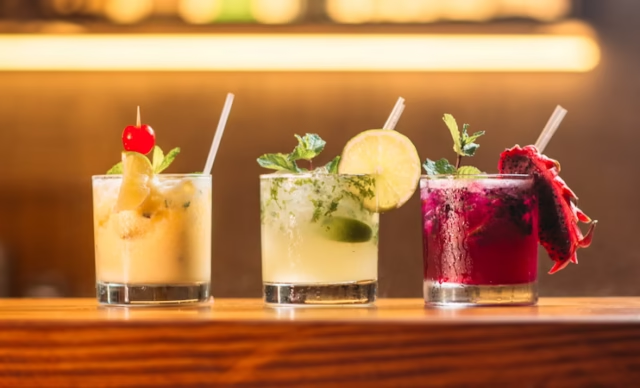
A couple of years ago, you might have felt the need to offer a small apology when requesting a non-alcoholic drink at a wedding reception. This habit is rapidly vanishing. While attending a wedding reception today, it is more probable for a person getting a zero-proof cocktail to be asked about its ingredients than the reasons for opting for this beverage. And this trend means more for the future of the drinking culture than all the articles about “sober curious” put together.
The Category That Grew Up
For a long time, no- and low-alcohol beverages resided in a sorry corner of the drink menu – an unappetizing, flavorless drink that nobody selected voluntarily. This corner of the drink menu has grown tremendously and become one of the fastest-growing categories in the beverage industry. For example, the amount of no-alcohol products globally rose by approximately 9% in a single year recently, and the entire category of no- and low-alcohol beverages is expected to grow at a CAGR of around 7% through 2026. This is significantly higher than the growth rates seen previously. The market for no- and low-alcohol drinks exceeded $11 billion in revenue.
But the truth of the matter is in who is drinking and how. Approximately four out of ten regular drinkers fall into the category of people who are not rigid about their choice of drink, instead switching between a no- or low-alcoholic and a strong alcoholic drink depending on the particular evening, rather than being strictly one way or another. But while young people have joined this category in higher proportions than any other age group, they aren’t the only ones redefining it; the practice of choosing what to switch to has become generational.
Deciding What a Night Off Actually Includes: Online Casino Options
As drinking ceases to be automatic and becomes a real choice, occasion by occasion, so does the same principle of “decide, don’t default” spill over to other aspects of the night as well. For some, it applies to an unimportant online gambling session added on to the mix – a conscious choice and not just something done without much thought.

Bonus offers at Lucky Dreams and other casinos are worth checking against their actual terms before assuming a promotional banner tells the whole story, the same way a menu description rarely captures what’s actually in a zero-proof pour until someone asks.
A Chemical Reason Nobody Saw Coming
There are reasons for this beyond cultural momentum alone, though cultural momentum accounts for much of it. In one study, 108 people with alcohol use disorder were given either a GLP-1 medication (semaglutide), which is currently used as a weight-loss drug, or a placebo. Over 26 weeks, the GLP-1 medication reduced the number of days of heavy drinking by 41%, while the placebo reduced it by 26%. Both groups started with about 17 days of heavy drinking per month. Over a 30-day period, alcohol intake in the former group declined by over 70%, falling from 78 ounces of pure alcohol to 23.
The exact mechanism by which a drug designed to regulate blood sugar levels and control hunger reduces the temptation of alcohol remains unknown, but one possible explanation lies in the reward pathways inhibited by these drugs in relation to food. In any case, CasinosAnalyzer treats such an approach as standard due diligence practice – investigating the reason for a result before accepting a trend as solely cultural, economic, or biological.
The Guidelines Behind the Trend
A nonprofit health information service quantifies what “moderate” drinking actually means: no more than two standard drinks per day and ten per week for women, and no more than three standard drinks per day and fifteen per week for men. This is much less alcohol per occasion than we tend to assume. Amid the thriving no/low category, the organization’s key message is clear: there is no safe level of drinking. This perspective helps frame the boom in such products as a genuine health trend rather than a marketing strategy targeting the younger generation.
The same organization describes a realistic strategy for those willing to drink less without abstaining completely: tracking alcohol consumption, recognizing circumstances that lead to unconscious drinking, and planning accordingly. This strategy differs greatly from the popularization of trendy mocktail lists in its pragmatism. However, it is precisely this aspect of the change that will make a difference.
Signs “Cutting Back” Has Quietly Become Something More
Sometimes, choosing no- or low-alcohol beverages is a personal preference. Knowing when this choice requires more attention is a different skill.
- Ordering a non-alcoholic drink should still be considered a special event that requires additional attention rather than something typical.
- An evening of “moderate” drinking can equal or exceed the daily consumption recommendations provided by standard health guidelines.
- Reducing alcohol consumption only occurs as a reaction to a bad morning, never as an initial decision made beforehand.
- People choose non-alcoholic beverages with the aim of limiting their consumption for the rest of the night, not to avoid drinking completely.
- People never count or monitor the actual number of drinking days per week.
This does not make a night out problematic. These indicators signal whether “cutting back sometimes” means “drinking less.”
Building a Habit That Outlasts the Trend
A couple of pragmatic decisions make “trying the no/low category” an activity that continues beyond one abstinent month.
- Maintain at least one no- or low-alcohol beverage at home, so the decision won’t rely only on what particular establishment serves.
- Decide ahead of time, not in the middle of an event, when to order a full-strength drink and when not to.
- Give a particular type or brand several tries, because the quality of flavoring among such drinks varies drastically.
- Count the number of days of actual drinking for a few weeks; people tend to underestimate it unconsciously.
- See any fall back to the old ways as a lesson learned, not a failure, because the goal is a tendency, not a streak of perfection.
None of these suggestions imply declaring a quit in anything, which makes it similar to what was done with the terms of the casino and zero-proof menu both.
The Apology Was Never Really Necessary
The drink itself never needed defending because a quality non-alcoholic cocktail can stand up to almost anything else that’s served alongside it. What has changed is the underlying assumption about the order. That drinking something non-alcoholic must be for a reason, while drinking something alcoholic needs no justification. The rapidly growing market, which is now expanding almost twice as fast as before, along with a drug that has been developed for different reasons yet still alters one’s desires, proves that the old assumption was wrong from the beginning.
Disclaimer
Artificial Intelligence Disclosure & Legal Disclaimer
AI Content Policy.
To provide our readers with timely and comprehensive coverage, South Florida Reporter uses artificial intelligence (AI) to assist in producing certain articles and visual content.
Articles: AI may be used to assist in research, structural drafting, or data analysis. All AI-assisted text is reviewed and edited by our team to ensure accuracy and adherence to our editorial standards.
Images: Any imagery generated or significantly altered by AI is clearly marked with a disclaimer or watermark to distinguish it from traditional photography or editorial illustrations.
General Disclaimer
The information contained in South Florida Reporter is for general information purposes only.
South Florida Reporter assumes no responsibility for errors or omissions in the contents of the Service. In no event shall South Florida Reporter be liable for any special, direct, indirect, consequential, or incidental damages or any damages whatsoever, whether in an action of contract, negligence or other tort, arising out of or in connection with the use of the Service or the contents of the Service.
The Company reserves the right to make additions, deletions, or modifications to the contents of the Service at any time without prior notice. The Company does not warrant that the Service is free of viruses or other harmful components.