Picture next March. The calendar fills up: a day on the boat along the Intracoastal, lunch by the pool at the club, a long weekend in the islands. The resort wear is packed. And you are still reaching for the razor every morning, hoping nothing shows.
Meanwhile, the people who started laser hair removal this fall are three or four sessions in, with noticeably less hair to think about.
The difference is timing. Laser hair removal is a series, not a single appointment, and it works best with as little sun on the skin as possible. In South Florida, that makes October and November the smartest months to start.
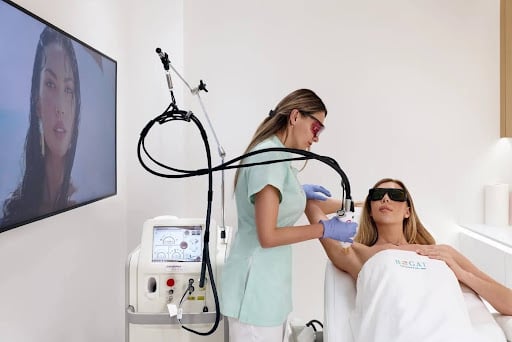
Laser hair removal on a dual-wavelength Candela GentleMax Pro Plus at Bogat Aesthetics & Wellness in Hallandale Beach.

Why one appointment is never enough
Laser hair removal works by sending pulses of light into the hair follicle, the tiny structure under the skin that grows each hair. The pigment in the hair absorbs that light and turns it into heat, which slows the follicle down.
The catch is timing. Hair grows in cycles, and the laser only affects follicles in their active growth phase. At any moment, only part of your hair is in that phase.
That is why most treatment plans run six to eight sessions, spaced four to eight weeks apart depending on the area. Each round catches a new set of growing hairs. Hair comes back finer, lighter and sparser every time.
Do the math and a full series takes many months. Six sessions four weeks apart already span about five months.
The sun problem
The laser looks for pigment. Ideally, it finds that pigment in the hair and not in the skin around it.
A tan adds pigment to the skin. That makes it harder for the laser to tell hair from skin, and it raises the risk of burns, blisters and dark or light patches. The risk is higher on deeper skin tones.
So clinics ask for a break from the sun around every session. A common baseline is about two weeks without direct sun or self-tanner before and after each treatment, plus sunscreen on treated areas for the whole series.
Now picture doing that in July: two weeks before, two weeks after, every few weeks, through the brightest months of the year. It is possible, but it is a lot to ask when the beach is ten minutes away.
Why fall works better
South Florida does not have a real winter. The sun is out all year, and sunscreen is never optional here.
But fall and winter still make things easier:
- Fewer beach days. Most people simply spend less time in direct sun from October to March.
- Less skin on show. Long sleeves and pants make it easier to keep treated areas covered.
- Less tanning. Skin that is less tanned gives the laser a clearer target.
There is one more practical reason. Between sessions you should not wax, pluck or thread, because the laser needs the follicle in place. Shaving is fine. Switching from waxing to shaving is far easier in sweater weather than in August.
A sample fall-start timeline
A typical plan that begins in October looks like this:
- October: consultation and first session
- November to December: second session
- January to February: third session
- March: fourth session, with noticeably less hair as spring plans fill up
- Spring and summer: remaining sessions, then maintenance as needed
Your provider sets the exact spacing for each area.
What to do before your first session
A little preparation goes a long way:
- Stop waxing, plucking and threading at least four weeks before your first appointment.
- Shave the area within 24 hours of each session.
- Skip the sun and self-tanner for about two weeks before treatment.
- Mention your history: a recent tan, keloid scarring, tattoos in the area, or any medications. Some medications make skin more sensitive to light.
During the session, you wear protective eyewear, and many lasers add a burst of cooling with each pulse to ease discomfort. Treatment takes anywhere from about 15 minutes to an hour, depending on the area.
Afterward, expect some redness for a few hours. Treated hairs usually shed on their own over the next one to two weeks.
Darker skin needs the right laser
Many South Floridians have medium to deep skin tones, so the type of laser matters.
Lasers are defined by their wavelength. The long-pulsed 1064 nm Nd:YAG wavelength is widely used for darker skin because its light passes more of the pigment near the skin’s surface and reaches the follicle below. Some devices carry two wavelengths, such as a 755 nm Alexandrite laser often used on lighter skin, paired with a 1064 nm Nd:YAG.
Ask which wavelength will be used for your skin, and how often the provider treats skin like yours.
Set realistic expectations
Laser hair removal reduces hair. It does not erase every hair forever.
The FDA’s term is “permanent hair reduction,” which means a long-term, stable drop in the number of hairs that grow back. After a full series, most people see a significant, lasting reduction, and the hair that returns tends to be finer and lighter. A maintenance session now and then keeps results where you want them.
Plan it like a project
Think of laser hair removal as a project with a deadline. If you want next spring to feel effortless, the best day to start is a fall day.
At Bogat Aesthetics & Wellness in Hallandale Beach, for example, laser hair removal for all skin tones is performed on a dual-wavelength Candela GentleMax Pro Plus inside a physician-supervised practice, with sessions timed around South Florida’s sun.
Start now, and by the first boat day of spring, you will already be well into your series.
Disclaimer
Artificial Intelligence Disclosure & Legal Disclaimer
AI Content Policy.
To provide our readers with timely and comprehensive coverage, South Florida Reporter uses artificial intelligence (AI) to assist in producing certain articles and visual content.
Articles: AI may be used to assist in research, structural drafting, or data analysis. All AI-assisted text is reviewed and edited by our team to ensure accuracy and adherence to our editorial standards.
Images: Any imagery generated or significantly altered by AI is clearly marked with a disclaimer or watermark to distinguish it from traditional photography or editorial illustrations.
General Disclaimer
The information contained in South Florida Reporter is for general information purposes only.
South Florida Reporter assumes no responsibility for errors or omissions in the contents of the Service. In no event shall South Florida Reporter be liable for any special, direct, indirect, consequential, or incidental damages or any damages whatsoever, whether in an action of contract, negligence or other tort, arising out of or in connection with the use of the Service or the contents of the Service.
The Company reserves the right to make additions, deletions, or modifications to the contents of the Service at any time without prior notice. The Company does not warrant that the Service is free of viruses or other harmful components.