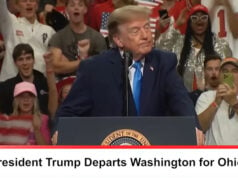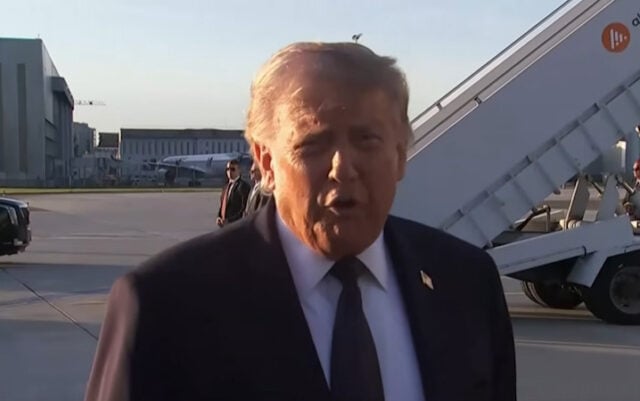
The landscape of transatlantic diplomacy shifted dramatically when U.S. President Donald Trump arrived outside Paris at the historic Palace of Versailles. Fresh off three intense days of geopolitical maneuvering at the 52nd G7 Summit in Évian-les-Bains, Trump arrived at the gilded estate on Wednesday night as the guest of honor for a highly anticipated private dinner hosted by French President Emmanuel Macron. Stepping onto the grounds of the former seat of the French monarchy, Trump bypassed standard diplomatic talking points to offer a glowing, real-estate-minded assessment of his surroundings, telling reporters: “Versailles is not gold leaf—Versailles is the real deal. I’m a fan of beautiful places.”
The lavish dinner date represented a carefully calculated deployment of French soft power by Macron. For months, Washington and Paris had been locked in diplomatic sparring matches over global trade policy, European security, and digital taxation. By throwing open the gates of Louis XIV’s spectacular 2,300-room palace, the French presidency sought to flatter Trump’s well-known affinity for architectural grandeur while securing his full participation through the final hours of the international summit. The strategy successfully inverted the narrative of the previous year’s G7 gathering in Canada, which Trump had exited a day early amidst rising trade disputes.
“Versailles is not gold leaf—Versailles is the real deal. I’m a fan of beautiful places.” — U.S. President Donald Trump, upon arriving for dinner outside Paris.
The Backdrop of the Évian Summit
The journey to Paris followed a intense series of multilateral working sessions at the G7 Summit, held from June 15 to 17 along the shores of Lake Geneva. The summit brought together the world’s major industrialized economies—the United States, France, the United Kingdom, Germany, Italy, Japan, Canada, and the European Union—alongside a diverse roster of outreach guest nations, including India, Brazil, South Korea, Egypt, Ukraine, and the United Arab Emirates.

While the official G7 schedule culminated with cutting-edge discussions on Wednesday regarding the contentious future of artificial intelligence, social media security, and tech sector dominance, the true focal point of the summit remained the heavy footprint of American foreign policy. Trump consistently dominated the spotlight throughout his stay in the lakeside resort town, keeping international allies tethered to Washington’s fast-moving diplomatic agendas.
Brokering the Iran Memorandum
The primary catalyst for Trump’s triumphalist mood heading into the Paris dinner was a major breakthrough in Middle Eastern diplomacy finalized just as the summit commenced. Trump arrived in France carrying the momentum of a newly brokered interim agreement—a memorandum of understanding (MoU)—aimed at defanging an intense regional conflict between the United States and Iran. Under the preliminary framework, Iran agreed to reopen the strategically vital Strait of Hormuz to international shipping traffic, while the United States agreed to lift its corresponding naval blockade.
Trump wasted no time celebrating the development on social media, declaring his French trip an absolute “great success” because “everyone’s excited about no nukes for Iran and the Hormuz reopening.” However, subsequent comments made by Trump during a bilateral meeting with Egyptian President Abdel Fattah al-Sisi in Évian revealed that the peace framework remained highly volatile. Describing the document as a temporary setup subject to an upcoming 60-day negotiation window before a final signing ceremony in Switzerland, Trump explicitly warned Tehran to remain compliant:
“It’s not final. It’s a memorandum of understanding. And if I don’t like it, we’ll go back to shooting at them, dropping bombs on their head… if they don’t behave, we’ll go right back to dropping bombs right smack in the middle of their head.”
The striking duality of his rhetoric—praising the framework as a historic triumph while simultaneously threatening devastating military airstrikes—underscored the high-pressure tactics defining his administration’s approach. While G7 leaders collectively welcomed the immediate cooling of hostilities, Trump still faces the arduous task of selling the unreleased text of the agreement to skeptical hawk-leaning lawmakers back on Capitol Hill, who remain deeply wary of potential sanctions relief.
“I’m the Boss”
As the formal working sessions unfolded in Évian, Trump’s rhetorical style pivoted from geopolitical warnings to a raw display of political dominance inside the conference doors. Arriving last to a critical morning session of the G7 leaders, Trump walked into the room, surveyed his international counterparts, and declared, “I’m the boss,” before taking his seat directly next to Macron.
The room reportedly erupted into laughter, and Trump grinned, effectively defusing what could have been a tense moment with a characteristically bold assertion of American centrality. The performance fit perfectly into what political analysts describe as the “geopolitical theater” of modern summits—a public dance where leaders project immense personal strength for the rolling cameras while hiding deep underlying policy divides.
Beyond the theater, the G7 leaders managed to hammer out several key declarations. Trump described the multilateral conversations regarding the war in Ukraine as “productive,” noting that the U.S. side had confirmed its intention to maintain strict pressure on the Russian oil sector while tying future security decisions to Europe’s participation in stabilizing the Middle East. Additionally, the G7 nations collectively pledged to step up coordinated operations against multibillion-dollar international drug cartels and human trafficking networks.
The Red Carpet Controversy at Versailles
The grand finale of Trump’s French visit shifted from the diplomatic tables of the Alps to the historical opulence of Versailles, located just outside the Paris city limits. Officially, Macron’s office organized the dinner to commemorate the upcoming 250th anniversary of American independence, celebrating France’s historical military and financial role in supporting the American Revolution. Officials noted that it was at Versailles where King Louis XVI famously pledged military support to Benjamin Franklin in 1778, and where the definitive Treaty of Paris was signed in 1783.
Before sitting down to dinner, Trump and his delegation were treated to a private tour of a temporary exhibition highlighting this shared Franco-American history. For Trump, the architecture carried deep personal resonance. The former real estate developer, known for his love of grand aesthetics and gilding, expressed genuine delight at the invitation. He noted to reporters that the exquisite, authentic craftsmanship of the palace represented “a real luxury,” even though the late-night scheduling would force him to depart for Washington well after midnight. “In any case, I’m not much of a sleeper,” Trump smiled.
The decision to roll out the red carpet at Versailles provoked fierce domestic backlash within France. Left-wing French politicians loudly criticized Macron, accusing his administration of being “naive” and “obsequious” by honoring an American president who had previously threatened 100% tariffs on French wine over a disputed digital services tax. Opponents argued that the lavish hospitality and “grovelling” would do little to extract genuine concessions from Washington on volatile trade disputes.
Macron, however, firmly defended his pragmatic approach during an interview with French television station TF1, insisting the event was a focused working dinner rather than a frivolous gala. “I’m pragmatic,” Macron stated. “It’s by firm and respectful discussion that one gets results.” By anchoring the final hours of Trump’s visit in several centuries of shared national history, the French presidency successfully maintained a unified front. As Trump concluded his stay and prepared to jet back to Washington, his initial fascination with the “real deal” architecture of Versailles signaled that Macron’s soft-power gamble had succeeded in keeping the mercurial American president engaged until the very end.
Sources and Links:
- The Guardian: ‘Very naive’: French left up in arms as Macron hosts Trump at Versailles https://www.theguardian.com/world/2026/jun/17/french-reaction-macron-host-trump-versailles
- Associated Press (via KSAT 12): The Latest: G7 summit focuses on contentious future of AI and US dominance of the industry https://www.ksat.com/news/world/2026/06/17/the-latest-g7-summit-focuses-on-contentious-future-of-ai-and-us-dominance-of-the-industry/
- Courthouse News Service: Macron ‘rolls out red carpet’ for Trump after months of geopolitical friction https://www.courthousenews.com/macron-rolls-out-red-carpet-for-trump-after-months-of-geopolitical-friction/
- Al-Monitor: Macron winds up G7 with AI, Trump dinner https://www.al-monitor.com/originals/2026/06/macron-winds-g7-ai-trump-dinner
- Ukrainian News (Ukranews): Trump was thrilled by Macron’s invitation to dinner at Versailles because “it’s a real luxury” https://ukranews.com/en/news/1158096-trump-was-thrilled by-macron-s-invitation-to-dinner-at-versailles-because-it-s-a-real-luxury
- Associated Press (via King 5): Macron deploys Versailles’ gold, mirrors and history in a high-stakes courtship of Trump https://www.king5.com/article/syndication/associatedpress/macron-deploys-versailles-gold-mirrors-and-history-in-a-high-stakes-courtship-of-trump/616-5472cb25-b23a-41f4-b532-e7cf6be4706d
- Times of Israel: Trump: My France trip has been ‘great success’; everyone’s excited about no nukes for Iran and Hormuz reopening https://www.timesofisrael.com/liveblog_entry/trump-my-france-trip-has-been-great-success-everyones-excited-about-no-nukes-for-iran-and-hormuz-reopening/
- State Information Service of Egypt (SIS): President El-Sisi meets U.S. President Trump on Sidelines of the G7 Summit in Évian, France https://sis.gov.eg/en/presidency/foreign-affairs/presidents-receptions/president-el-sisi-meets-us-president-trump-on-sidelines-of-the-g7-summit-in-%C3%A9vian-france/
Disclaimer
Artificial Intelligence Disclosure & Legal Disclaimer
AI Content Policy.
To provide our readers with timely and comprehensive coverage, South Florida Reporter uses artificial intelligence (AI) to assist in producing certain articles and visual content.
Articles: AI may be used to assist in research, structural drafting, or data analysis. All AI-assisted text is reviewed and edited by our team to ensure accuracy and adherence to our editorial standards.
Images: Any imagery generated or significantly altered by AI is clearly marked with a disclaimer or watermark to distinguish it from traditional photography or editorial illustrations.
General Disclaimer
The information contained in South Florida Reporter is for general information purposes only.
South Florida Reporter assumes no responsibility for errors or omissions in the contents of the Service. In no event shall South Florida Reporter be liable for any special, direct, indirect, consequential, or incidental damages or any damages whatsoever, whether in an action of contract, negligence or other tort, arising out of or in connection with the use of the Service or the contents of the Service.
The Company reserves the right to make additions, deletions, or modifications to the contents of the Service at any time without prior notice. The Company does not warrant that the Service is free of viruses or other harmful components.