Executive Gathering in Maryland
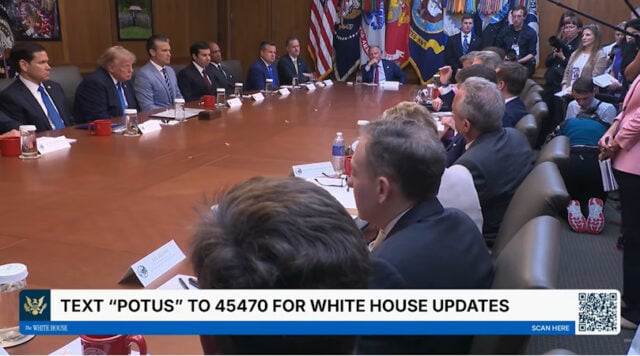
President Donald Trump gathered his top administration officials at the presidential retreat in Camp David, Maryland, for the thirteenth Cabinet meeting of his second term. Breaking from the traditional confines of the White House Cabinet Room, the retreat served as a high-stakes backdrop for sweeping discussions spanning Middle Eastern conflict, national cybersecurity vulnerabilities, energy policy, and contentious battles brewing with Congress.
The session featured extended remarks from President Trump alongside briefs from key Cabinet members, culminating in a wide-ranging press conference where the president addressed a rapid sequence of global and domestic developments.
Trump Press Q&A: Iran, Gaza Disarmament, and Foreign Affairs
During an unscripted exchanges with reporters, President Trump weighed in on the escalating confrontational climate in the Middle East. Trump strongly dismissed assertions that Tehran was gaining leverage, declaring that the Iranian regime is struggling under intense pressure.
“Iran is doing very poorly,” Trump told reporters during his opening press briefing. “They’re having a hard time. They’ve been very dishonest. They’ve been very dishonorable to deal with, but that makes no difference. They’re doing very, very poorly.”
Trump coupled his warning to Tehran with an emphasis on American energy production. Interjecting during a diplomatic brief, Trump touted domestic output, asserting that the United States is currently producing more oil by double than Russia and Saudi Arabia combined.

On the diplomatic front in Gaza, the administration highlighted a breakthrough framework aimed at winding down hostilities. Trump announced that negotiations had produced a roadmap for Hamas to disarm its military wing and relinquish its weapons arsenal in exchange for a phased withdrawal of Israeli forces from the territory. While acknowledging that significant conditions and implementation timelines remain, administration officials framed the agreement as a crucial step toward long-term stabilization in the region.
Turning to Eastern Europe, Trump addressed the ongoing war involving Russia and Ukraine. Highlighting U.S. military assistance and arms transfers, Trump noted that American defense planners are also actively examining war-weary Ukraine’s advances in battlefield technology, particularly regarding tactical drone warfare and rapid field innovations, to inform broader U.S. military readiness and defense capabilities.
Domestic Flashpoint: Minnesota Cyberattack and State Liability
One of the most sharp exchanges during the Q&A centered on a major domestic incident involving a coordinated cyberattack that targeted more than 30 municipal water facilities across Minnesota. State authorities and federal intelligence agencies indicated that early investigative leads pointed toward Iranian-backed state actors.
However, President Trump directly rejected the intelligence community’s initial assessment, placing blame squarely on local governance and state officials.
“We heard in Minnesota there was a cyber attack, and they blame it on Iran. I don’t think so,” Trump remarked. “I think I blame it on Minnesota because they’re grossly incompetent. There was a cyber attack of 30 water plants, and I would blame it on Minnesota and the governor, the corrupt governor of Minnesota. They like to say, oh, it’s Iran. Iran should be so lucky. Iran’s got bigger problems than worrying about Minnesota.”
Trump’s refusal to attribute the attack to external adversaries drew immediate reactions, emphasizing the administration’s skepticism toward traditional intelligence narratives and highlighting ongoing political friction between the executive branch and state leaders.
Washington Standoffs: Todd Blanche Nomination and Anti-Weaponization Debate
The Cabinet meeting also touched upon friction on Capitol Hill, where key administration nominations and legislative funding priorities face resistance.
At the center of the confirmation battle is Todd Blanche, nominated by President Trump to serve as Attorney General. Senate Republicans, led by outgoing Senator John Cornyn, have utilized procedural leverage to slow Blanche’s confirmation process. Trump publicly criticized GOP resistance, reaffirming his full backing of Blanche to head the Department of Justice.
Simultaneously, debate continues over the administration’s proposed $1.8 billion anti-weaponization fund. Intended to overhaul internal Department of Justice procedures and prevent political bias within federal law enforcement, the slush fund concept has faced scrutiny from both Democrats and moderate Republicans concerned about federal oversight and spending allocation. Trump vigorously defended the necessity of the fund, arguing that federal agencies must be thoroughly cleansed of systemic weaponization.
Info Snippets: Remarks from Key Cabinet Officials
Following President Trump’s opening statement and press Q&A, key members of the Cabinet provided concise updates outlining their respective agency directives:
- Vice President JD Vance: Emphasized burden-sharing among global allies and argued that regional partners must take primary financial and operational responsibility during security operations, ensuring American economic interests remain protected.
- Secretary of State Marco Rubio: Detailed ongoing diplomatic efforts regarding Middle East ceasefires, proxy deterrence, and the operational hurdles required to verify the proposed Gaza disarmament plan.
- Treasury Secretary Scott Bessent: Reported on domestic economic indicators, pointing to strong output driven by American energy dominance, tariff strategies, and federal deregulation.
- Secretary of Defense Pete Hegseth: Outlined Pentagon readiness updates, military force posture in regional waters, ongoing deterrence measures, and tactical lessons drawn from recent Houthi engagement strikes.
- HHS Secretary Robert F. Kennedy Jr.: Highlighted public health initiatives focusing on chronic disease prevention, federal health data review, and comprehensive reviews into medical records regarding developmental health.
Looking Ahead
As the retreat concluded, the Camp David Cabinet session underscored the Trump administration’s intent to push aggressive policies simultaneously across foreign, economic, and domestic fronts. With international ceasefires hanging in the balance and major nomination battles awaiting resolution in Congress, the administration faces a pivotal road ahead as midterm season approaches.
Sources Used
- The Guardian: Trump attacks Republican senator and defends $1.8bn slush fund amid Blanche nomination standoff
- Associated Press (AP News): Trump announces a deal for Hamas to disarm in Gaza, but many hurdles and uncertainty remain
- The Times of Israel: Trump: Iran being very dishonorable, but eventually something will happen
- Al Jazeera: Hamas reaches Gaza disarmament agreement with Trump’s Board of Peace
- CBS News: Top Trump officials included The Atlantic editor in group chat about plans to bomb Yemen
- Jewish Insider: Gaza peace plan and State Department negotiations update
- CNN Transcripts: Trump to Nominate Blanche as A.G. Amid Outrage Over $1.8 Billion Fund
Disclaimer
Artificial Intelligence Disclosure & Legal Disclaimer
AI Content Policy.
To provide our readers with timely and comprehensive coverage, South Florida Reporter uses artificial intelligence (AI) to assist in producing certain articles and visual content.
Articles: AI may be used to assist in research, structural drafting, or data analysis. All AI-assisted text is reviewed and edited by our team to ensure accuracy and adherence to our editorial standards.
Images: Any imagery generated or significantly altered by AI is clearly marked with a disclaimer or watermark to distinguish it from traditional photography or editorial illustrations.
General Disclaimer
The information contained in South Florida Reporter is for general information purposes only.
South Florida Reporter assumes no responsibility for errors or omissions in the contents of the Service. In no event shall South Florida Reporter be liable for any special, direct, indirect, consequential, or incidental damages or any damages whatsoever, whether in an action of contract, negligence or other tort, arising out of or in connection with the use of the Service or the contents of the Service.
The Company reserves the right to make additions, deletions, or modifications to the contents of the Service at any time without prior notice. The Company does not warrant that the Service is free of viruses or other harmful components.