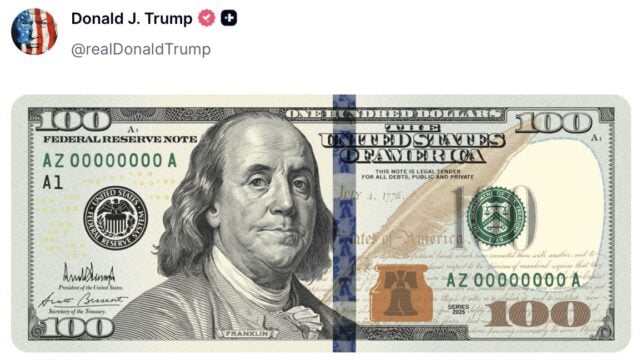
In a historic shift that upends more than a century and a half of American numismatic tradition, the U.S. Department of the Treasury has officially introduced a redesigned $100 bill featuring the signature of sitting President Donald J. Trump. The unveiling offers the public its first glimpse at the new currency, which went into production at the Bureau of Engraving and Printing this summer.
The redesign represents a fundamental change to the aesthetic of federal reserve notes. For the past 165 years, U.S. paper currency has strictly featured the signatures of the Secretary of the Treasury and the Treasurer of the United States. Under this new policy, the signature of the U.S. Treasurer is being dropped entirely from federal bills. Instead, President Trump’s signature appears in bold black ink in the lower-left corner of the $100 bill, positioned directly above the signature of Treasury Secretary Scott Bessent.
Former U.S. Treasurer Lynn Malerba will go down as the last Treasurer to have her name printed on American paper currency, marking the conclusion of an unbroken lineage dating back to the onset of the Civil War in 1861.
Treasury officials and administration allies have strongly defended the change, framing it as a monumental tribute to the upcoming 250th anniversary of American independence. Secretary Bessent praised the decision in an official statement, noting that the historic milestone of the semiquincentennial makes it highly appropriate to honor the country’s economic path and fiscal stability. U.S. Treasurer Brandon Beach echoed those sentiments, stating that marking the currency with the president’s name is both well-deserved and a fitting symbol of national prosperity.
While the change has been celebrated by the administration, it has simultaneously ignited intense political pushback from congressional critics. Detractors argue that utilizing national currency to display a sitting president’s name crosses a line into overt political branding, especially as consumers navigate broader economic pressures. Opponents have also pointed out that this development aligns with separate legislative pushes by some lawmakers to feature Trump’s likeness on a proposed $250 commemorative bill—an effort that faces rigid statutory hurdles, given that federal law explicitly prohibits living individuals from being depicted on U.S. currency.

Because the Treasury Secretary maintains broad statutory discretion over the security and design elements of Federal Reserve notes to protect against counterfeiting, the signature change did not require congressional approval. Aside from the historic alteration of the signatures, the core design elements of the $100 bill—including Benjamin Franklin’s portrait and the mandatory phrase “In God We Trust”—remain entirely unchanged. Financial historians note that while the move is unprecedented for a sitting president, the bills will likely become highly sought-after collectors’ items globally, even as the new notes begin working their way into automated tellers and everyday commercial circulation over the coming weeks.
Sources and Links:
- U.S. Department of the Treasury Press Release: Treasury Announces President Donald J. Trump’s Signature to Appear on Future U.S. Paper Currency
- WGRZ News: Trump shares first look at new $100 bill featuring his signature
- SBS News: Trump’s signature to replace treasurer’s on US paper currency
- The Associated Press / KSAT: US Treasury plans to put Trump’s signature on new paper currency in first for sitting president
- WFMY News 2: President Trump’s signature will be on U.S. paper currency in 2026
Disclaimer
Artificial Intelligence Disclosure & Legal Disclaimer
AI Content Policy.
To provide our readers with timely and comprehensive coverage, South Florida Reporter uses artificial intelligence (AI) to assist in producing certain articles and visual content.
Articles: AI may be used to assist in research, structural drafting, or data analysis. All AI-assisted text is reviewed and edited by our team to ensure accuracy and adherence to our editorial standards.
Images: Any imagery generated or significantly altered by AI is clearly marked with a disclaimer or watermark to distinguish it from traditional photography or editorial illustrations.
General Disclaimer
The information contained in South Florida Reporter is for general information purposes only.
South Florida Reporter assumes no responsibility for errors or omissions in the contents of the Service. In no event shall South Florida Reporter be liable for any special, direct, indirect, consequential, or incidental damages or any damages whatsoever, whether in an action of contract, negligence or other tort, arising out of or in connection with the use of the Service or the contents of the Service.
The Company reserves the right to make additions, deletions, or modifications to the contents of the Service at any time without prior notice. The Company does not warrant that the Service is free of viruses or other harmful components.