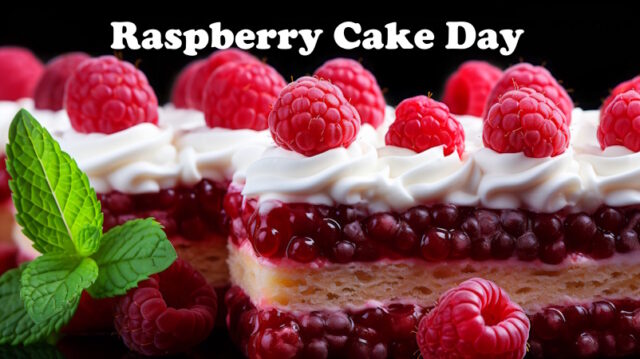
National Raspberry Cake Day sweetens the calendar every July 31, inviting everyone to indulge in this delightful fruit-infused dessert. This day celebrates the refreshing blend of fluffy cake and vibrant raspberries, a perfect summer treat.
- 4th Century – Roman agriculturist, Palladius, writes about raspberry cultivation — one of the earliest records of this berry’s cultivation.
- 5th to 15th Century – Medieval Europe uses the raspberry for medicine and in paintings; only the rich can afford to eat them at this time.
- 1562 – The saying “You can’t have your cake and eat it”(originally “eat your cake and have it”) is first seen in print in 1562 in John Heywood’s ‘Proverbs and Epigrams.’
- 18th Century – After many British gardens grow berry bushes and plants, the cultivation of this fruit spreads around Europe.
- 1700s – The journey of the raspberry cake itself seems to have taken off in the 1700s. During this time, raspberries made their grand entrance into Europe from Asia
- 1771 – William Price sells the first batch of cultivated raspberry plants in New York.
- 19th Century – By the 19th century, raspberry cake emerged as a popular dessert, evolving with the invention of butter cakes in the mid-1800s, which provided a rich and tender base for the tangy sweetness of raspberries.
- 2015 – National Raspberry Cake Day first gained significant attention on the internet on July 31, 2015. It sparked a wave of enthusiasm among cake and fruit lovers alike, leading to the sharing of recipes, baking tips, and countless mouthwatering photos.
- 2019 – The world produces 822,493 tonnes of raspberries — Russia contributes to 21% of this total, followed by Mexico and Serbia.
- Raspberries are the edible fruit of the plant that belongs to the genus Rubus of the rose family.
- Raspberries are made of little droplets or units, and each can be considered a separate fruit
- One raspberry bush can yield several hundred berries a year.
- A single raspberry has a hollow core once it is removed from the receptacle.
- Raspberries are a rich source of vitamin C, manganese, and dietary fiber.
- Raspberries contain vitamin B1, vitamin B3, folic acid, magnesium, copper, and iron.
- The word “raspberry” comes from the Old French raspise, a term meaning “sweet rose-colored wine”.
- Raspberries are a type of fruit known as aggregate fruit. Aggregate fruits have flowers with multiple ovaries, and each ovary produces druplets around a core formed by the flower. Each druplet could actually be considered a separate fruit.
- There are over 200 different species of raspberries, but only 2 species are grown on a large scale.
- Raspberries come in red, purple, gold, or black — the golden ones are the sweetest.
- Raspberries and blackberries are crossed to create the loganberry — a cross between red raspberries, blackberries, and loganberries creates boysenberries.
- The term “raspberry” for a flapping noise made with the tongue and mouth seems to have originated in the Cockney dialect of England. The sound was originally called a raspberry tart and was later shortened to raspberry.
- Phytonutrients from raspberries can be an effective treatment for high blood pressure and joint inflammation. They’re also beneficial for the normal functioning of the liver.
- Raspberry ketone, a compound isolated from raspberries, has applications in the cosmetics industry for producing shampoos, lotions, creams, and perfumes.
- The proverb ‘a piece of cake’ was coined in the 20th century.
- Popular raspberry cake varieties include classic vanilla or lemon cake with raspberry filling, rich chocolate raspberry cake, and elegant white chocolate raspberry cheesecake. Many also enjoy lighter options like raspberry angel food cake or raspberry almond cake.
Sources:

Tons of Facts
Food Lovers
Disclaimer
Artificial Intelligence Disclosure & Legal Disclaimer
AI Content Policy.
To provide our readers with timely and comprehensive coverage, South Florida Reporter uses artificial intelligence (AI) to assist in producing certain articles and visual content.
Articles: AI may be used to assist in research, structural drafting, or data analysis. All AI-assisted text is reviewed and edited by our team to ensure accuracy and adherence to our editorial standards.
Images: Any imagery generated or significantly altered by AI is clearly marked with a disclaimer or watermark to distinguish it from traditional photography or editorial illustrations.
General Disclaimer
The information contained in South Florida Reporter is for general information purposes only.
South Florida Reporter assumes no responsibility for errors or omissions in the contents of the Service. In no event shall South Florida Reporter be liable for any special, direct, indirect, consequential, or incidental damages or any damages whatsoever, whether in an action of contract, negligence or other tort, arising out of or in connection with the use of the Service or the contents of the Service.
The Company reserves the right to make additions, deletions, or modifications to the contents of the Service at any time without prior notice. The Company does not warrant that the Service is free of viruses or other harmful components.