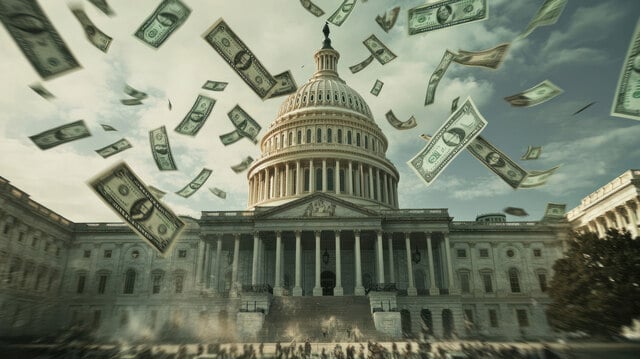
When discussions turn to the U.S. national debt, the numbers thrown around often feel impossible to comprehend. Trillions of dollars, ceiling debates, and abstract deficit charts sound like distant issues for lawmakers in Washington rather than matters that influence whether you can afford to buy a home, expand a business, or pay off college tuition.
However, as a report by The Conference Board reveals, the federal debt is far from an abstract macroeconomic figure. In their Solutions Brief, “How the National Debt Affects All Generations of Americans,” researchers show that persistent federal borrowing directly reshapes the day-to-day financial health of citizens across every stage of life.
The Economic Engine: How Public Debt Drives Private Interest Rates
Government borrowing does not happen in a vacuum. When the federal government runs large deficits year after year, it must issue trillions of dollars in Treasury securities to finance its spending. Over time, an escalating supply of government debt increases borrowing demand and forces interest payments to absorb a larger share of the federal budget.
If investors and bond markets begin to view the ballooning debt as riskier—or simply demand higher yields to absorb the sheer volume of issuance—interest rates on government debt rise. Because yields on U.S. Treasuries serve as the benchmark for borrowing throughout the broader financial system, higher federal borrowing costs steadily cascade into the private sector, lifting the interest rates charged on home mortgages, auto financing, student debt, and commercial credit lines.

The Five Fiscal Paths
To assess how these dynamics will unfold over the next decade, The Conference Board modeled five fiscal scenarios:
- Baseline Scenario: Assumes current tax policies and spending laws continue under standard economic projections.
- Deficit-Reduction Scenario: Models disciplined fiscal policy that curbs government deficits, stabilizing the debt-to-GDP ratio and lowering benchmark interest rates.
- Higher-Deficit Scenario: Assumes spending expands beyond current baselines, significantly increasing the debt-to-GDP ratio and driving bond yields higher.
- The 2029 One-Week Default Shock: Models a hypothetical political stalemate leading to a brief, seven-day default on U.S. debt in 2029, triggering an immediate surge in interest rates and lasting market volatility.
- The Extreme Interest Rate Shock: Evaluates a severe macroeconomic disruption where borrowing rates double from the baseline across all sectors.
The differences among these paths translate into measurable changes for American household budgets. Under the deficit-reduction path, student loan costs decline by 0.8%, housing expenses fall between 1.2% and 2.3%, and small business loan payments decrease by 1.9%.
Conversely, widening deficits increase student loan payments by 1.0%, raise housing costs by up to 2.3%, and increase small-business debt costs by 1.9%. Under the simulated one-week default, student borrowing costs jump 2.8%, housing costs climb between 3.0% and 4.4%, and commercial loan payments rise by 6.1%. Under the extreme doubling of interest rates, student debt burdens surge by 19.4%, illustrating how sensitive personal balance sheets are to federal borrowing conditions.
How Every Generation Feels the Squeeze
The Conference Board’s research illustrates these findings through four everyday case studies, demonstrating the ripple effect across different generations:
- The College Student: For young adults entering higher education, rising benchmark rates directly inflate the cost of student loans. Even slight increases in interest rates add thousands of dollars in cumulative lifetime debt service, forcing young graduates to delay moving out, starting families, or building an emergency fund.
- The Family of Four: For working parents, rising mortgage rates represent the single largest strain on household budgets. High borrowing costs make buying a home unaffordable, restrict refinancing opportunities, and elevate car loan payments, leaving less room for healthcare, childcare, and everyday essentials.
- The Small Business Owner: Main Street entrepreneurs rely heavily on short-term lines of credit, equipment loans, and Small Business Administration (SBA) financing. When borrowing costs rise, profit margins tighten, forcing small businesses to delay capital investments, freeze hiring, and slow expansion.
- The Future Retiree: For older Americans approaching or living in retirement, rising federal debt poses twin dangers. Growing interest expenses on the national debt threaten to crowd out funding for critical entitlement programs like Social Security and Medicare. At the same time, debt-driven market turbulence and inflation risk erode fixed-income savings.
Moving from Abstract Debt to Practical Action
For decades, the national debt debate has struggled to engage the public because the numbers felt disconnected from daily life. By modeling how government borrowing directly affects mortgage payments, tuition balances, and retirement security, The Conference Board’s analysis bridges that gap.
Addressing fiscal imbalances is not just a matter of macroeconomic theory or political debate—it is essential to safeguarding the purchasing power, borrowing capacity, and financial future of every generation in America.
Sources Used
- The Conference Board: How the National Debt Affects All Generations of Americans
Disclaimer
Artificial Intelligence Disclosure & Legal Disclaimer
AI Content Policy.
To provide our readers with timely and comprehensive coverage, South Florida Reporter uses artificial intelligence (AI) to assist in producing certain articles and visual content.
Articles: AI may be used to assist in research, structural drafting, or data analysis. All AI-assisted text is reviewed and edited by our team to ensure accuracy and adherence to our editorial standards.
Images: Any imagery generated or significantly altered by AI is clearly marked with a disclaimer or watermark to distinguish it from traditional photography or editorial illustrations.
General Disclaimer
The information contained in South Florida Reporter is for general information purposes only.
South Florida Reporter assumes no responsibility for errors or omissions in the contents of the Service. In no event shall South Florida Reporter be liable for any special, direct, indirect, consequential, or incidental damages or any damages whatsoever, whether in an action of contract, negligence or other tort, arising out of or in connection with the use of the Service or the contents of the Service.
The Company reserves the right to make additions, deletions, or modifications to the contents of the Service at any time without prior notice. The Company does not warrant that the Service is free of viruses or other harmful components.