Tracking who has the upper hand in American politics used to be a guessing game of waiting around for telephone polls or listening to cable news pundits state the obvious.
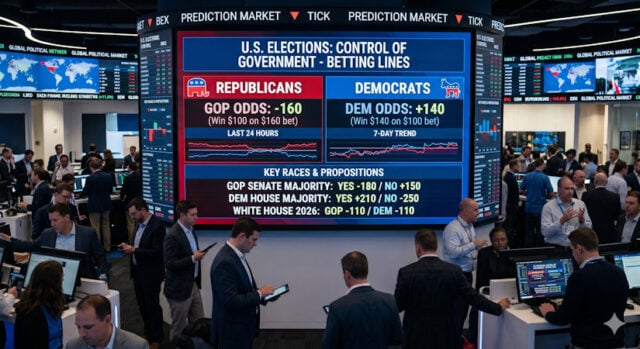
But a massive shift is happening right now under our noses. Wall Street data is colliding with Capitol Hill, and it’s turning politics into a living, breathing financial index. This week, the regulated prediction exchange Kalshi launched a brand-new tool that is being called the “S&P 500 for politics.” It is a dynamic index designed to measure, in real time, exactly which political party holds a firmer grip on power in Washington.
Instead of looking at static opinion data, investors and political junkies can now watch a single, constantly updating financial ticker to see which way the wind is blowing inside the Beltway.
From the Fringes of Legal Betting to Mainstream Finance
It’s easy to forget how fast this space has grown. Just a couple of years ago, betting money on U.S. election outcomes was essentially banned by federal regulators. The Commodity Futures Trading Commission (CFTC) blocked exchanges from listing these types of contracts for years, viewing them as a form of illegal gambling that didn’t serve the public interest.

The real game-changer came in late 2024. Kalshi won a massive, historic federal court battle against the CFTC. The courts ruled that the government had overstepped its bounds by blocking election contracts, clearing the way for regulated, high-stakes political trading.
Fast forward to today, and Kalshi doesn’t look like a casual gambling website. It operates as a fully regulated Designated Contract Market, subject to the same compliance rules as the Chicago Mercantile Exchange. Big institutional players can take positions up to $7 million, turning these markets into a serious financial playground.
How the New Power Index Works
This new index takes all that trading volume and packages it into a single scannable metric. By aggregating thousands of bets on individual congressional races, executive orders, and legislative outcomes, the platform creates a unified index score.
Think of it as a scoreboard for political leverage. If a piece of legislation favors the Republican agenda or a key swing-state primary swings toward a certain faction, the index responds instantly.
| Feature / Metric | Old School Polling | Kalshi’s New Political Power Index |
| Update Speed | Every few weeks or months | Second-by-second, continuous tracking |
| Accuracy Driver | Random sample phone calls | Traders putting real capital on the line |
| Data Type | A static mood snapshot | A fluid, forward-looking financial asset |
| Maximum Stakes | None (purely voluntary) | Institutional position limits up to $7 million |
Because every contract pays out exactly $1.00 if an event happens and zero if it doesn’t, the price of the asset perfectly mirrors what the market thinks the true probability is. If the index shows a party at 60%, it means millions of dollars are betting there’s a 60% chance they maintain or win structural control.
The Big D.C. Backlash: Washington Is Nervous
Unsurprisingly, Washington has mixed feelings about being turned into a ticker symbol. While traders love the transparency, Capitol Hill is pushing back hard.
Just this month, the United States Senate took the extraordinary step of officially banning all senators and their staffers from trading on prediction markets like Kalshi. The big fear among lawmakers is insider trading and political integrity. After all, if a congressional staffer knows a bill is going to fail before it hits the news cycle, they could easily use that information to turn a quick profit on the exchange.
At the same time, local state regulators and Tribal Gaming Commissions are putting up a fierce fight. They argue that these event contracts are just sports betting dressed up in fancy financial terms, and they want the right to tax and regulate them under state gambling laws.
Why Corporate America Is Paying Attention
Despite the political drama, the power of index tracking is here to stay because it solves a massive problem for corporate America. For major companies, shifting political tides aren’t just fodder for dinner party debates—they represent massive financial risks.
If a change in party control means new tariffs, a rewrite of the corporate tax code, or a sudden end to renewable energy subsidies, businesses need a way to protect themselves. By treating political control like an index fund, corporations, hedge funds, and everyday investors finally have a highly liquid, data-driven way to hedge against Washington risk. Politics has officially become an institutional asset class.
Sources and External Links
- Axios: Kalshi launches an ‘S&P 500 for politics’
- Bloomberg via Finviz: Kalshi Adds Index Tracking Republican, Democratic Power Shifts
- NBC Montana: Lawmakers eye prediction markets like Kalshi amid insider trading fears
- Wikipedia: Kalshi Exchange History, CFTC Lawsuits, and Senate Trading Ban
- Advisor Perspectives: The Wall Street Journal embeds political market probabilities
Disclaimer
Artificial Intelligence Disclosure & Legal Disclaimer
AI Content Policy.
To provide our readers with timely and comprehensive coverage, South Florida Reporter uses artificial intelligence (AI) to assist in producing certain articles and visual content.
Articles: AI may be used to assist in research, structural drafting, or data analysis. All AI-assisted text is reviewed and edited by our team to ensure accuracy and adherence to our editorial standards.
Images: Any imagery generated or significantly altered by AI is clearly marked with a disclaimer or watermark to distinguish it from traditional photography or editorial illustrations.
General Disclaimer
The information contained in South Florida Reporter is for general information purposes only.
South Florida Reporter assumes no responsibility for errors or omissions in the contents of the Service. In no event shall South Florida Reporter be liable for any special, direct, indirect, consequential, or incidental damages or any damages whatsoever, whether in an action of contract, negligence or other tort, arising out of or in connection with the use of the Service or the contents of the Service.
The Company reserves the right to make additions, deletions, or modifications to the contents of the Service at any time without prior notice. The Company does not warrant that the Service is free of viruses or other harmful components.