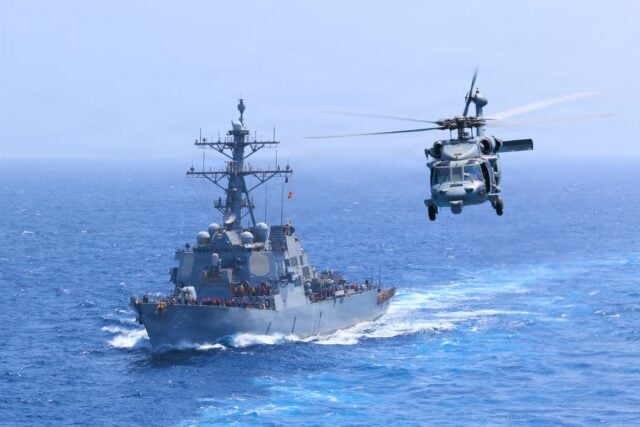
Escalation at the Brink: The U.S.-Iran Strategic Exchange
The military confrontation between the United States and Iran has entered a volatile and dangerous phase, characterized by continuous nighttime bombardment, regional drone counter-attacks, and escalating economic shocks. What began as targeted containment operations has spiraled into an ongoing direct exchange of firepower across multiple theaters in the Middle East. Following thirteen consecutive nights of U.S. airstrikes aimed at dismantling Iranian military installations and degrading Tehran’s ability to threaten maritime trade, the risk of an all-out regional war has reached its highest point in decades.
U.S. President Donald Trump warned that Washington is considering a massive offensive—potentially the largest since hostilities commenced—while Iranian leadership maintains that Tehran will not yield to military pressure or international threats. As both nations trade retaliatory blows across several sovereign borders, regional stability hangs by a thread, leaving international allies, global energy markets, and civilian populations caught in the crossfire.
Night After Night: Airstrikes and Maritime Blockades
The epicenter of recent U.S. military operations has focused heavily on coastal defense positions and strategic hubs along the Strait of Hormuz, including major military assets near Qeshm and Bandar Abbas. U.S. Central Command confirmed its thirteenth consecutive night of aerial bombardments, explicitly targeting Iranian coastal defense systems, drone launch infrastructure, and weapons storage facilities. The core objective of the campaign, according to Washington officials, is to break the Iranian naval blockade and secure vital maritime shipping lanes responsible for transporting a significant portion of the world’s daily petroleum supply.
However, the intensity of the military campaign has generated severe shockwaves throughout global logistics and energy markets. Global benchmark oil prices surged past $100 per barrel before settling near $92, while American consumers have experienced immediate pressure at the pump, with average gasoline prices rising to $4.10 per gallon. At the same time, commercial transit through the Strait of Hormuz has experienced unprecedented disruption. United Nations officials estimate that over 6,000 seafarers remain stranded aboard commercial vessels trapped in the narrow waterway, creating a dire human rights and humanitarian situation.

“The Middle East is teetering on the edge of the unimaginable. The situation is getting out of control, and one escalation triggers the next.” — António Guterres, United Nations Secretary-General
Tehran’s Response: Drone Barrages and Asymmetric Counter-Offensives
In response to the sustained American aerial campaign, Iran’s armed forces and the Islamic Revolutionary Guard Corps (IRGC) have launched broad-spectrum retaliatory strikes across the region. Utilizing advanced Arash kamikaze drones and long-range missile volleys, Iranian forces targeted key U.S. military bases and coalition assets stationed throughout the Persian Gulf and neighboring countries.
Retaliatory strikes were carried out against Isa Air Base in Bahrain—where Iranian state TV reported that fuel storage tanks, equipment warehouses, and barracks were targeted—as well as military installations hosting U.S. forces in Jordan, Kuwait, and Erbil in northern Iraq. Air defense systems surrounding Erbil airport were activated to intercept incoming suicide drones hovering over regional diplomatic and military facilities. In a notable expansion of regional targeting, the IRGC claimed responsibility for a strike on an Amazon data center in Bahrain, seeking to disrupt regional logistics and commercial cloud infrastructure. Human costs continue to mount rapidly; Iranian state media reported that U.S. airstrikes have resulted in at least 59 fatalities and over 660 injuries within Iranian territory since late June.
| Operational Domain | U.S. Military Actions | Iranian Retaliatory Actions |
| Air & Missile | 13 consecutive nights of targeted strikes on key infrastructure | Kamikaze drone attacks on U.S. bases in Bahrain, Jordan, Kuwait, Iraq |
| Maritime | Enforcement of naval blockades & protection of commercial shipping | Targeted mine laying & drone harassment in the Strait of Hormuz |
| Regional Dynamics | Strikes against Houthi targets in Yemen | Mobilization of the “Axis of Resistance” across multiple regional fronts |
Diplomatic Breakdown and Regional Spillover
The current military exchange represents the dramatic collapse of months of fragile diplomatic maneuvering. Previous rounds of indirect and direct negotiations—including high-stakes talks held in Islamabad—failed to yield a durable ceasefire agreement or nuclear consensus. Deep division over missile proliferation, regional proxy networks, and economic sanctions left both capitals on a collision course.
Iranian Foreign Minister Abbas Araghchi firmly rejected American demands for unilateral concessions, reiterating that Tehran will not negotiate under the threat of force or economic coercion. Instead, Iran has deepened its diplomatic alignment with Beijing and Moscow, seeking economic buffers and political backing within the UN Security Council. Meanwhile, the widening conflict has drawn in regional allies, including Yemen’s Houthi movement, further destabilizing crucial trade corridors in the Red Sea and Gulf of Aden.
Conclusion
As direct military exchanges enter a critical juncture, the path toward de-escalation appears increasingly narrow. With President Trump weighing a major military expansion and Tehran expanding its retaliatory operations across the Persian Gulf, the margin for diplomatic error has virtually disappeared. Without an immediate backchannel effort or international intervention, this compounding cycle of violence threatens to drag the entire region into an uncontainable conflict.
Sources and Links:
- NPR Illinois: Trump threatens a major escalation in Iran after 13 straight nights of strikes
- The Hindu: West Asia war LIVE: Iran’s military says attacked U.S. bases in Bahrain, Jordan, Kuwait
- The Spokesman-Review: US, Iran exchange strikes as Trump mulls wider offensive
- Wikipedia: 2025–2026 Iran–United States negotiations
Disclaimer
Artificial Intelligence Disclosure & Legal Disclaimer
AI Content Policy.
To provide our readers with timely and comprehensive coverage, South Florida Reporter uses artificial intelligence (AI) to assist in producing certain articles and visual content.
Articles: AI may be used to assist in research, structural drafting, or data analysis. All AI-assisted text is reviewed and edited by our team to ensure accuracy and adherence to our editorial standards.
Images: Any imagery generated or significantly altered by AI is clearly marked with a disclaimer or watermark to distinguish it from traditional photography or editorial illustrations.
General Disclaimer
The information contained in South Florida Reporter is for general information purposes only.
South Florida Reporter assumes no responsibility for errors or omissions in the contents of the Service. In no event shall South Florida Reporter be liable for any special, direct, indirect, consequential, or incidental damages or any damages whatsoever, whether in an action of contract, negligence or other tort, arising out of or in connection with the use of the Service or the contents of the Service.
The Company reserves the right to make additions, deletions, or modifications to the contents of the Service at any time without prior notice. The Company does not warrant that the Service is free of viruses or other harmful components.