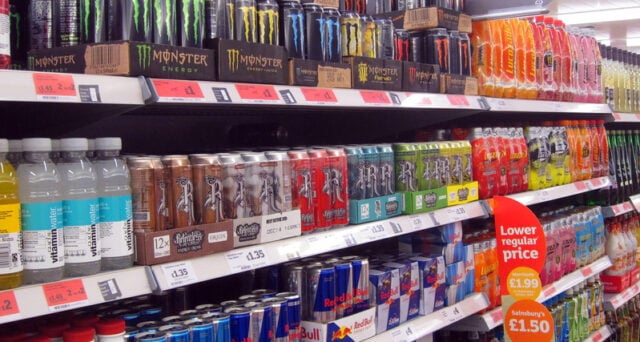
The nonalcoholic beverage industry is currently witnessing a historic transformation. For decades, the market was defined by the steady, predictable performance of carbonated soft drinks and bottled water. However, recent data from Goldman Sachs and NielsenIQ reveals that the “energy” segment is no longer a peripheral category for athletes or late-night workers. It has become a cornerstone of daily consumer habits, officially securing its place as the second-largest packaged beverage category in the United States, with annual sales reaching a staggering $24.78 billion.
While the broader beverage market has seen relatively flat growth, energy drinks jumped nearly 14% year over year through March 7, 2026. This surge is more than a sales fluctuation; it represents a fundamental shift in how people view hydration and productivity. The modern consumer is increasingly looking for “functional” beverages—drinks that don’t just quench thirst but also provide a measurable boost to physical and cognitive performance.
The New Hierarchy of the Beverage Aisle
To understand the current state of the market, one must look at the five companies that control over 90% of the industry’s sales. Monster Energy Co., Red Bull, Celsius Holdings, Keurig Dr Pepper, and Nutrabolt are the primary architects of this growth. However, their paths to success have been vastly different.
Monster Energy remains the market leader in terms of total dollar share, but its portfolio is currently a tale of two worlds. The flagship Monster brand continues to perform well, particularly in its health-conscious iterations. Monster Zero Sugar saw a 32.1% spike in sales, and the flavor-focused Juice Monster line skyrocketed by 111.9%. These figures suggest that consumers are moving away from the traditional medicinal taste of energy drinks toward profiles that mimic sodas or juices while maintaining the caffeine punch.

Conversely, Monster’s attempts at diversification through acquisition and internal brand launches have met with significant resistance. Bang, the high-performance brand Monster acquired in 2023, saw a 4.1% decline. Similarly, Reign, which was launched to compete in the “performance” space, fell by 7.1%. This trend indicates that the “extreme” branding that dominated the 2010s is losing its luster, replaced by brands that fit more seamlessly into a wellness-oriented lifestyle.
The Celsius Phenomenon and the Power of Wellness
Perhaps no brand better exemplifies the shift toward “cleaner” energy than Celsius. Leading the category with a 25.8% increase in annual sales, Celsius has successfully rebranded the energy drink as a fitness supplement and lifestyle accessory. Its growth is even more impressive over a two-year horizon, where it has seen a 42.6% increase in sales.
The company’s most significant strategic move was the early 2025 acquisition of Alani Nu. By bringing Alani Nu into its portfolio, Celsius tapped into a demographic that values aesthetics and better-for-you ingredients. Alani Nu nearly doubled its sales year-over-year, contributing roughly $1.6 billion to the Celsius Holdings bottom line. This acquisition has effectively allowed Celsius to dominate the “lifestyle” segment of the market, even as its legacy brands like Rockstar continue to struggle, losing 7% in sales during the same period.
Red Bull and the Zero-Sugar Revolution
While Celsius and Monster fight for market share through broad portfolios, Red Bull has stayed focused on its core identity while embracing the industry-wide pivot toward low-calorie options. Red Bull Zero saw its sales increase by nearly 200% following its wide release in early 2025. This massive growth underscores a critical market reality: sugar is out, and functionality is in.
The success of zero-sugar offerings across the board—from Monster to Red Bull to Celsius—highlights a change in consumer demographics. The energy drink consumer is no longer just the young male gamer; it is the office professional, the parent, and the health enthusiast. For these groups, the negative impact of high sugar content is a deal-breaker, making zero-sugar formulations the primary engine of category growth.
The Rise of Coffee-Based Energy and the Fall of Viral Hype
One of the most surprising success stories of the past year is the N.A. Coffee Partnership, a collaboration between Starbucks and PepsiCo. By marketing energy beverages under the Starbucks brand, the partnership saw sales quadruple, increasing by 339.8%. This suggests that for many consumers, the “coffee” label serves as a more approachable entry point into the energy category than traditional energy drink branding.
On the other end of the spectrum is the cautionary tale of Prime. The brand, which went viral through the influence of Logan Paul and KSI, saw its energy drink sales crash by nearly 65% over the past year. This decline signals the end of the “hype cycle” for the brand and proves that long-term retail success requires more than just social media impressions. In a market this competitive, shelf space is ultimately held by products that can convert a one-time viral purchase into a daily habit.
Why the Market is Exploding Now
The data provided by Goldman Sachs points to several sociological factors driving this $24.8 billion boom. As schedules become more fragmented and stress levels rise, caffeine has transitioned from a luxury to a necessity. Retailers like Casey’s General Stores have reported that energy drinks were a primary contributor to their 4% same-store sales boost, as commuters increasingly rely on convenience stores for their daily functional fuel.
Furthermore, the “better-for-you” movement has removed the stigma once associated with energy drinks. When these beverages were synonymous with high sugar and artificial ingredients, they were viewed with skepticism by health-conscious adults. Today, with the proliferation of thermogenic fuels, natural flavors, and zero-sugar options, the barrier to entry has vanished.
Future Outlook
As we look toward the remainder of 2026, the energy drink market is expected to continue its upward trajectory, potentially challenging regular carbonated beverages for the top spot in the nonalcoholic industry. The keys to future dominance will be flavor innovation, functional credibility, and the ability to capture the “lifestyle” consumer. The age of the “energy drink” as we once knew it is over; we have entered the age of the “functional beverage,” where every can is expected to deliver more than just a taste.
Sources and Links:
-
1. Goldman Sachs “Beverage Bytes” Report
The charts and data regarding the 2026 energy drink landscape (including the $24.8 billion valuation) originate from Goldman Sachs Equity Research. This series, “Beverage Bytes,” frequently features surveys of convenience store retailers and NielsenIQ data.
-
Access: This is a proprietary report distributed to Goldman Sachs clients. You can find their general research portal below. Link: Goldman Sachs Research
2. NACS State of the Industry Reports
The article references convenience store (“C-store”) performance trends that are typically compiled by the National Association of Convenience Stores (NACS) in their annual State of the Industry reports.
-
Access: These reports are available for purchase or through a NACS membership. Link: NACS State of the Industry Data
3. C-Store Dive “Trendline” & Category News
The article itself is part of C-Store Dive’s “Trendline” series, which aggregates multiple data points from Circana, NielsenIQ, and Goldman Sachs into a public-facing summary.
-
Link to the Summary Article: 5 charts showing the changing energy drink landscape Link to C-Store Category Trends: C-Store Dive Category News
4. NielsenIQ (NIQ) Beverage Data
The raw retail sales data (the $30.2 billion for carbonated drinks vs. $24.8 billion for energy drinks) comes from NielsenIQ. They provide periodic public insights and deep-dive reports for the beverage sector. Summary of Sources Used: Link: NielsenIQ Beverage Insights
-
Loder, J. (2026). 5 charts showing the changing energy drink landscape. C-Store Dive. https://www.cstoredive.com/news/5-charts-energy-drink-landscape/816620/
-
NACS. (2026). State of the Industry Report. https://www.convenience.org/
-
Disclaimer
Artificial Intelligence Disclosure & Legal Disclaimer
AI Content Policy.
To provide our readers with timely and comprehensive coverage, South Florida Reporter uses artificial intelligence (AI) to assist in producing certain articles and visual content.
Articles: AI may be used to assist in research, structural drafting, or data analysis. All AI-assisted text is reviewed and edited by our team to ensure accuracy and adherence to our editorial standards.
Images: Any imagery generated or significantly altered by AI is clearly marked with a disclaimer or watermark to distinguish it from traditional photography or editorial illustrations.
General Disclaimer
The information contained in South Florida Reporter is for general information purposes only.
South Florida Reporter assumes no responsibility for errors or omissions in the contents of the Service. In no event shall South Florida Reporter be liable for any special, direct, indirect, consequential, or incidental damages or any damages whatsoever, whether in an action of contract, negligence or other tort, arising out of or in connection with the use of the Service or the contents of the Service.
The Company reserves the right to make additions, deletions, or modifications to the contents of the Service at any time without prior notice. The Company does not warrant that the Service is free of viruses or other harmful components.