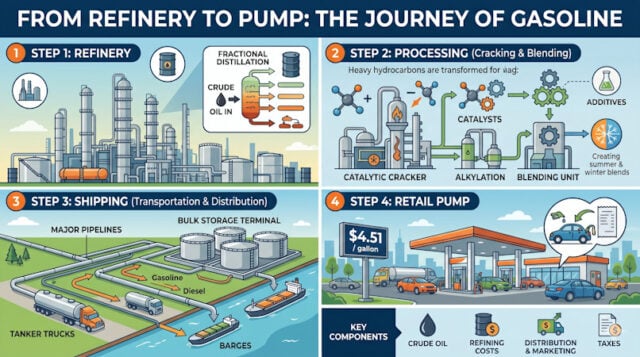
As of May 13, 2026, the national average for a gallon of regular unleaded gasoline in the United States stands at approximately $4.51, reflecting a year of significant volatility and complex global shifts. For the average driver idling at a station in The Villages, Florida, or navigating the dense traffic of Los Angeles, the price on the marquee is more than just a number—it is the final sum of a global supply chain that spans continents, deep-sea oil rigs, high-tech refineries, and thousands of miles of underground pipelines.
To understand why gas prices fluctuate so wildly, one must look beyond the gas station owner’s control. In reality, the price of a gallon of gasoline is composed of four distinct layers: the cost of crude oil, refining costs and profits, distribution and marketing, and federal and state taxes. Each of these components is influenced by a unique set of economic, geopolitical, and environmental factors.
The Foundation: Crude Oil (The 45%–51% Variable)
The single largest factor in the price of gasoline is the cost of crude oil. Historically, crude oil has accounted for roughly 50% of the retail price at the pump. However, as of early 2026, the U.S. Energy Information Administration (EIA) notes that this share has fluctuated as global supply chains reorganize.
Crude oil is a global commodity. This means that even if the United States is a leading producer of oil, the price Americans pay is dictated by the global market. In 2026, we have seen this play out vividly. While domestic production remains robust at approximately 13.6 to 14.1 million barrels per day, disruptions in international transit points—most notably the Strait of Hormuz—can send shockwaves through the system. When a critical chokepoint that handles 20% of the world’s petroleum liquids experiences tension, the global benchmark prices for Brent and West Texas Intermediate (WTI) crude spike.

Because gasoline is refined from crude, its price moves in lockstep with the barrel. Typically, for every $1 change in the price of a barrel of oil, the price at the pump changes by about 2.4 cents. In the first quarter of 2026, we witnessed a steady increase in these costs as global demand outpaced the immediate recovery of supply in certain regions.
The Transformation: Refining (The 20% Process)
Once the crude oil is pulled from the ground, it is essentially useless to your car’s engine. It must be transported to a refinery, where it is heated and distilled into various products, including gasoline, diesel, and jet fuel. This refining process currently accounts for about 20% of the total price of a gallon of gas.
Refining is not a static cost. It is subject to “crack spreads”—the difference between the price of crude oil and the wholesale price of the finished products. In 2026, refining margins have remained elevated due to a combination of factors:
- Capacity Constraints: Several older refineries have been decommissioned or converted to biofuels over the last two years, leading to a tighter supply of traditional gasoline.
- Seasonal Blends: During the spring months, refineries must switch from “winter blend” to “summer blend” gasoline. The summer blend is less prone to evaporation in high temperatures, which helps reduce smog, but it is more expensive to produce and requires refineries to temporarily shut down or slow down for the transition.
- Input Costs: Refineries are massive industrial complexes that require significant amounts of electricity and natural gas to operate. Higher utility costs in 2026 have directly trickled down to the cost of refining each gallon.
Getting to the Tank: Distribution and Marketing (The 11%–14% Margin)
After the gasoline leaves the refinery, it enters a vast network of pipelines, barges, and tanker trucks. This “last mile” of the journey, combined with the costs of operating a retail gas station, makes up roughly 11% to 14% of the price you pay.
It is a common misconception that gas station owners make a fortune when prices are high. In reality, most gas stations are independently owned franchises that make very slim margins on the fuel itself—often just a few cents per gallon after expenses. Their primary revenue often comes from the “convenience” side of the store: coffee, snacks, and car washes.
The distribution and marketing category covers:
- Pipeline Fees: Transporting fuel from the Gulf Coast to the East Coast via the Colonial Pipeline, for example.
- Labor and Transport: The cost of the truck drivers who deliver fuel to the station.
- Credit Card Fees: This is a hidden cost for many consumers. When you pay with a credit card, the bank takes a percentage of the total transaction. When gas is $4.50 a gallon, those fees can eat up nearly 10 cents of the station’s margin.
- Brand Licensing: Payments to major oil companies for the right to use their logos (Shell, Exxon, Chevron, etc.).
The Public Share: Taxes (The 15%–18% Fixed Cost)
The final component of the gas price is one that rarely changes, regardless of whether oil is $40 or $140 a barrel: taxes. Taxes currently account for approximately 18% of the national average price.
The federal government levies a flat tax of 18.4 cents per gallon on gasoline. This rate has remarkably remained unchanged since 1993. However, state and local taxes vary wildly and are the primary reason why gas in Florida might be $4.10 while gas in California exceeds $5.50.
- California: Often has the highest taxes in the nation, exceeding 70 cents per gallon when combining excise taxes, sales taxes, and environmental fees like the Low Carbon Fuel Standard and Cap-and-Trade programs.
- Florida: Generally stays below the national average, though it still applies a mix of state fuel taxes and local option taxes that fund infrastructure projects.
- Alaska: Traditionally holds the lowest state tax rate at roughly 9 cents per gallon.
These taxes are typically earmarked for the Highway Trust Fund, used to maintain roads, bridges, and public transportation systems. While “gas tax holidays” are often proposed by politicians during price spikes, economists argue they provide minimal relief to consumers because the other three components (crude, refining, and distribution) are much larger drivers of the final price.
Regional Variances: Why Your Neighbor Pays Less
If you’ve ever noticed gas prices drop by 20 cents just by crossing a county line, you’re seeing regional factors at work. Beyond state taxes, regional prices are dictated by:
- Proximity to Refineries: The Gulf Coast typically has the lowest prices in the country because it is the heart of the U.S. refining industry. The closer you are to the source, the lower the transportation costs.
- Competition: A station located right off a major interstate with four competitors across the street will likely have lower prices than a lone station in a rural area.
- Environmental Regulations: Some regions require specific “boutique” blends of gasoline to meet local air quality standards, which are more expensive to produce and harder to transport from other regions during a shortage.
The Outlook for Late 2026 and Beyond
As we move toward the second half of 2026, the EIA predicts a slight easing of prices as global crude oil supply is expected to catch up with demand. Forecasts suggest a possible 6% decrease in retail prices by the end of the year, provided geopolitical tensions in the Middle East do not escalate further.
However, the long-term trend is shifting. The increasing adoption of electric vehicles (EVs) is beginning to affect “demand destruction,” meaning the total amount of gasoline needed in the U.S. is slowly starting to plateau. While this should theoretically lower prices, it also discourages companies from investing in new refineries, which can keep supply tight and prices volatile in the short term.
In conclusion, when you watch the numbers spin at the pump today, you aren’t just paying for a liquid; you are paying for the geopolitical stability of the Middle East, the industrial efficiency of a Gulf Coast refinery, the labor of a truck driver in your home state, and the maintenance of the very road you are about to drive on.
Sources Used and Links:
- California Energy Commission: Estimated Gasoline Price Breakdown and Margins
- Bureau of Transportation Statistics (BTS): Motor Fuel Prices – March 2026
- American Petroleum Institute (API): Gas prices explained: What goes into the price at the pump?
- U.S. Energy Information Administration (EIA): Gasoline and Diesel Fuel Update
- U.S. Energy Information Administration (EIA): Short-Term Energy Outlook for Petroleum Products
- YCharts: US Retail Gas Price (Weekly) – Historical Data
- Marcus by Goldman Sachs: How Gas Prices Are Determined
Disclaimer
Artificial Intelligence Disclosure & Legal Disclaimer
AI Content Policy.
To provide our readers with timely and comprehensive coverage, South Florida Reporter uses artificial intelligence (AI) to assist in producing certain articles and visual content.
Articles: AI may be used to assist in research, structural drafting, or data analysis. All AI-assisted text is reviewed and edited by our team to ensure accuracy and adherence to our editorial standards.
Images: Any imagery generated or significantly altered by AI is clearly marked with a disclaimer or watermark to distinguish it from traditional photography or editorial illustrations.
General Disclaimer
The information contained in South Florida Reporter is for general information purposes only.
South Florida Reporter assumes no responsibility for errors or omissions in the contents of the Service. In no event shall South Florida Reporter be liable for any special, direct, indirect, consequential, or incidental damages or any damages whatsoever, whether in an action of contract, negligence or other tort, arising out of or in connection with the use of the Service or the contents of the Service.
The Company reserves the right to make additions, deletions, or modifications to the contents of the Service at any time without prior notice. The Company does not warrant that the Service is free of viruses or other harmful components.