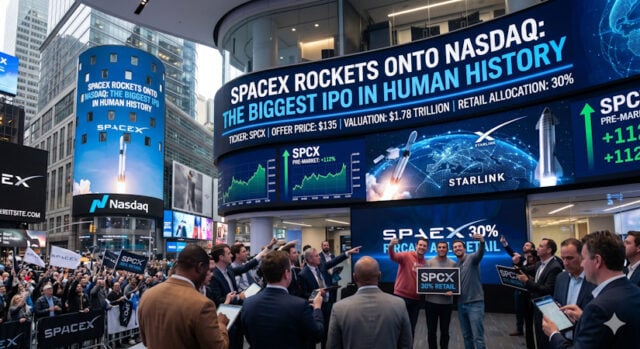
If you have been tracking the financial markets lately, you know that Wall Street has seen its fair share of highly anticipated initial public offerings (IPOs). But what is happening right now isn’t just an IPO—it is a full-blown economic event. Tonight, June 11, 2026, after the market close, Elon Musk’s SpaceX is finalizing the pricing for its public market debut. Tomorrow morning, Friday, June 12, the ticker symbol SPCX will go live on the Nasdaq.
We aren’t just looking at another tech company trying to raise a few billion dollars to scale an app. This is the largest public offering in the history of global capital markets. SpaceX is targeting a valuation of roughly $1.75 trillion to $1.78 trillion, attempting to raise a staggering $75 billion by floating 555.6 million shares at a fixed price of $135 each. To put that in perspective, the previous all-time record holder was Saudi Aramco, which raised $29.4 billion back in 2019. SpaceX isn’t just breaking that record; it is completely shattering it, coming in at nearly three times the size.
But as with anything involving Elon Musk, this listing is surrounded by equal parts jaw-dropping enthusiasm and severe skepticism. Let’s dive deep into the mechanics of this historic float, the hidden engines driving its multi-trillion-dollar narrative, the fierce battles happening behind the scenes among index providers, and why some seasoned analysts are warning that the stock might be headed for a dramatic orbital descent.
The Insane Demand and the Retail Revolution
When a company tries to vacuum up $75 billion from the market in one go, you might expect underwriters to sweat a little bit about finding enough buyers. Not this time. Goldman Sachs, leading a massive syndicate of 21 participating investment banks, has reported that investor demand has blown past $250 billion. The deal is sitting at roughly three and a half to four times oversubscribed before final pricing even locks in. Institutional asset managers, hedge funds, and sovereign wealth funds have been aggressively clamoring for a piece of the action.

However, the real shockwave is how the shares are being distributed. Historically, institutional heavyweights get first dibs on hot tech IPOs. Retail investors—everyday people using standard brokerage accounts—are usually left with the scraps, typically getting allocated a measly 5% to 10% of the public float.
SpaceX Chief Financial Officer Bret Johnsen completely flipped the script for this offering. In a move that shocked traditional Wall Street gatekeepers, SpaceX has explicitly allocated up to 30% of its total IPO float directly to retail investors. That is over $22 billion worth of stock reserved specifically for the public, backed by dedicated retail events that brought together thousands of individual investors earlier this spring. It is a brilliant philosophical and populist play by Musk, ensuring that the online community that championed his companies for a decade gets a front-row seat on day one—though it also sets the stage for massive retail-driven volatility once trading opens.
The Valuation Engine: Rockets, Starlink, and the xAI Twist
To understand how a company that was valued at roughly $800 billion during a private tender offer in December 2025 can suddenly demand a $1.75 trillion public market valuation six months later, you have to look at how SpaceX has aggressively redefined its core business model.
For years, people viewed SpaceX simply as an aerospace manufacturing and launch services provider. If it were just a rocket company flying Falcon 9s and building Starship, a $1.78 trillion price tag would be mathematically impossible to justify. But SpaceX has successfully executed a pivot into a vertically integrated telecom, deep-tech, and artificial intelligence titan.
The Starlink Cash Cow
First and foremost, there is Starlink. The low-Earth orbit satellite constellation is no longer a speculative project; it is the dominant economic pillar of the company. In 2025, SpaceX brought in $18.7 billion in total revenue. Starlink alone accounted for $11.4 billion of that figure—roughly 61% of the company’s entire top line. As the service expands its enterprise, maritime, aviation, and direct-to-cell capabilities, public investors are treating SpaceX as a high-margin global utility provider rather than a capital-intensive aerospace firm.
The xAI Merger Architecture
The real catalyst for the massive 2026 valuation surge, however, was the corporate architecture shift that took place in February. Elon Musk officially merged his artificial intelligence startup, xAI, into SpaceX in a transaction that valued the combined entity at $1.25 trillion (with xAI valued at roughly $80 billion within the deal).
The strategic rationale here is pure vertical integration. SpaceX needs cutting-edge AI infrastructure to handle the autonomous routing, network optimization, and constellation management of tens of thousands of Starlink satellites. Conversely, xAI needed massive physical infrastructure, power access, and data center space to train its large language models.
This brings us to the crown jewel of the prospectus: the Colossus 1 data center. In March 2026, SpaceX leveraged this infrastructure to sign a mind-boggling cloud compute contract with AI research company Anthropic. The deal is worth a stunning $1.25 billion per month through May 2029. This contract provided immediate validation to the public markets that the xAI-SpaceX merger wasn’t just financial engineering—it was generating unprecedented, high-margin enterprise software revenue from major third-party AI firms.
The Bear Case: A “Major Disconnect” From Reality
Despite the overwhelming bookbuilding demand, a vocal contingent of financial experts and regulators are waving bright red flags. They argue that the euphoria surrounding the SpaceX IPO has blinded investors to the cold, hard realities of the company’s current financial statements.
SpaceX Financial Snapshot (S-1 Prospectus Disclosures)
=========================================================
2025 Total Revenue:                     $18.7 Billion
  - Starlink Share:                     $11.4 Billion (61%)
  - Launch & Other Share:                $7.3 Billion (39%)

Q1 2026 Net Loss:                       $4.28 Billion
Estimated AI Infrastructure Losses:      $2.50 Billion / quarter
Accumulated Deficit:                   $41.30 Billion
=========================================================
When SpaceX publicly pulled back the curtain by lodging its S-1 prospectus with the SEC, the numbers revealed a company spending cash at an astronomical rate. Despite pulling in billions from Starlink, SpaceX posted a net loss of $4.28 billion in the first quarter of 2026 alone. The company is currently carrying an accumulated deficit of $41.3 billion.
Where is all that cash going? It is being swallowed up by the immense capital expenditures required to build out AI data centers—running close to $2.5 billion per quarter in pure AI infrastructure losses—alongside the continuous, unproven development costs of the Starship orbital launch system.
Independent research firms have been quick to point out the valuation math simply doesn’t add up. Nicholas Owens, an equity analyst at Morningstar, published a scathing note calculating SpaceX’s true fundamental fair value at just $63 per share—a massive 53% discount to the $135 IPO price. Owens warned:
“There is a major disconnect between market expectations and underlying fundamentals. At $1.78 trillion, the IPO values SpaceX at roughly 92 times its trailing sales. This is a very hefty valuation which means investors are wagering that Musk can seamlessly achieve his most ambitious, long-term sci-fi goals perfectly without a single technical or regulatory hitch.”
Similarly, NYU finance professor Aswath Damodaran, famously known as Wall Street’s “Dean of Valuation,” initially pegged SpaceX’s intrinsic value at $1.21 trillion before the prospectus was made public. While he revised his model slightly upward to a range of $1.25 trillion to $1.3 trillion after analyzing the official S-1 data, his figures still suggest that the public market is paying a premium of nearly half a trillion dollars based purely on the “Musk Premium” and structural hype.
Index Inclusion Madness: The Tectonic Shift in Passive Investing
The debate over whether SpaceX is fundamentally overvalued might actually be irrelevant in the short term due to a fascinating structural quirk in modern equity markets: passive index tracking.
Because SpaceX is debuting as a top-six largest company in America on day one, passive mutual funds and exchange-traded funds (ETFs) that track major indexes are facing an immediate operational crisis. If a company represents 2% or 3% of a major benchmark, trillions of dollars of automated capital are legally required to buy hundreds of millions of shares to accurately replicate that index.
Recognizing the sheer scale of the SPCX listing, major index providers have scrambled to rewrite their playbook:
- Nasdaq-100: Historically, the Nasdaq required a full year of “seasoning” (public trading history) and a minimum 10% public float before a new listing could join the index. Effective May 1, 2026, the Nasdaq implemented an accelerated “Fast Entry” rule. This allows any top-40 ranked company by market cap (roughly anything over $100 billion) to bypass the seasoning period and enter the elite index in just 15 trading days.
- MSCI: The global index provider confirmed it will utilize its existing early-inclusion exemptions for mega-cap IPOs to absorb SpaceX into its Global Standard Indexes almost immediately, creating immediate buying pressure from international passive funds.
- S&P Dow Jones Indices: Standing as the lone conservative holdout, S&P completed a market consultation in late May and announced it would not relax its strict entry rules. SpaceX will still be required to prove financial viability screens, maintain standard seasoning, and clear traditional float thresholds before it can enter the S&P 500. This means it could take many months, if not longer, for SPCX to join the broader market benchmark.
This split approach creates an incredible trading dynamic. Because Nasdaq and MSCI funds are forced to buy immediately while the available public float is relatively tiny, a massive supply-demand imbalance is highly likely. Bloomberg Intelligence estimates that index-tracking passive funds will need to instantly absorb over 40% of SpaceX’s public float. This structural buying pressure could drive the stock price up rapidly post-listing, completely independent of whether the company is actually turning a profit.
Corporate Governance and the Political Crosswinds
You cannot talk about an Elon Musk public debut without mentioning corporate governance and political friction. The public S-1 filing confirmed what many already suspected: Musk will maintain absolute ironclad control over the company. While he owns roughly 42% of the actual equity, the dual-class share structure grants him a staggering 85% of the total voting power. Public shareholders will have effectively zero say in how the company is run, how capital is allocated between Starlink and Mars initiatives, or how corporate boards are structured.
This extreme concentration of power, combined with the financial intertwining of SpaceX and xAI, has caught the attention of Washington. Earlier this week, US Senator Elizabeth Warren formally called on the Securities and Exchange Commission (SEC) to delay the IPO. Warren cited deep concerns regarding potential conflicts of interest, corporate governance anomalies, and whether retail investors are being properly protected from an opaque, highly leveraged corporate structure.
While the SEC has allowed the listing timeline to proceed, the political scrutiny highlights a persistent risk. SpaceX operates in an intensely regulated environment. Its launch cadences depend entirely on Federal Aviation Administration (FAA) approvals; its satellite networks rely on Federal Communications Commission (FCC) spectrum allocations; and a significant portion of its long-term revenue relies on sensitive defense and national security contracts with the US government. Any future regulatory bottlenecks or political standoffs could instantly dent the company’s operational margins.
The Ultimate Market Litmus Test
When the opening bell rings tomorrow morning and ticker symbol SPCX starts flickering on the screens, it will represent the ultimate litmus test for the financial world.
On one side stand the fundamental purists—the analysts looking at a $4.28 billion quarterly net loss, a 92x price-to-sales multiple, and a complex web of overlapping private-to-public tech mergers, wondering if the market has lost its mind. On the other side stand the structural traders and visionary believers—those who see an unmatched global satellite monopoly, a high-margin AI infrastructure powerhouse pulling in billions from contracts like Anthropic, and an inevitable tidal wave of passive index buying that will force Wall Street to push the price higher.
SpaceX has spent the last two decades proving that it can successfully defy the laws of physics to reach orbit. Starting tomorrow, we will see if it can do the exact same thing with the laws of gravity on Wall Street.
Sources and Links
- CME Group: The SpaceX Mega-IPO: Why Index Choice Matters | https://www.cmegroup.com/articles/2026/the-spacex-mega-ipo-why-index-choice-matters.html
- The Guardian: SpaceX heads for record $1.78tn float amid fears it is overvalued | https://www.theguardian.com/science/2026/jun/11/spacex-record-178tn-float-fears-overvalued-elon-musk-ipo
- Capital.com: SpaceX IPO targets 12 June 2026 Nasdaq listing | https://capital.com/en-int/market-updates/spacex-ipo-targets-11-06-2026
- Forbes: SpaceX Cements Final IPO Price At $135 As Retail Investor Orders Top $100 Billion | https://www.forbes.com/sites/tylerroush/2026/06/11/spacex-cements-final-ipo-price-at-135-as-retail-investor-orders-top-100-billion-live-updates/
- BitMEX Research: SpaceX IPO Guide: S-1 Breakdown, Valuation & Trading Strategy | https://www.bitmex.com/blog/spacex-ipo-guide
- The Motley Fool: Can You Invest in Starlink in 2026? Details & Alternatives | https://www.fool.com/investing/how-to-invest/stocks/how-to-invest-in-starlink-stock/
- MarketWise Financial: SpaceX IPO 2026: 8 Other Stocks That Win When SpaceX Wins | https://marketwise.com/investing/spacex-ipo-2026-alternative-stocks/
Disclaimer
Artificial Intelligence Disclosure & Legal Disclaimer
AI Content Policy.
To provide our readers with timely and comprehensive coverage, South Florida Reporter uses artificial intelligence (AI) to assist in producing certain articles and visual content.
Articles: AI may be used to assist in research, structural drafting, or data analysis. All AI-assisted text is reviewed and edited by our team to ensure accuracy and adherence to our editorial standards.
Images: Any imagery generated or significantly altered by AI is clearly marked with a disclaimer or watermark to distinguish it from traditional photography or editorial illustrations.
General Disclaimer
The information contained in South Florida Reporter is for general information purposes only.
South Florida Reporter assumes no responsibility for errors or omissions in the contents of the Service. In no event shall South Florida Reporter be liable for any special, direct, indirect, consequential, or incidental damages or any damages whatsoever, whether in an action of contract, negligence or other tort, arising out of or in connection with the use of the Service or the contents of the Service.
The Company reserves the right to make additions, deletions, or modifications to the contents of the Service at any time without prior notice. The Company does not warrant that the Service is free of viruses or other harmful components.