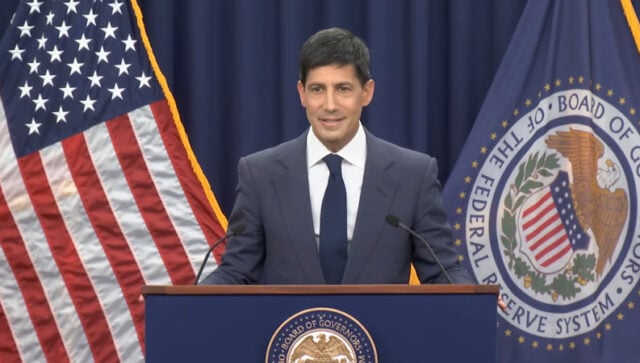
If you were expecting the standard, carefully choreographed routine from the Federal Reserve today, newly minted Fed Chair Kevin Warsh had other plans. In his first official policy meeting and news briefing since taking the oath of office in May, Warsh presided over a unanimous 12-0 vote to keep the benchmark federal funds rate right where it has been: at a target range of 3.50% to 3.75%.
While the decision to hold rates steady for a fourth consecutive meeting surprised absolutely no one in the financial world, the tone and execution of the briefing signaled a massive cultural shift at the nation’s central bank. Warsh used his maiden turn at the microphone to deliver a blunt, jargon-free message on price stability, announce a sweeping operational overhaul, and completely rewrite how the Fed talks to the public.
The War on Inflation and the New Task Forces
The backdrop for today’s meeting is an economic landscape that has grown increasingly uncomfortable for American families. Driven largely by energy spikes connected to conflicts in the Middle East, headline inflation recently ticked past 4% for the first time since 2023—drifting further away from the Fed’s ultimate 2% target.
“We recognize that inflation has been running well ahead of the Fed’s stated goal,” Warsh told reporters, leaning into the microphone with a stark, serious demeanor. “But the recent past does not need to be prologue. This committee will deliver price stability.”

To back up those words, Warsh announced that he isn’t just sticking to the old playbook. He has established five new specialized internal task forces designed to completely review and reshape how the central bank functions. Rather than focusing purely on abstract modeling, these task forces will dive into five critical pillars of central banking:
- The Inflation Framework: Re-evaluating the tools and timelines required to bring prices back under control.
- Communications: Changing how the Fed projects its intentions to the public and financial markets.
- The Fed’s Balance Sheet: Reviewing the central bank’s massive holdings of financial assets.
- Existing Data Sources: Scrutinizing where the Fed gets its economic information and finding better real-time indicators.
- Productivity and Jobs: Evaluating the true state of the American labor market and output.
Warsh made it clear that he isn’t interested in moving the goalposts to make the data look better. When asked if the Fed would consider raising its 2% inflation target to give itself breathing room, his response was sharp: “I see no reason to revisit the 2% inflation goal until we are actually able to deliver 2% inflation.”
Warsh 101: How the Fed Works (And What’s Changing)
In an unusual move for a Fed Chair, Warsh spent a portion of his opening remarks breaking down how the central bank operates, treating it less like a mysterious priesthood and more like a public institution accountable to the economy.
Monetary policy, at its core, is a balance of adjusting the supply of money and the cost of borrowing to keep the economy stable. When inflation runs hot, the Fed traditionally keeps interest rates higher to cool down spending and borrowing. When the economy stalls, they lower rates to make money cheaper and jumpstart growth.
But Warsh used this moment to deliver a philosophical lecture that marks a clean break from his predecessor, Jerome Powell. Under the previous regime, the Fed relied heavily on “forward guidance”—essentially telling the markets exactly what they planned to do months in advance.
Warsh is throwing that out. In fact, today’s official policy statement was stripped down to just a half-page, completely eliminating any clues about future rate moves. To explain why, Warsh gave a masterclass on his economic philosophy:
“Inflation is a choice for central bankers,” Warsh remarked, repeating a mantra he has held for years. “Monetary policy is the primary driver of inflation, not just random economic events.”
Because he believes the Fed is directly responsible for controlling prices, he argues that promising a fixed path of interest rates in advance makes the central bank rigid. Under his leadership, the Fed will look at raw economic data rather than trying to manage market expectations. “We are no longer offering forward guidance,” he stated flatly. He even admitted that he chose not to contribute to the Summary of Economic Projections (the famous “dot plot”) this quarter, preferring to let the factual data speak for itself.
Facing the Press: The Q&A Highlights
When the floor opened for questions, journalists immediately pushed Warsh on how Wall Street and Main Street should interpret this new, tighter-lipped Federal Reserve. The tension in the room was palpable, given that President Donald Trump—who nominated Warsh—has frequently vocalized his desire for lower interest rates.
When asked whether he worried that limiting communication and dropping forward guidance would cause panic or wild swings in the stock and bond markets, Warsh didn’t flinch.
“This is a lot of change for financial markets to digest,” Warsh acknowledged calmly. However, he clarified that he doesn’t want the stock market to react frantically to every single morning economic data release just because traders assume a specific number will automatically force the Fed’s hand. By breaking the cycle of constant reassurance, Warsh intends to build a more disciplined central bank that reacts to long-term trends rather than short-term market noise.
Reporters also tried to corner him on whether the next move for interest rates would be a hike, given the rising inflation numbers. While six of his fellow policymakers have already hinted in their projections that multiple rate hikes might be necessary in 2026, Warsh refused to take the bait. He reiterated that by dropping forward guidance, he will not drop hints, promise cuts, or threaten hikes. The Fed will look at the facts as they find them, keep a massive amount of reserves in the banking system to keep things running smoothly, and focus entirely on protecting the purchasing power of the American dollar.
Ultimately, Warsh’s first outing proved that the era of a highly predictable, gentle Fed is officially over. The rates are holding steady for now, but under this new leadership, the rules of the game have completely changed.
Sources and Links:
- Intellectia.ai: Fed Interest Rate Decision June 2026: Warsh’s First FOMC Meeting Guide
- The Financial Express: US Fed Meeting 2026 LIVE: Kevin Warsh holds rates steady at 3.5%-3.75% in his first FOMC meeting as Fed chair
- Stock Titan: Fed Rate Decision June 17, 2026: What to Watch
- The Washington Post: Fed holds rates steady amid elevated inflation
- BNN Bloomberg: Warsh-led Fed expected to leave U.S. interest rates unchanged
- CFO Dive: Fed ends bias toward more easing, holds benchmark rate steady
- CBS 8 (San Diego): LIVE: Fed Chair Kevin Warsh holds first news conference in new role
- Kiplinger: June Fed Meeting: Live Updates and Commentary
- Seeking Alpha: New Fed Chair Warsh establishes task forces to review its operations, policies
- Financial Times: What should investors expect from Kevin Warsh’s first Fed meeting?
Disclaimer
Artificial Intelligence Disclosure & Legal Disclaimer
AI Content Policy.
To provide our readers with timely and comprehensive coverage, South Florida Reporter uses artificial intelligence (AI) to assist in producing certain articles and visual content.
Articles: AI may be used to assist in research, structural drafting, or data analysis. All AI-assisted text is reviewed and edited by our team to ensure accuracy and adherence to our editorial standards.
Images: Any imagery generated or significantly altered by AI is clearly marked with a disclaimer or watermark to distinguish it from traditional photography or editorial illustrations.
General Disclaimer
The information contained in South Florida Reporter is for general information purposes only.
South Florida Reporter assumes no responsibility for errors or omissions in the contents of the Service. In no event shall South Florida Reporter be liable for any special, direct, indirect, consequential, or incidental damages or any damages whatsoever, whether in an action of contract, negligence or other tort, arising out of or in connection with the use of the Service or the contents of the Service.
The Company reserves the right to make additions, deletions, or modifications to the contents of the Service at any time without prior notice. The Company does not warrant that the Service is free of viruses or other harmful components.