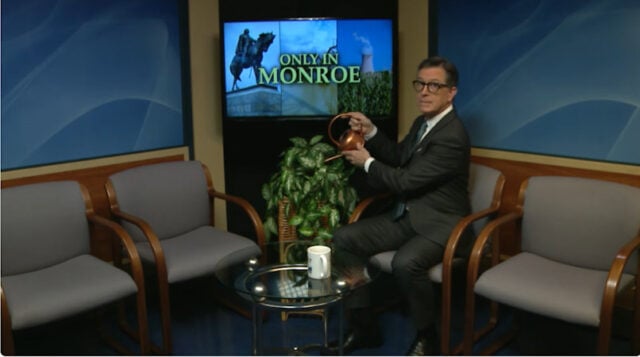
Exactly twenty-three hours after the house lights dimmed inside Manhattan’s historic Ed Sullivan Theater for what many feared would be the final chapter of his broadcast career, Stephen Colbert sat behind a laminate desk in a cramped, beige studio in southeastern Michigan. There was no roaring applause from a studio audience of millions, no multi-tiered house band directed by Louis Cato, and no sweeping network graphics. Instead, there was a lone potted fern, a hum from a local access camera crew, and a digital clock ticking down the seconds on a regional public access broadcast.
Following the abrupt and highly contentious cancellation of The Late Show with Stephen Colbert by CBS and its parent company, Paramount, the veteran satirist pulled off what media critics are already calling one of the most brilliant, defiant, and surreal counter-programming stunts in television history. On Friday evening, May 22, 2026, residents tuning into Monroe Community Media’s localized program Only in Monroe were greeted not by their usual hometown hosts, but by the highest-paid exile in American entertainment.
“It’s been an excruciating twenty-three hours without being on television,” Colbert announced directly into a camera lens that lacked a teleprompter, grinning with the sharp, unblinking irony that characterized his eleven-year run on network television. “So I am grateful to be able to be here on Monroe Community Media before they also get acquired by Paramount.”

The hour-long broadcast, which quickly reverberated across global digital platforms via frantic YouTube uploads and social media leaks, served as both an affectionate love letter to small-town Midwest culture and a scorched-earth parody of the corporate consolidation that claimed his network position.
A Corporate Casualty Resurfaces in the Midwest
The road that led Colbert from a premier late-night desk to a public access facility along the shores of Lake Erie began last July, when CBS executives stunned the industry by announcing The Late Show would be canceled at the end of the 2025–2026 season. The network cited a purely financial rationale, pointing to a challenging economic backdrop, declining linear viewership, and a broader industry shift toward digital clips and podcasts.
However, industry insiders and political commentators viewed the decision through a highly skeptical lens. Throughout his tenure, Colbert remained an unyielding critic of Donald Trump and his administration. With the Paramount-Skydance merger awaiting federal regulatory approval, critics suggested the network’s decision was an effort to appease Washington and protect its corporate interests. The reality of that political friction was underscored on Friday night when Trump posted an artificial-intelligence-generated video online depicting himself throwing Colbert into a dumpster, set to canned studio applause.
Rather than quietly exiting into the lucrative world of streaming contracts or prestige podcasting, Colbert chose to retreat to the very arena where his CBS journey symbolically began. In the summer of 2015, weeks before taking over the late-night mantle from David Letterman, Colbert traveled to Monroe, Michigan, to secretly guest-host an episode of Only in Monroe. That initial appearance became a legendary piece of late-night lore, featuring an unannounced interview with Detroit rap icon Eminem. Eleven years later, facing the sudden end of his network run, Colbert went back to the Great Lakes state to complete the circle.
Local News, Chili Dogs, and Star-Studded Absurdity
Operating with near-zero production values, the Only in Monroe special replicated the structure of a major network talk show, stripped of its commercial gloss. Colbert spent the opening segment of the broadcast leaning heavily into hyper-local Michigan news, including a detailed analysis of a deer processed by a local hunter and the grand opening of a nearby dance studio.
The monologue featured a lengthy segment on a historic local culinary rivalry between two iconic Monroe establishments: “Monroe’s Original Hot Dogs” and “Vince’s Hot Dogs.” To settle the debate, Colbert introduced his “volunteer music director” for the evening: legendary rock musician and Detroit native Jack White. Hunched over a vintage reel-to-reel tape machine and armed only with a portable boombox, White provided deadpan comedic timing and a silent, brooding presence. In a bizarrely tender display of local solidarity, Colbert and White shared a chili dog from each establishment, consuming them simultaneously from opposite ends in a parody of Lady and the Tramp.
         ========================================================
                      THE ONLY IN MONROE LINEUP
         ========================================================
         [Host] ................................. Stephen Colbert
         [Volunteer Music Director] ................. Jack White
         [The Sandwich Chef] ....................... Jeff Daniels
         [Local Ad Spokesman] ..................... Steve Buscemi
         [The Fire Marshal] ............................. Eminem
         ========================================================
The hour quickly transformed into a parade of high-profile talent who had flown to Michigan to participate in the broadcast experiment. Emmy-winning actor Jeff Daniels, a lifelong resident of nearby Chelsea, Michigan, sat down for an interview that bypassed standard Hollywood promotional cycles. Instead of plugging an upcoming film, Daniels demonstrated how to construct a highly specific, chaotic sandwich—a culinary creation he had previously introduced during a segment on The Late Show earlier this spring.
The commercial breaks were equally surreal. In lieu of national corporate advertisements, actor Steve Buscemi appeared in a pre-recorded segment, delivering an overly dramatic, deadpan endorsement for Buscemi’s Pizza, a beloved local regional chain. Another mandatory public service slot featured an agonizingly long, literal description of the official Monroe city flag, designed mockingly for the visually impaired.
Colbert also used the public-access platform to directly address his immediate successor in the network. Using a FaceTime connection on his personal phone, Colbert placed a live call to comedian Byron Allen. Allen’s syndicated series Comics Unleashed has been selected by CBS to fill the 11:35 PM time slot previously occupied by The Late Show.
“I’m coming for you, brother,” Colbert joked over the speakerphone, pointing out that because Only in Monroe aired at exactly 11:35 PM on Friday night, the two programs were now locked in direct regional competition.
A Toast to Remission and a Fiery Conclusion
Despite the underlying corporate tension, the heart of the broadcast rested on Colbert’s interaction with the program’s legitimate, non-celebrity hosts: Michelle Baumann and former Miss America Kaye Lani Rae Rafko Wilson. In 2015, Colbert had playfully commandeered their show during their temporary hiatus. On Friday, the trio reunited behind the desk for a segment that balanced dark humor with authentic human emotion.
The hosts openly discussed Baumann’s ongoing battle with thyroid cancer, sharing the news that her illness was officially in remission. To celebrate, Colbert produced a bottle of Cane & Grain, an 80-proof spirit manufactured locally at Monroe’s River Raisin Distillery. The three television hosts toasted to Baumann’s health, chasing the shots of liquor by inhaling helium from nearby celebratory balloons. As they spoke in high-pitched, distorted voices, a text warning flashed across the bottom of the public access screen: “Former professional TV host. Do not try this at home.”
                     +---------------------------------------+
                     |                WARNING                |
                     |       FORMER PROFESSIONAL TV HOST.    |
                     |          DO NOT TRY THIS AT HOME.     |
                     +---------------------------------------+
The climax of the episode leaned directly into the therapeutic destruction of the medium itself. Standing among the cardboard facades and painted backdrops of the Monroe Community Media studio, Colbert looked directly into the camera.
“Since they are no longer using this set, the station managers told me it would actually be helpful for me to destroy it,” Colbert remarked, his voice dropping into a tone of mock gravity. “Which is pretty great news, because right now, for no particular reason at all, I would very much like to break something.”
At that moment, Detroit hip-hop legend Eminem appeared on screen via a pre-recorded tape, dressed in an official uniform and acting as the local “fire marshal” who granted administrative approval for the upcoming demolition.
With authorization secured, Colbert, Jack White, and Jeff Daniels systematically dismantled the public access set on camera. They ripped down the curtains, broke the laminate desk, and carried the remnants of the studio out into the Michigan night air. The episode concluded with a wide shot of the three men standing in a gravel parking lot, watching the physical pieces of their television show burn inside a metal drum.
The Great Lakes Approach to Modern Media
While the broadcast was executed as an elaborate comedy piece, media analysts note that the underlying implications of Colbert’s choice are significant. By shifting his audience from a major network to a localized, independent cable access channel, Colbert drew attention to the vulnerability of corporate-controlled entertainment ecosystems.
Cultural critics have noted that the humble cable access approach offers a distinct antidote to an increasingly homogenized, frictionless digital media landscape dominated by algorithmic recommendations and mega-mergers. Historically, digital media was characterized by a chaotic constellation of independent, localized programs. Colbert’s sudden pivot to Monroe demonstrated that comedy can flourish entirely outside of major commercial institutions.
Whether this public access stint represents a temporary palate cleanser or the beginning of a decentralized new chapter for Stephen Colbert remains entirely unknown. Representatives for the comedian have declined to comment on his long-term post-CBS plans. For one night, however, television’s most prominent political satirist found his voice not in the media capital of New York City, but inside a public utility station in Monroe, Michigan, proving that true independence cannot be canceled by a corporate board.
Sources Used and Links:
- CBS News Detroit: Stephen Colbert appears on Michigan community access show broadcast night after “The Late Show” finale
- The Guardian: Stephen Colbert hosts Michigan public access show day after last appearance on Late Show
- Associated Press: Stephen Colbert is back on TV on community access in Michigan along with rocker Jack White
- LateNighter: Stephen Colbert Returns to Only in Monroe After Late Show Finale
- Consequence: Stephen Colbert Returns to TV with Hilarious Hour on Monroe, Michigan Public Access
- Mother Jones: Stephen Colbert Escaped Late Night and Immediately Started Having Fun
- Kotaku: [Stephen Colbert Already Lands New Hosting Gig On Michigan Public Access](https://kotaku.com/stephen-colbert already-lands-new-hosting-gig-on-michigan-public-access-2000698949)
- The Independent: Stephen Colbert returns to TV one night after his Late Show farewell
- NJArts.net: A day after CBS show ends, Stephen Colbert resurfaces … on public access TV
Disclaimer
Artificial Intelligence Disclosure & Legal Disclaimer
AI Content Policy.
To provide our readers with timely and comprehensive coverage, South Florida Reporter uses artificial intelligence (AI) to assist in producing certain articles and visual content.
Articles: AI may be used to assist in research, structural drafting, or data analysis. All AI-assisted text is reviewed and edited by our team to ensure accuracy and adherence to our editorial standards.
Images: Any imagery generated or significantly altered by AI is clearly marked with a disclaimer or watermark to distinguish it from traditional photography or editorial illustrations.
General Disclaimer
The information contained in South Florida Reporter is for general information purposes only.
South Florida Reporter assumes no responsibility for errors or omissions in the contents of the Service. In no event shall South Florida Reporter be liable for any special, direct, indirect, consequential, or incidental damages or any damages whatsoever, whether in an action of contract, negligence or other tort, arising out of or in connection with the use of the Service or the contents of the Service.
The Company reserves the right to make additions, deletions, or modifications to the contents of the Service at any time without prior notice. The Company does not warrant that the Service is free of viruses or other harmful components.