Operation Economic Outcast Takes Aim at Tehran
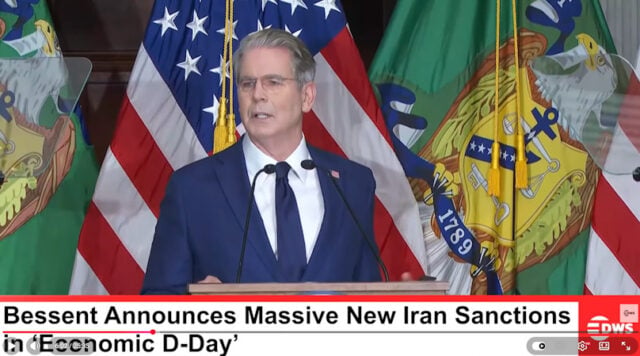
U.S. Treasury Secretary Scott Bessent announced a sweeping financial offensive against Iran, unveiling what the administration has characterized as an “economic D-Day”. Formally titled Operation Economic Outcast, the campaign represents a coordinated push to sever Tehran’s remaining lifelines to the global financial system and break a protracted geopolitical stalemate.
Writing in the Financial Times ahead of the announcement, Bessent described the measures as “the single greatest financial offensive ever marshaled against an adversary,” invoking the Allied Normandy landings to frame the operation as a decisive turning point designed to force Tehran into total isolation.
Five Lifeline Sectors and the Global Sanctions Web
The Treasury Department’s strategy centers on aggressive enforcement against five specific sectors that Iranian networks exploit internationally: digital assets, advanced technology, gold, aviation, and maritime shipping. Alongside these broad sectoral designations, the Office of Foreign Assets Control (OFAC) designated nearly 60 Iran-linked entities, individuals, and shadow fleet vessels across jurisdictions including China, Hong Kong, the United Arab Emirates, Switzerland, and Europe.
The penalties target crucial logistical and financial nodes. Designated targets include front companies involved in procuring sensitive dual-use optical technology, logistics operators facilitating ballistic missile components, and key individuals orchestrating currency conversions through foreign financial channels. Bessent delivered a blunt warning to international banks and intermediaries: any entity facilitating illicit transactions for Tehran will be permanently cut off from U.S. dollar clearing systems.

Treasury Secretary Bessent Says He’s Likely To Meet With China Again In ‘Next Few Weeks’ (Video)
Ultimatum and Phased Rollouts for Trading Partners
Rather than levying sudden blanket penalties across international markets, the Treasury is rolling out secondary sanctions in calibrated waves. This phased structure gives foreign governments, commercial hubs, and private enterprises a defined window to actively wind down their dealings with Iranian entities before facing unilateral American sanctions.
Bessent noted that President Trump has been directly contacting world leaders to request an immediate halt to all commercial and financial engagements with Tehran. Pointing to recent moves by Gulf nations—such as the United Arab Emirates suspending financial and commercial exchanges with Iran—Bessent characterized international compliance as already underway.
When pressed on how the sanctions would impact major buyers like China, which historically absorbs the vast majority of Iranian crude, Bessent stated that “no one is above the reach of U.S. sanctions,” maintaining that third-party facilitators will face enforcement regardless of broader diplomatic dialogues.
Escalating Stakes in an Unfolding Conflict
The economic offensive arrives as the broader conflict reaches its sixth month, with Washington leveraging financial pressure to compel Iran to reopen the Strait of Hormuz and bring Tehran to the negotiating table. Iranian leadership has pushed back sharply, with state officials threatening a “seismic” retaliation, including targeting maritime energy transit routes across the Persian Gulf.
While sanctions experts debate whether additional financial measures can produce concessions from an economy already enduring extensive naval blockades and trade restrictions, the Treasury Department emphasized that enforcement will follow a “zero-leakage” doctrine. With the administration preparing to sanction a major international financial institution later this week, Operation Economic Outcast represents Washington’s most comprehensive attempt to date to achieve strategic capitulation through pure economic pressure.
Disclaimer
Artificial Intelligence Disclosure & Legal Disclaimer
AI Content Policy.
To provide our readers with timely and comprehensive coverage, South Florida Reporter uses artificial intelligence (AI) to assist in producing certain articles and visual content.
Articles: AI may be used to assist in research, structural drafting, or data analysis. All AI-assisted text is reviewed and edited by our team to ensure accuracy and adherence to our editorial standards.
Images: Any imagery generated or significantly altered by AI is clearly marked with a disclaimer or watermark to distinguish it from traditional photography or editorial illustrations.
General Disclaimer
The information contained in South Florida Reporter is for general information purposes only.
South Florida Reporter assumes no responsibility for errors or omissions in the contents of the Service. In no event shall South Florida Reporter be liable for any special, direct, indirect, consequential, or incidental damages or any damages whatsoever, whether in an action of contract, negligence or other tort, arising out of or in connection with the use of the Service or the contents of the Service.
The Company reserves the right to make additions, deletions, or modifications to the contents of the Service at any time without prior notice. The Company does not warrant that the Service is free of viruses or other harmful components.