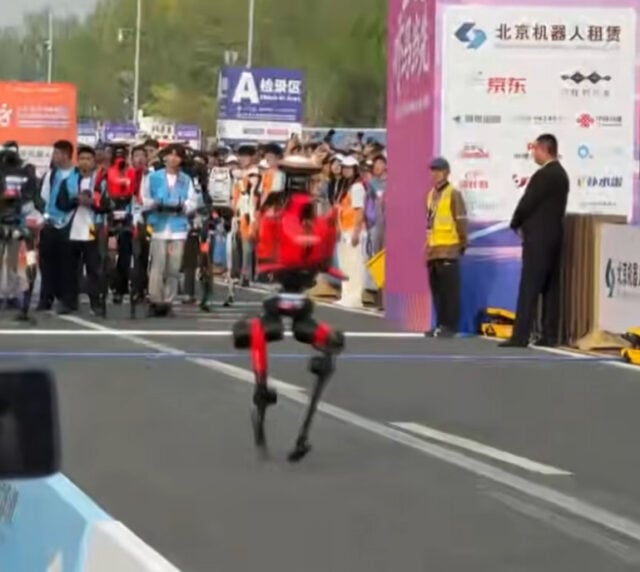
Imagine standing at a starting line on a crisp April morning in Beijing. To your left is a seasoned marathoner, calves like carved granite, eyes focused on the asphalt. To your right? A 169-centimeter-tall hunk of carbon fiber and servos named “Flash.” The hum of electric motors replaces the sound of heavy breathing, and for the first time in history, you aren’t just watching a race—you’re watching the moment the torch of physical dominance officially passed from flesh and blood to silicon and steel.
On Sunday, April 19, 2026, the Beijing E-Town Half-Marathon didn’t just host a race; it hosted a revolution. While the world has seen robots dance, backflip, and even carry groceries, we’ve never seen them do this. A humanoid robot developed by Shenzhen Honor Smart Technology Development Co. didn’t just win the robotic division; it obliterated the human world record for the half-marathon, crossing the finish line in a staggering 50 minutes and 26 seconds.
To put that in perspective, Uganda’s Jacob Kiplimo holds the human world record at roughly 57 minutes and 20 seconds. Flash didn’t just beat it; it took a nearly seven-minute sledgehammer to it.

The Machine vs. The Man
Let’s talk about the vibe on the ground. This wasn’t some sterile laboratory test. This was the Beijing Economic-Technological Development Area, filled with 12,000 human runners and over 300 robotic participants from 112 different teams. The humans and robots shared the same route, though they occupied separate lanes for safety (a wise choice, considering some of these robots weigh as much as a middleweight boxer and move like a motorcycle).
On the human side, the hero of the day was China’s Zhao Haijie, who took the men’s title with a very respectable 1:07:47. In any other year, Zhao would be the talk of the town. But today, he was essentially playing opening act for a metallic sprinter that doesn’t know the meaning of lactic acid.
When Flash crossed the line, there was a collective gasp from the crowd. Spectators like Sun Zhigang, who attended the inaugural race in 2025, were visibly stunned. “I feel enormous changes this year,” Sun told reporters. “It’s the first time robots have surpassed humans, and that’s something I never imagined.”
The Anatomy of a Record-Breaker
So, how did “Flash” do it? If you look at the robot, it’s clearly designed with a “form follows function” philosophy. Its legs are 95 centimeters long—modeled specifically after the limb proportions of elite human marathoners. But unlike a human, who relies on sweat and heavy breathing to stay cool, Flash uses a proprietary liquid-cooling system borrowed from smartphone technology.
Imagine a heat exchange flow rate exceeding four liters per minute, pulsing through the robot’s “veins” to keep its high-torque motors from melting under the pressure of a 50-minute sprint. It generates 400 newton-meters of peak torque, allowing it to maintain a stride that looked less like a jog and more like a sustained, high-speed gallop.
Interestingly, there were two versions of Flash. One was remotely controlled, and it actually finished even faster—48 minutes and 19 seconds. But the “real” winner was the autonomous version. The event organizers, led by the Chinese Institute of Electronics, implemented a clever “autonomy coefficient.” If a robot was remotely controlled, its time was multiplied by 1.2. The goal was to force engineers to build “smart brains,” not just fast legs. Flash navigated the 21.1-kilometer course entirely on its own, using multi-sensor fusion to dodge obstacles and manage its pace.
The Great Leap Forward: 2025 vs. 2026
What makes this feat truly mind-boggling is the sheer speed of progress. Just one year ago, at the 2025 edition of this race, the winning robot—a Tiangong Ultra—finished in 2 hours, 40 minutes, and 42 seconds. Only six out of twenty robots even managed to cross the finish line that year. The rest were a mess of tangled wires, stalled motors, and “mechanical exhaustion.”
In 365 days, the industry went from “barely able to finish a jog” to “shattering the world record.” That kind of exponential growth is unheard of in traditional sports. It’s the difference between a toddler taking its first steps and that same toddler outrunning an Olympic athlete a year later.
It Wasn’t All Smooth Sailing
Despite the record-breaking headlines, the race was a reminder that the “real world” is a messy place for robots. One robot fell flat on its face at the starting line, its sensors likely overwhelmed by the proximity of so many other metallic competitors. Another robot, a Tiangong 1.0 Ultra, famously crashed into a barrier after failing to detect an obstacle, breaking apart on the asphalt.
Even the champion, Flash, had a moment of drama. Videos circulating on social media showed the robot stumbling just meters before the finish line, requiring a quick “pick-up” from its engineering team. It was a humble reminder that while these machines can outrun us, they still lack the innate “body sense” or proprioception that allows a human to navigate a curb or a patch of uneven gravel without thinking.
The Global Stakes
This marathon wasn’t just about sports; it was a loud, metallic statement of intent. China’s latest five-year plan (2026–2030) specifically targets the development of humanoid robots as a “frontier of science and technology.” The goal isn’t just to win races; it’s to create machines that can work in factories, assist in disaster relief, and care for the elderly.
With teams from Germany, France, and Brazil also participating, the Beijing E-Town race has become the unofficial World Cup of robotics. For China, having Honor (a company with deep roots in consumer electronics) take the gold is a sign that the bridge between “high-tech research” and “mass-market application” is finally being built.
Why This Matters for You
You might be thinking, “Great, a robot ran fast. Why should I care?”
The significance lies in the technology that made it possible. The structural reliability and liquid-cooling systems tested on that Beijing asphalt are the same technologies that will eventually power robots in our homes and workplaces. If a robot can navigate 21 kilometers of varying terrain and inclines while managing its own heat and power, it can probably navigate a warehouse or a hospital hallway.
Furthermore, it challenges our very definition of “athleticism.” For over a century, the marathon has been the ultimate test of human endurance. Now, we are entering an era of “augmented athletics.” While humans will always want to see who the fastest person is, there is a new, growing curiosity about how far the limits of motion can be pushed when we remove biological constraints.
The Finish Line
As the sun set over Beijing E-Town, the podium looked a little different than usual. There were the human champions, Zhao and Wang, holding their trophies with pride. And next to them stood “Flash” and its engineers, representing a new kind of champion.
We aren’t at the point where robots are replacing human runners in our local 5Ks—yet. But the 2026 Beijing Half-Marathon proved that the gap isn’t just closing; it’s been leaped over. The next time you lace up your running shoes, take a look at your watch and remember: somewhere out there, there’s a robot that could give you a 20-minute head start and still beat you to the finish line with a liquid-cooled smile.
Sources and Links:
- Hindustan Times: Humanoid robot in China breaks human world record for half-marathon
- The Economic Times: Chinese humanoid robot shatters half marathon record, beats human mark by big margin
- LiveMint: Humanoid robot wins Beijing half-marathon, posts time faster than human world record
- The Financial Express: Robot beats human world record in Beijing half-marathon, signals China’s tech leap
- Associated Press (AP): A humanoid robot sprints to victory in Beijing, beating the human half-marathon world record
- The Next Web: A humanoid robot just beat the human half-marathon world record by seven minutes in Beijing
- Xinhua News Agency: Humanoid robot surpasses human half-marathon world record in Beijing
- Xinhua News Agency (Letter from China): Humanoid robots shatter human record, showcase autonomy at Beijing half marathon
- NBC News (via YouTube): Chinese humanoid robots prepare for second-ever half marathon in Beijing
- DRM News (via YouTube): Humanoid Robots Race Past Humans in Beijing Half Marathon
Disclaimer
Artificial Intelligence Disclosure & Legal Disclaimer
AI Content Policy.
To provide our readers with timely and comprehensive coverage, South Florida Reporter uses artificial intelligence (AI) to assist in producing certain articles and visual content.
Articles: AI may be used to assist in research, structural drafting, or data analysis. All AI-assisted text is reviewed and edited by our team to ensure accuracy and adherence to our editorial standards.
Images: Any imagery generated or significantly altered by AI is clearly marked with a disclaimer or watermark to distinguish it from traditional photography or editorial illustrations.
General Disclaimer
The information contained in South Florida Reporter is for general information purposes only.
South Florida Reporter assumes no responsibility for errors or omissions in the contents of the Service. In no event shall South Florida Reporter be liable for any special, direct, indirect, consequential, or incidental damages or any damages whatsoever, whether in an action of contract, negligence or other tort, arising out of or in connection with the use of the Service or the contents of the Service.
The Company reserves the right to make additions, deletions, or modifications to the contents of the Service at any time without prior notice. The Company does not warrant that the Service is free of viruses or other harmful components.