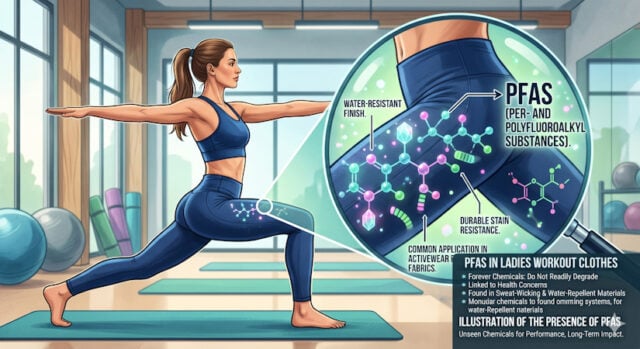
Texas Attorney General Ken Paxton announced Monday that his office plans to investigate whether clothing from the athleisure brand Lululemon contains per- and polyfluoroalkyl substances (PFAS), long-lasting compounds commonly referred to as “forever chemicals.” The investigation has thrust these chemicals—linked to a range of negative health outcomes and used in a variety of products—into the spotlight. Here’s what to know about the Lululemon probe, forever chemicals, and what PFAS lurking in your clothing could mean for your health.
What’s the Investigation About, Exactly?
According to a press release from Paxton’s office, the investigation will examine whether Lululemon’s clothing contains PFAS “that their health-conscious customers would not expect based on the brand’s marketing.” The office “will also review the company’s Restricted Substances List, testing protocols, and supply chain practices to determine whether Lululemon’s products comply with its stated safety standards,” the release continued.
The statement cites “emerging research and consumer concerns” as the basis for the probe.
Lululemon, meanwhile, denied using PFAS in its apparel, which includes leggings, workout tops, and casual athleisure wear. In an email to Health, a company spokesperson said:

“The company phased out the substance in FY23, which had been used in durable water repellent products, a small percentage of our assortment. The health and safety of our guests is paramount, and our products meet or exceed global regulatory, safety, and quality standards. We require all our vendors to regularly conduct testing for restricted substances, including PFAS, by credible third-party agencies to confirm ongoing compliance.”
What Are PFAS?
PFAS is an umbrella term for a class of chemical compounds used in a wide range of everyday products, including furniture, carpets, paint, food packaging, and clothing. They’re often added to fabrics for their stain-resistant or water-repellant properties, said Alex LeBeau, PhD, MPH, CIH, a toxicologist, certified industrial hygienist, and owner of Exposure Consulting in Orlando, Florida.
These compounds—which number in the thousands—have been dubbed “forever chemicals” because they don’t break down easily and have been discovered in soil, air, water, and in animals. They’ve been found in humans, too. Nearly everyone in the U.S. has measurable amounts of PFAS in their blood, according to the Centers for Disease Control and Prevention.
How Harmful Are PFAS?
Scientists still don’t fully know how PFAS affect human health. The chemicals can be particularly challenging to study because the category includes thousands of compounds, products contain varying levels, and exposure can come from many sources.
Some of the most widely studied PFAS are PFOS and PFOA, which were phased out in the U.S. in the 2010s, LeBeau said. Those long-chain PFAS, which tend to accumulate in the body and stick around for longer, were largely replaced with short-chain alternatives, which are thought to be less bioaccumulative but may still raise health concerns.
Research has also focused largely on what happens when people ingest PFAS. A 2025 study found a link between PFAS in drinking water and increased incidence of digestive, endocrine, respiratory, and oral cancers.
Still, LeBeau said that overall, “the health impacts are still up for debate in the scientific community.” Many human studies have produced mixed results, and much of the existing research—including some studies linking PFOS and PFOA exposure to certain cancers, as well as reproductive, developmental, immune, and cardiovascular effects—has been conducted in animals, he added.
When it comes to PFAS in clothing, LeBeau said skin absorption is possible but not considered as concerning as ingestion. “Dermal PFAS uptake does not appear to be a concerning PFAS exposure route into the body,” he said. “Limited animal studies have suggested that PFAS may permeate the skin, but skin impact may also depend on the PFAS chemical form.”
How to Know If Your Clothing Contains PFAS
Federal law doesn’t ban clothing manufacturers from using PFAS or require them to disclose whether their products contain them. However, some states have prohibited their use in apparel and other products, and many well-known brands—including Lululemon—have said they are voluntarily phasing them out.
While LeBeau said people should be most concerned about PFAS in their food and water, it’s understandable to want to avoid potentially harmful chemicals altogether. Unfortunately, it’s not always easy to tell whether clothing contains PFAS—but there are a few clues.
To start, check if a garment is labeled as being made with GORE-TEX or Teflon, both of which are PFAS-based materials. Clothing marketed as moisture-wicking, waterproof or water-repellant, or stain-resistant is also more likely to contain PFAS. Finally, if a brand explicitly labels a product or line as PFAS-free—and that claim has been verified through third-party testing—that’s a strong sign the clothing doesn’t contain the chemicals
Disclaimer
Artificial Intelligence Disclosure & Legal Disclaimer
AI Content Policy.
To provide our readers with timely and comprehensive coverage, South Florida Reporter uses artificial intelligence (AI) to assist in producing certain articles and visual content.
Articles: AI may be used to assist in research, structural drafting, or data analysis. All AI-assisted text is reviewed and edited by our team to ensure accuracy and adherence to our editorial standards.
Images: Any imagery generated or significantly altered by AI is clearly marked with a disclaimer or watermark to distinguish it from traditional photography or editorial illustrations.
General Disclaimer
The information contained in South Florida Reporter is for general information purposes only.
South Florida Reporter assumes no responsibility for errors or omissions in the contents of the Service. In no event shall South Florida Reporter be liable for any special, direct, indirect, consequential, or incidental damages or any damages whatsoever, whether in an action of contract, negligence or other tort, arising out of or in connection with the use of the Service or the contents of the Service.
The Company reserves the right to make additions, deletions, or modifications to the contents of the Service at any time without prior notice. The Company does not warrant that the Service is free of viruses or other harmful components.