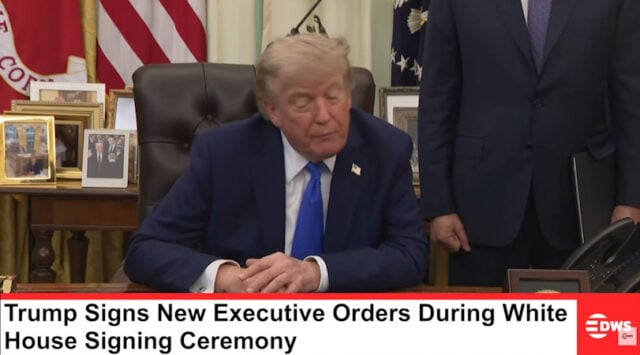
Gathered in the Oval Office for the official signing of new executive orders restricting birthright citizenship, President Donald Trump transformed the ceremonial briefing into a wide-ranging, question-and-answer session with reporters. Flanked by senior aides, including White House Deputy Chief of Staff Stephen Miller, the President signed directives aimed at curbing “birth tourism” and restricting automatic citizenship following a recent Supreme Court ruling. However, the press engagement quickly broadened as reporters pressed the President on U.S. military weapons reserves, ongoing foreign policy regarding Ukraine, national economic strategies, and the pending Senate confirmation of Acting Attorney General Todd Blanche.
Targeting Birthright Citizenship in the Oval Office
The explicit catalyst for the gathering was the execution of two executive orders designed to limit birthright citizenship guarantees under the 14th Amendment. Seated at the Resolute Desk, Trump argued that automatic constitutional citizenship was historically intended solely for the children of freed slaves following the Civil War, rather than temporary visitors or undocumented foreign nationals. “We had a very unfortunate decision in the Supreme Court concerning birthright,” Trump stated, referencing a 6-3 high court ruling that struck down an earlier administration attempt to curtail citizenship guarantees. “So we’re making adjustments.”
The primary order bars entry to foreign visitors suspected of traveling to the United States for the sole purpose of giving birth on American soil—a practice the administration estimates involves hundreds of thousands of individuals annually. The companion directive expands categories of individuals deemed ineligible for automatic citizenship, excluding children born to foreign government officials, foreign lobbyists, and individuals participating in commercial birth tourism transactions. Legal scholars and civil rights organizations immediately signaled plans to challenge the orders in federal court, setting up another high-profile constitutional showdown over executive authority and 14th Amendment interpretation.

Addressing Weapons Supplies and Ukraine Strategy
As reporters seized the opportunity to question the President on broader international developments, the focus turned directly to national security and defense readiness. Pushed on reports of military supply constraints following extensive defense transfers to Ukraine, Trump firmly denied that the U.S. is facing a critical shortage of munitions while acknowledging that domestic stockpiles require immediate industrial replenishment.
Addressing foreign military assistance, Trump reiterated his administration’s position that ongoing support for Ukraine must be weighed against domestic defense posture and domestic industrial capacity. He emphasized that rebuilding American artillery and advanced weapons stockpiles remains an urgent imperative for the Department of Defense. The President asserted that future military aid packages would remain tied to rigorous evaluations of U.S. inventory levels, maintaining that national security interests override open-ended foreign military commitments.
Economic Directives, Energy Policy, and Interest Rates
Between exchanges on legal and foreign affairs, Trump pivoted to the economy, emphasizing his administration’s efforts to lower consumer costs through deregulation and expanded energy production. Speaking from the desk, the President highlighted executive actions aimed at removing regulatory hurdles for domestic oil and natural gas production, framing energy independence as the primary weapon against inflationary pressures.
Trump pointed to recent commitments by major domestic and international manufacturers to build or expand production facilities within the United States as evidence that his trade tariffs and economic policies are succeeding. Additionally, Trump renewed his public pressure on the Federal Reserve to implement sharp interest rate reductions, arguing that lower borrowing costs are necessary to spark commercial investment, support home purchases, and maintain long-term economic momentum.
Defending Todd Blanche Amid Confirmation Battle
The Oval Office session also addressed pressing domestic legal disputes, specifically the nomination battle surrounding Acting Attorney General Todd Blanche. Blanche’s confirmation had stalled in the Senate due to objections from GOP holdouts over a proposed $1.8 billion “Anti-Weaponization Fund” and a controversial IRS tax audit settlement involving Trump family business entities.
Trump vigorously defended Blanche to reporters, describing him as a brilliant legal strategist and urging Senate Republicans to proceed with a final confirmation vote before the upcoming legislative recess. The President noted that Blanche had successfully resolved Republican concerns by providing written commitments to formally drop the proposed fund and clarifying that tax audit protections applied strictly to past claims. Furthermore, Trump endorsed Blanche’s aggressive stance on civil denaturalization, reaffirming Justice Department plans to target foreign nationals who obtained U.S. citizenship through fraudulent means.
Sources Used
- CBS News: Trump issues new executive orders aimed at birthright citizenship after Supreme Court ruling
- The Guardian: Trump signs executive orders in effort to limit US birthright citizenship and target so-called ‘birth tourists’
- Associated Press: Todd Blanche’s nomination for attorney general clears critical hurdle after deal with GOP holdouts
- Associated Press: As Blanche’s path to confirmation is cleared, Trump’s tax audit immunity remains in place
- PBS NewsHour: Fact-checking the Trump administration’s challenges to birthright citizenship
- The White House: Protecting The Meaning And Value Of American Citizenship
Disclaimer
Artificial Intelligence Disclosure & Legal Disclaimer
AI Content Policy.
To provide our readers with timely and comprehensive coverage, South Florida Reporter uses artificial intelligence (AI) to assist in producing certain articles and visual content.
Articles: AI may be used to assist in research, structural drafting, or data analysis. All AI-assisted text is reviewed and edited by our team to ensure accuracy and adherence to our editorial standards.
Images: Any imagery generated or significantly altered by AI is clearly marked with a disclaimer or watermark to distinguish it from traditional photography or editorial illustrations.
General Disclaimer
The information contained in South Florida Reporter is for general information purposes only.
South Florida Reporter assumes no responsibility for errors or omissions in the contents of the Service. In no event shall South Florida Reporter be liable for any special, direct, indirect, consequential, or incidental damages or any damages whatsoever, whether in an action of contract, negligence or other tort, arising out of or in connection with the use of the Service or the contents of the Service.
The Company reserves the right to make additions, deletions, or modifications to the contents of the Service at any time without prior notice. The Company does not warrant that the Service is free of viruses or other harmful components.