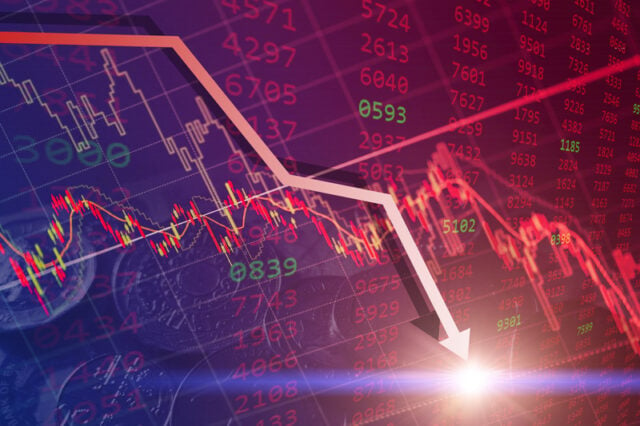
Wall Street endured a brutal reckoning on Friday, November 20, 2026, as technology stocks collapsed. The tech-heavy Nasdaq Composite plunged 1,261.47 points, or 5.28 percent, to close at 22,617.73. That steep drop pushed the index down 2.7 percent for the year. Just six weeks ago, the Nasdaq sat at record highs. Now, it has fallen roughly 16 percent from its October peak.
The broader market fared little better during the worst trading week since April 2025. The S&P 500 sank 3.7 percent on Friday, leaving it up just 0.9 percent for 2026. Meanwhile, the Dow Jones Industrial Average tumbled 949.73 points, or 1.93 percent, to 48,147.33. The Dow now holds a razor-thin 0.2 percent gain for the year. Both the S&P 500 and the Dow officially entered correction territory, falling over 10 percent from recent peaks.
Artificial intelligence companies stood at the center of this historic market reversal. Investors rapidly abandoned high-flying tech names amid growing doubts over long-term AI profitability. Even Anthropic, creator of the Claude chatbot, could not escape the downturn. Anthropic shares fell roughly 9 percent on Friday. That slide marked a sharp reversal from Thursday’s record 81.3 billion initial public offering.
Chipmaking giant Nvidia took an even harder hit from nervous traders. Nvidia shares dropped between 7 and 13 percent on Friday alone. The stock has now lost over 25 percent of its value in just two weeks. Investors remain rattled by the recent downfall and scandal surrounding co-founder and former CEO Jensen Huang. Without its longtime leader, Nvidia faces mounting questions about sustaining its massive data center growth.

The semiconductor selloff quickly spread across the entire hardware ecosystem. Advanced Micro Devices and Broadcom each tumbled roughly 11 percent during Friday’s session. Intel and SpaceX also ranked among the heaviest drags on the Nasdaq. Memory and storage suppliers also took severe hits. SanDisk plunged 15 percent, while Seagate and Western Digital each lost more than 12 percent.
Global markets echoed Wall Street’s panic overnight. In Asia, Japan’s Nikkei and South Korea’s Kospi indexes both sank more than 5 percent. European stock benchmarks followed with sharp declines. Traders worldwide are reassessing whether massive AI infrastructure spending will generate timely returns for corporations.
Energy markets added another layer of stress for equity investors. International benchmark Brent crude rose 0.6 percent on Friday to settle at 92.57 dollars per barrel. Persistent geopolitical conflict continues to keep global oil supplies on edge. The ongoing war between the United States and Iran has heightened security risks near the Strait of Hormuz. On Friday, Saudi Arabia reported fresh missile and drone attacks from Iran-backed Houthi rebels. Elevated energy costs threaten to keep inflation sticky and complicate future interest rate cuts.
Fear gauge readings reflected the sudden shift in Wall Street sentiment. The CBOE Volatility Index, known as the VIX, surged above 32 as tech shares cratered. Rather than selling everything indiscriminately, portfolio managers rotated cash into safer, defensive industries. Consumer staples gained roughly 1.7 percent during the session. Packaged food maker General Mills jumped 4.4 percent, while homebuilder Lennar rose 2.5 percent.
Interestingly, bond markets and everyday consumers reacted more calmly than stock traders. The yield on the benchmark 10-year U.S. Treasury slipped to 4.93 percent from 5.04 percent. Meanwhile, the University of Michigan’s latest consumer sentiment index rose sharply, beating economists’ forecasts. American households welcomed some relief from slightly lower domestic gas prices and post-midterm political clarity. Still, overall consumer confidence remains below levels seen before the Iran conflict began in February.
As NASDAQ SLUMPS INTO NEGATIVE TERRITORY AS AI ROUT AND OIL PRICES RATTLE WALL STREET captures the week’s turmoil, investors face tough choices ahead. Several major Wall Street banks still project an S&P 500 rebound in 2027. However, near-term stability depends heavily on de-escalation in the Middle East and proof of real AI earnings. Until oil prices cool and tech valuations settle, volatility will likely rule the trading floor.
Sources
Disclaimer
Artificial Intelligence Disclosure & Legal Disclaimer
AI Content Policy.
To provide our readers with timely and comprehensive coverage, South Florida Reporter uses artificial intelligence (AI) to assist in producing certain articles and visual content.
Articles: AI may be used to assist in research, structural drafting, or data analysis. All AI-assisted text is reviewed and edited by our team to ensure accuracy and adherence to our editorial standards.
Images: Any imagery generated or significantly altered by AI is clearly marked with a disclaimer or watermark to distinguish it from traditional photography or editorial illustrations.
General Disclaimer
The information contained in South Florida Reporter is for general information purposes only.
South Florida Reporter assumes no responsibility for errors or omissions in the contents of the Service. In no event shall South Florida Reporter be liable for any special, direct, indirect, consequential, or incidental damages or any damages whatsoever, whether in an action of contract, negligence or other tort, arising out of or in connection with the use of the Service or the contents of the Service.
The Company reserves the right to make additions, deletions, or modifications to the contents of the Service at any time without prior notice. The Company does not warrant that the Service is free of viruses or other harmful components.