By Christopher J. Phillips, Carnegie Mellon University
Baseballs are charismatic objects. It is no accident that the narrative spine of novelist Don DeLillo’s magnum opus of 20th-century American life, “Underworld,” involves the ownership of the baseball from the “shot heard ’round the world” – the ninth-inning home run New York Giants slugger Bobby Thomson hit to beat the Brooklyn Dodgers for the 1951 National League pennant. A lot of Americana has been projected onto the surface of a baseball.
But the surface of a baseball is not typically a canvas. The 26 or so square inches of area, created when two pieces of leather are connected with 108 red stitches, are awkward surfaces on which to draw. And most of the time, the only thing people want drawn on baseballs is a signature from an admired player.
But that’s not how George Sosnak saw them.

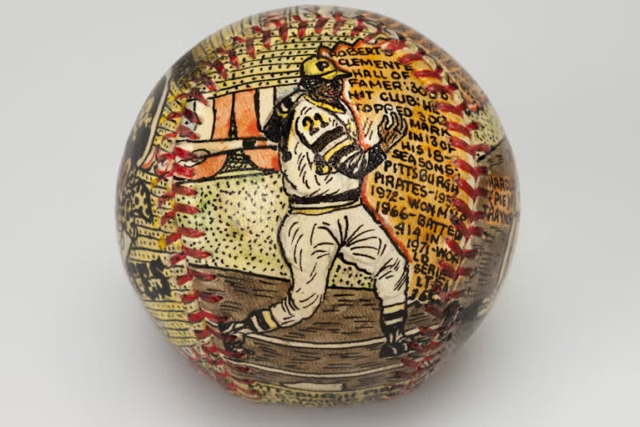
Born in Pittsburgh in 1924, Sosnak worked as a minor league umpire starting in his 30s, but he became better known as a self-taught artist over the subsequent four decades. Each baseball offered Sosnak at least four spaces to fill with images of players, team insignia or text recounting playing statistics or triumphs, all meticulously rendered in India ink.
An ongoing exhibit at the Westmoreland Museum of American Art features over 60 of the approximately 800 balls he finished painting in his lifetime – he began painting nearly 3,000 balls.

Ed Pollard/Chrysler Museum of Art
Sosnak’s creations are often colorful, depicting players in action, with facts about them or their games written alongside. Many of the baseballs function as miniature stories, a spherical, secular altarpiece that tells the story of a key game or season.
His “Pittsburgh Pirates, 1978” ball features Harold “Pie” Traynor, Bill Mazeroski and Roberto Clemente.
Traynor and Clemente had both died in 1972, the year Mazeroski retired, and the three never played on a single team together. Depicting three of Sosnak’s most legendary hometown Pirates together created a kind of pantheon, with the timeless image of Clemente finishing his swing juxtaposed with the specific moment Mazeroski raised his hat while circling the bases after hitting the home run that won the 1960 World Series.
Sosnak’s scenes often involve these juxtapositions, using the raised seams and the uneven leather strips to both separate and connect moments for artistic effect. He even depicted something other than baseball itself on the balls, including other sports. But his main focus was on using the spherical leather canvas to memorialize the moments and people that mattered to Sosnak – and to fellow fans who commissioned the balls. He often used such detail – spectators in Forbes Field represented by tiny ink dashes – that magnifying glasses are required to fully appreciate the nuances.
Sosnak linked the American folk art tradition with the talismanic nature of an actual baseball. Unlike the case in most other professional sports, some fans come away from baseball games with balls as souvenirs — whether they were hit as home runs or foul balls, or just tossed into the crowd by players.
Baseballs are disposable – most balls last only a few pitches, so around 100 balls are used in every professional game – and yet they become treasured relics when caught. Sosnak’s painted balls combine these tensions: You can hold one in your hand, visualizing its past while touching the otherwise disposable object that was imparted meaning only through the triumph.
Christopher J. Phillips, Professor of History, Carnegie Mellon University
This article is republished from The Conversation under a Creative Commons license. Read the original article.
Disclaimer
Artificial Intelligence Disclosure & Legal Disclaimer
AI Content Policy.
To provide our readers with timely and comprehensive coverage, South Florida Reporter uses artificial intelligence (AI) to assist in producing certain articles and visual content.
Articles: AI may be used to assist in research, structural drafting, or data analysis. All AI-assisted text is reviewed and edited by our team to ensure accuracy and adherence to our editorial standards.
Images: Any imagery generated or significantly altered by AI is clearly marked with a disclaimer or watermark to distinguish it from traditional photography or editorial illustrations.
General Disclaimer
The information contained in South Florida Reporter is for general information purposes only.
South Florida Reporter assumes no responsibility for errors or omissions in the contents of the Service. In no event shall South Florida Reporter be liable for any special, direct, indirect, consequential, or incidental damages or any damages whatsoever, whether in an action of contract, negligence or other tort, arising out of or in connection with the use of the Service or the contents of the Service.
The Company reserves the right to make additions, deletions, or modifications to the contents of the Service at any time without prior notice. The Company does not warrant that the Service is free of viruses or other harmful components.