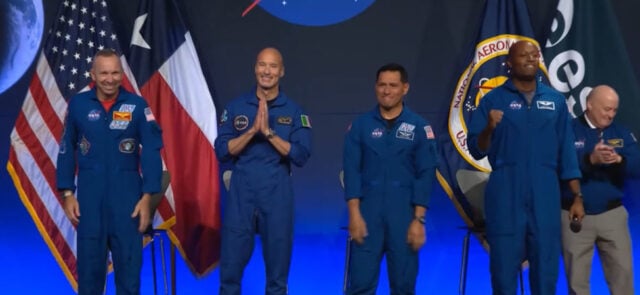
The path back to the Moon has taken a definitive, highly choreographed detour through low Earth orbit. In a major press event on June 9, 2026, broadcast from the Johnson Space Center in Houston, Texas, NASA announced the official assignment of the four-member prime crew for Artemis 3, alongside structural and logistical overhauls that fundamentally shift the mission’s design.
Once envisioned as the monumental return of American astronauts to the lunar surface for the first time since 1972, Artemis 3 has been formally rescoped. Under the updated directives championed by NASA Administrator Jared Isaacman, the mission is now structured as an intensive, Earth-orbit risk-reduction flight scheduled for late 2027. It will serve as the final technological gatekeeper before crewed surface landings commence on Artemis 4 and Artemis 5 in 2028.
By choosing to thoroughly evaluate vehicle integration, complex docking procedures, and life support systems closer to home, NASA aims to secure a more frequent, repeatable launch cadence. This historic announcement marks a vital transition from exploratory milestones to an integrated, multi-partner orbital campaign.
The Flight Crew: Leadership, Alliances, and Deep-Space Veteran Expertise
The centerpiece of NASA’s announcement was the unveiling of the prime crew tasked with piloting this revised, high-fidelity test flight. The four-way assignment mirrors the geopolitical strategy and corporate-public synthesis defining modern space exploration.

Artemis 3 Prime Crew Configuration
├── Commander: Randy Bresnik (NASA)
├── Pilot: Luca Parmitano (ESA)
├── Mission Specialist: Andre Douglas (NASA)
└── Mission Specialist: Frank Rubio (NASA)
* Backup Crew Member: Bob Hines (NASA)
Commander Randy Bresnik (NASA)
A veteran of both the Space Shuttle program and long-duration expeditions aboard the International Space Station (ISS), Bresnik brings extensive operational command experience to the cockpit of the Orion spacecraft. His leadership will be vital in orchestrating the dense timeline of proximity operations and unexpected docking variables.
Pilot Luca Parmitano (ESA)
Representing the European Space Agency, Parmitano’s inclusion solidifies the international coalition vital to the long-term sustainability of the Artemis program. An experienced military test pilot and former ISS commander, Parmitano is celebrated for his spacewalking execution and cool handling of critical on-orbit contingencies.
Mission Specialist Andre Douglas (NASA)
A systems engineer and coast guard veteran selected in NASA’s 2021 astronaut cohort, Douglas provides essential technical acumen to the crew. His background in mechanical design and maritime system failures maps directly to the intricate, hands-on mechanical evaluation required during the mission’s dual-lander integration.
Mission Specialist Frank Rubio (NASA)
Rubio enters the crew possessing a historic asset: the American record for the single longest continuous spaceflight, totaling 371 days in orbit. His deep personal familiarity with extended microgravity environments will aid the crew as they spend a significantly prolonged duration inside the Orion capsule compared to previous test flights.
Anatomy of a Redesign: Why NASA Rescoped Artemis 3
The programmatic shift away from a lunar landing on Artemis 3 stems from engineering realities and supply chain considerations. Originally targeting 2024 under aggressive timelines, development bottlenecks involving commercial landing vehicles and advanced spacesuits forced a realistic restructuring of the flight order.
Rather than waiting for every parallel element to reach complete structural maturity simultaneously—which risked keeping the Space Launch System (SLS) rocket and Orion capsule grounded for years—NASA elected to fly an incremental, high-value dress rehearsal.
The Apollo 9 Parallel: Space historians quickly noted that the new architecture for Artemis 3 mirrors the legacy of Apollo 9. In March 1969, Apollo 9 astronauts bypassed a journey to the Moon to thoroughly test the unproven Lunar Module in Earth orbit. That critical trial cleared the programmatic hurdles that eventually allowed Apollo 11 to land safely four months later.
By executing Artemis 3 in low Earth orbit, NASA eliminates the massive risks associated with lunar orbital insertions and deep-space communication delays while focusing intensely on the weakest links in the current infrastructure: complex vehicle rendezvous and private-public software interoperability.
The Flight Manifest: Launch, Docking, and Orbital Operations
Scheduled to lift off from Launch Complex 39B at the Kennedy Space Center in Florida in late 2027, Artemis 3 will feature a packed, highly complex operations manifest.
Artemis 3 Mission Progression
[SLS Super Heavy Lift] ──> [463 km Low Earth Orbit] ──> [Rendezvous & Interoperability Tests] ──> [Upgraded Heat Shield Reentry]
Launch Vehicle Modifications
The mission will utilize the standard core stage of the Space Launch System, powered by four refurbished RS-25 engines manufactured and verified at the Stennis Space Center. However, in a surprise logistics shift announced in May 2026, NASA will omit the standard Interim Cryogenic Propulsion Stage (ICPS) from this flight. To preserve the agency’s sole remaining ICPS for the deep-space needs of Artemis 4, engineers at the Marshall Space Flight Center are constructing a specialized structural “spacer.” This inert component matches the aerodynamic and spatial dimensions of the upper stage without its heavy, expensive propulsive hardware.
Dual-Lander Proximity Operations
Once Orion establishes its 463-kilometer (250 nautical mile) low Earth orbit, the core objectives begin. The crew will attempt to rendezvous and dock with test variants of the program’s two commercially sourced Human Landing Systems (HLS): SpaceX’s Starship HLS and Blue Origin’s Blue Moon Mark 1 variant.
Both vehicles will be launched independently via commercial heavy-lift rockets prior to Orion’s arrival. Over several days, Bresnik and his crew will test physical docking rings, data transfer lines, and communications arrays across both vehicles. NASA officials noted that while procedures are not entirely finalized, the crew is expected to physically enter at least one of the lander test articles to evaluate internal life support and habitation spaces under live orbital conditions.
Commercial Lunar Lander Interoperability
├── SpaceX Starship HLS: High-volume orbital propellant transfer testing
└── Blue Origin Blue Moon (Mk 1): Cryogenic fluid management and physical interface validation
Advanced Suit and Reentry Testing
Beyond vehicle tracking and docking, the crew will put Axiom Space’s new Extravehicular Mobility Unit (AxEMU) suits through rigorous cabin pressurized testing. This ensures the customized interfaces co-developed with fashion house Prada function seamlessly within Orion’s native environmental controls.
The mission concludes with a high-velocity atmospheric reentry. This profile is engineered specifically to test a newly upgraded, high-durability ablative heat shield designed to address the uneven erosion patterns identified during the uncrewed Artemis 1 return in 2022.
Industrial Partnerships and Congressional Scrutiny
The reorganization of the Artemis timeline represents a calculated bet by NASA’s leadership to hold private commercial contractors to strict accountability metrics while keeping the overall program on a firm financial footing. During an April 27, 2026 hearing before the House Appropriations Committee, NASA Administrator Jared Isaacman faced aggressive questioning regarding the White House’s $2.8 billion budget request dedicated exclusively to the Artemis Human Landing System contracts.
Isaacman clarified to lawmakers that the revamped late-2027 flight path offers a more realistic, achievable approach to space exploration. By verifying the interoperability of SpaceX and Blue Origin hardware in Earth orbit first, NASA creates a competitive, dual-source environment that forces both vendors to accelerate development ahead of the 2028 landing window. This mitigation strategy minimizes costly structural changes down the road, ensuring that when American boots finally touch down at the lunar South Pole during Artemis 4, the hardware will have been fully vetted by human hands in orbit.
Charting the Path to 2028 and Beyond
The assignment of Bresnik, Parmitano, Douglas, and Rubio infuses the Artemis program with fresh momentum, clarifying the immediate trajectory of human spaceflight. By shortening the operational gaps between missions—moving away from the multi-year delays that plagued the transition between Artemis 1 and Artemis 2—NASA is rebuilding the industrial muscle memory required to operate heavy-lift launch campaigns with high frequency.
The restructured timeline positions the global aerospace community for an extraordinarily dense window of exploration. If the Earth-orbit trials of Artemis 3 succeed in late 2027, the agency remains firmly positioned to execute a crewed lunar landing via Artemis 4 in early 2028, closely followed by the establishment of the foundational infrastructure for a permanent Moon base during Artemis V in late 2028. For the newly minted crew of Artemis 3, the training regimen begins immediately, carrying the weight of an international coalition eager to prove that humanity is not just visiting space, but learning to live there.
Sources and Links:
- National Aeronautics and Space Administration (NASA): NASA Marches Toward Artemis III Mission in 2027, Names Crew Members https://www.nasa.gov/news-release/nasa-marches-toward-artemis-iii-mission-in-2027-names-crew-members/
- National Aeronautics and Space Administration (NASA): NASA Outlines Preliminary Artemis III Mission Plans https://www.nasa.gov/missions/artemis/artemis-3/nasa-outlines-preliminary-artemis-iii-mission-plans/
- Space.com: Artemis 3 has been pushed to late 2027. Can NASA still land astronauts on the moon in 2028? https://www.space.com/space-exploration/artemis/artemis-3-has-been-pushed-to-late-2027-can-nasa-still-land-astronauts-on-the-moon-in-2028
- Wikipedia: Artemis III https://en.wikipedia.org/wiki/Artemis_III
Disclaimer
Artificial Intelligence Disclosure & Legal Disclaimer
AI Content Policy.
To provide our readers with timely and comprehensive coverage, South Florida Reporter uses artificial intelligence (AI) to assist in producing certain articles and visual content.
Articles: AI may be used to assist in research, structural drafting, or data analysis. All AI-assisted text is reviewed and edited by our team to ensure accuracy and adherence to our editorial standards.
Images: Any imagery generated or significantly altered by AI is clearly marked with a disclaimer or watermark to distinguish it from traditional photography or editorial illustrations.
General Disclaimer
The information contained in South Florida Reporter is for general information purposes only.
South Florida Reporter assumes no responsibility for errors or omissions in the contents of the Service. In no event shall South Florida Reporter be liable for any special, direct, indirect, consequential, or incidental damages or any damages whatsoever, whether in an action of contract, negligence or other tort, arising out of or in connection with the use of the Service or the contents of the Service.
The Company reserves the right to make additions, deletions, or modifications to the contents of the Service at any time without prior notice. The Company does not warrant that the Service is free of viruses or other harmful components.