Necessity, Survival, and the Inventions Born from Extreme Heat
When summer temperatures climb past triple digits, we rarely stop to think about the clever engineering humming away in our windows, ceilings, or refrigerators. But humans haven’t always had the luxury of a thermostat dial or an automatic ice dispenser. As Quartz aptly observes, “Heat has killed people throughout history in ways that cold rarely does: quietly, cumulatively, without the dramatic urgency of a blizzard or a flood.” That invisible, compounding danger is precisely why so many cooling breakthroughs emerged from sheer necessity rather than consumer luxury. As the publication points out, “so many of the inventions born from extreme heat came out of desperation rather than convenience.”
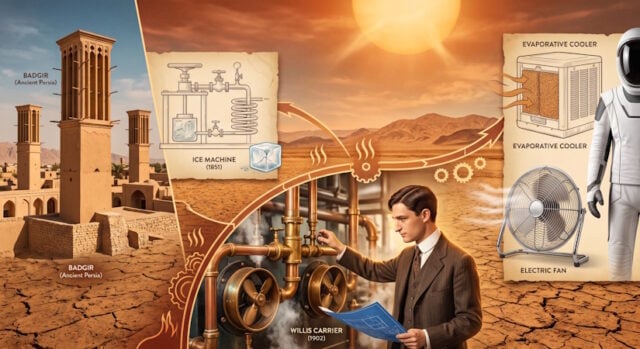
Take modern air conditioning, for instance. In 1902, a young engineer named Willis Carrier was not trying to create a beloved household amenity or rescue sweaty city dwellers. Instead, he was tasked with solving a stubborn humidity issue at the Sackett & Wilhelms printing plant in Brooklyn, New York, where damp air continually warped paper sheets and smeared ink on the presses. By passing air over chilled coils to wring out excess moisture, Carrier inadvertently invented modern climate control. As Quartz explains, “The technology Carrier built eventually became the single most important tool for surviving extreme heat that exists today.” What began as an industrial fix for paper soon spread to movie theaters in the 1920s, ultimately reshaping architecture and public health across the globe.
Half a century earlier, in Apalachicola, Florida, a physician engineered artificial ice out of pure medical urgency. Dr. John Gorrie watched yellow fever ravage his community in 1841 and realized that suffocating summer heat made his patients’ suffering far worse. Relying on erratic, expensive shipments of natural pond ice shipped from New England was completely unsustainable. In response, Gorrie designed a mechanical compressor in 1851 that expanded cooled air to freeze water on-site. While skeptics mocked his machine at the time, his innovative compression-expansion cycle became the operational cornerstone for nearly all modern refrigeration.
Long before electricity, ancient societies devised brilliant passive cooling methods to outsmart scorching climates. In arid Persian cities like Yazd, builders constructed towering rooftop shafts called badgirs, or windcatchers. These structures captured high-altitude breezes, funneled them downward across subterranean water channels, and dropped indoor temperatures by up to 18 degrees Fahrenheit without consuming any fuel or power. Similarly, the evaporative “swamp cooler” that became a staple of the American Southwest evolved from ancient Egyptian techniques that used wet pads and evaporation to draw out ambient heat.

Whether examining Persian towers, 19th-century ice makers, or space-age cooling suits, every heat innovation shares a common root. As Quartz concludes, “What ties these 10 together is not geography or era but the same basic engineering challenge. How does a body, a building, or a machine shed heat fast enough to keep functioning?” As heat waves grow longer and more severe worldwide, these historic breakthroughs remind us how much of our everyday comfort began as an urgent fight for survival.
Sources Used
- Quartz: 10 inventions that came out of trying to survive extreme heat by Cris Tolomia
Disclaimer
Artificial Intelligence Disclosure & Legal Disclaimer
AI Content Policy.
To provide our readers with timely and comprehensive coverage, South Florida Reporter uses artificial intelligence (AI) to assist in producing certain articles and visual content.
Articles: AI may be used to assist in research, structural drafting, or data analysis. All AI-assisted text is reviewed and edited by our team to ensure accuracy and adherence to our editorial standards.
Images: Any imagery generated or significantly altered by AI is clearly marked with a disclaimer or watermark to distinguish it from traditional photography or editorial illustrations.
General Disclaimer
The information contained in South Florida Reporter is for general information purposes only.
South Florida Reporter assumes no responsibility for errors or omissions in the contents of the Service. In no event shall South Florida Reporter be liable for any special, direct, indirect, consequential, or incidental damages or any damages whatsoever, whether in an action of contract, negligence or other tort, arising out of or in connection with the use of the Service or the contents of the Service.
The Company reserves the right to make additions, deletions, or modifications to the contents of the Service at any time without prior notice. The Company does not warrant that the Service is free of viruses or other harmful components.