For years, a frustrating legal wall stood between Medicare beneficiaries and the country’s most sought-after medications. If you had type 2 diabetes, Medicare Part D would cheerfully help pay for your GLP-1 drugs like Ozempic or Mounjaro. But if you were struggling with severe obesity and needed the exact same types of medication under their weight-loss brand names—like Wegovy or Zepbound—federal law forced Medicare to look the other way.
That wall is officially coming down.
Starting July 1, 2026, the Centers for Medicare & Medicaid Services (CMS) is launching a massive initiative called the Medicare GLP-1 Bridge Program. This temporary, 18-month demonstration program sidesteps old statutory restrictions to offer eligible seniors direct access to blockbuster weight-loss medications for a flat $50 monthly copay.
For millions of older adults who have been staring down out-of-pocket costs of $1,000 to $1,350 every single month, this shift isn’t just a minor policy update—it is an absolute game-changer for senior healthcare.

Why Medicare is Suddenly Changing Its Mind
To understand why this is happening now, you have to look at how much the medical landscape has shifted. When Congress designed the Medicare Part D prescription drug benefit back in 2003, weight-loss drugs were legally classified as “excluded drugs.” Back then, Washington viewed weight management largely as a cosmetic issue, grouping lifestyle treatments alongside hair-growth serums and cosmetic surgeries.
Flash forward to 2026, and the clinical consensus has completely flipped. Obesity is now recognized as a complex, chronic metabolic disease that acts as a gateway to heart failure, strokes, kidney disease, and severe joint degradation.
By leveraging its immense purchasing power, Medicare managed to negotiate a staggering 82% to 96% discount with pharmaceutical giants Novo Nordisk and Eli Lilly. Instead of the massive retail prices consumers usually face, Medicare secured a net price of just $245 per 30-day supply for the drugs in this program.
The financial logic for Uncle Sam is simple: paying a couple of hundred dollars a month for a preventative weight-management drug is vastly cheaper than paying tens of thousands of dollars later for emergency heart surgeries, stroke rehabilitation, or chronic dialysis. In fact, the Congressional Budget Office projects that expanding this coverage could save the healthcare system $3.4 billion by 2034 by drastically reducing obesity-related emergency room visits and hospitalizations.
What Drugs Are on the Approved List?
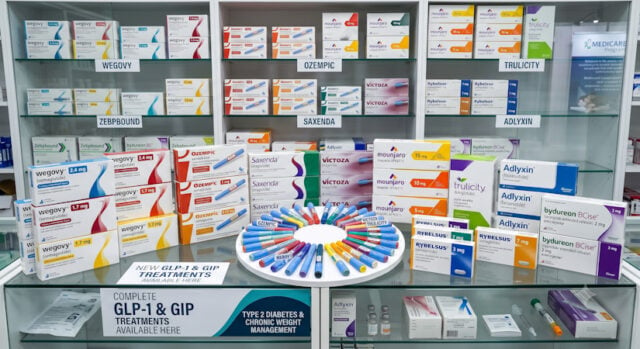
The Medicare GLP-1 Bridge Program doesn’t open the floodgates to every single anti-obesity medication on the market, but it covers the heavy hitters. Starting July 1, 2026, eligible seniors can get coverage for three specific FDA-approved weight-loss medications:
- Wegovy® (semaglutide): Available in both its traditional once-weekly injection and the newer tablet formulations.
- Zepbound® (tirzepatide): Covered strictly in its KwikPen® multi-dose formulation (note that single-dose vials or standard single-dose pens are excluded from the Bridge benefit).
- Foundayo®: A newly approved alternative added to the Medicare list for chronic weight management.
Important Detail: If you are currently taking medications like Ozempic, Mounjaro, Rybelsus, or Trulicity for type 2 diabetes, nothing changes for you. You will continue to get your prescriptions filled directly through your standard Medicare Part D plan. The Bridge program exists strictly to catch the people who were previously left out in the cold because their primary diagnosis was weight reduction rather than diabetes.
Do You Qualify? Cracking the Eligibility Code
Because these medications are in incredibly high demand and the program represents a major federal expenditure, CMS isn’t handing them out without strict guardrails. To qualify for the $50 monthly copay, you must be 18 or older, be actively enrolled in a Medicare Part D plan (either a standalone prescription plan or a Medicare Advantage plan that includes drug coverage), and meet specific clinical tiers based on your Body Mass Index (BMI):
| Tier | BMI Requirement | Required Co-occurring Health Conditions |
| Tier 1 | BMI of 35 or higher | None. You qualify based on weight criteria alone. |
| Tier 2 | BMI of 30 to 34.99 | At least one qualifying condition: uncontrolled high blood pressure, diastolic heart failure, or stage 3a (or higher) chronic kidney disease. |
| Tier 3 | BMI of 27 to 29.99 | At least one severe condition: prediabetes, a documented history of a heart attack or stroke, or symptomatic peripheral artery disease (blocked leg/arm arteries). |
Additionally, there are a few strict disqualifiers. You cannot jump into the Bridge program if you already have type 2 diabetes, moderate-to-severe sleep apnea, or fatty liver disease. If you have any of those three conditions, you are ineligible for the Bridge because your standard Medicare Part D plan is already legally allowed to cover GLP-1 medications for those specific diagnoses. Furthermore, to keep the program focused on expanding access to those who truly need it, you cannot have filled a GLP-1 prescription through your standard Part D plan at any point earlier in 2026.
The Fine Print: How the “Bridge” Actually Works
Because of the old federal laws banning weight-loss drug coverage, CMS had to get creative to make this happen. The Bridge program actually operates entirely outside of the standard Medicare Part D insurance system. Instead of your private insurance company handling the money, Medicare is using a centralized federal processor to manage the paperwork, handle prior authorizations, and pay local pharmacies directly.
This unique setup creates a few quirky financial rules that you need to watch out for:
- The $50 Doesn’t Count Toward Your Cap: In 2026, Medicare Part D introduced a historic $2,100 annual out-of-pocket cap for covered medications. However, because the GLP-1 Bridge runs on a separate track, your $50 monthly copays will not count toward that $2,100 limit, nor will they count toward any standard insurance deductibles.
- No Extra Help or Coupons Allowed: Financial assistance programs like Medicare’s “Extra Help” cannot be applied to the Bridge program. Manufacturer discount coupons are also barred. Everyone in the program pays the exact same flat $50 bill, regardless of their income level.
- Doctor Homework is Required: Your doctor can’t just hand you a paper slip to take to the pharmacy. Your healthcare provider must electronically submit a detailed prior authorization request to the central federal processor. In that paperwork, your doctor must officially certify your BMI, document your relevant medical history, and verify that you are taking the drug as part of an active lifestyle program that includes diet and exercise.
Looking Ahead: What Happens After the Bridge?
The Medicare GLP-1 Bridge Program is designed to run from July 1, 2026, through December 31, 2027. Think of it as a massive, real-world test run. Originally, CMS planned to hand the reins over to a long-term insurance model called the BALANCE Model in 2027, which would have integrated weight-loss coverage directly into regular Part D plans. However, officials recently delayed the BALANCE model indefinitely to gather more data.
For now, your approved prior authorization will protect your coverage all the way through the end of 2027. This gives Uncle Sam 18 months to study exactly how many of the estimated 3.8 million eligible seniors enroll, how well they stick to their treatments, and how much money the healthcare system saves on cardiovascular events in the process.
If you think you meet the criteria, your best move right now is to schedule a chat with your primary care doctor. Once the program goes live this July, having your clinical documentation and BMI history ready to send to the central processor will be your ticket to bypassing the old weight-loss wall and securing a vital tool for long-term health.
Sources and Links:
- Centers for Medicare & Medicaid Services (CMS): Information for Part D Plans – Medicare GLP-1 Bridge
- Medicare.gov (Official Government Publication): Medicare GLP-1 Bridge: GLP-1 Drugs for $50 a Month (Product No. 12234)
- Medicare Rights Center: GLP-1 Weight-Loss Drug Demonstration Begins July 2026
- KFF (Kaiser Family Foundation) Health Policy Analysis: Nearly Four Million Medicare Beneficiaries Could Be Eligible for the Temporary Medicare GLP-1 Bridge Program
- AmeriLife Insurance Insights: Medicare Weight Loss Drugs: 2026 Coverage Guide
- Humana Medicare Resources: Does Medicare Cover GLP-1 Weight Loss Drugs?
Disclaimer
Artificial Intelligence Disclosure & Legal Disclaimer
AI Content Policy.
To provide our readers with timely and comprehensive coverage, South Florida Reporter uses artificial intelligence (AI) to assist in producing certain articles and visual content.
Articles: AI may be used to assist in research, structural drafting, or data analysis. All AI-assisted text is reviewed and edited by our team to ensure accuracy and adherence to our editorial standards.
Images: Any imagery generated or significantly altered by AI is clearly marked with a disclaimer or watermark to distinguish it from traditional photography or editorial illustrations.
General Disclaimer
The information contained in South Florida Reporter is for general information purposes only.
South Florida Reporter assumes no responsibility for errors or omissions in the contents of the Service. In no event shall South Florida Reporter be liable for any special, direct, indirect, consequential, or incidental damages or any damages whatsoever, whether in an action of contract, negligence or other tort, arising out of or in connection with the use of the Service or the contents of the Service.
The Company reserves the right to make additions, deletions, or modifications to the contents of the Service at any time without prior notice. The Company does not warrant that the Service is free of viruses or other harmful components.