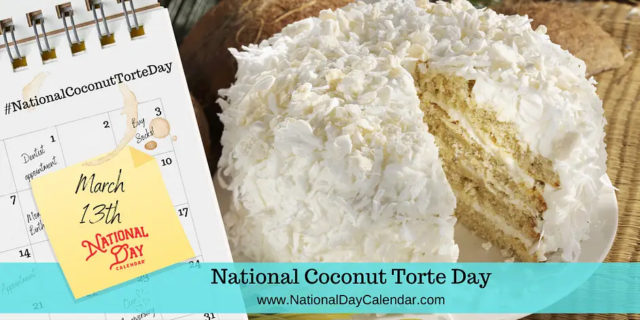
National Coconut Torte Day on March 13th recognizes a rich dessert featuring the decadent flavor of coconut and decorated with it, too! Coconut lovers may enjoy this holiday savoring the delicious taste of this rich dessert.
- The word torte is German and literally means cake.
- Torte refers to both a multi-layered cake filled with buttercream, jam, or cream and to a rich, moist and dense single-layered cake. A torte may be made with little to no flour, but instead with ground nuts or breadcrumbs, as well as sugar, eggs, and flavorings.
- Did you know that a coconut tree can grow to be as tall as ninety feet?
- Coconuts were available in the United States in the early 1700s even though the palm was not indigenous to the continental United States.
- There are many recipes using coconut, including cakes, cookies, and tortes from that era, so it was certainly as popular an ingredient as it is today.
- Coconut is rich in fiber, Vitamin B6, iron, and minerals like magnesium, manganese, phosphorus, selenium, and zinc.
- The oil from coconut moisturizes our skin and also helps keep our skin clear and hair silky, too.
- The first kind of torte to exist was the Linzer Torte, made from an almond shortcrust pastry and filled with red currant jelly.
- Claiming its fame from Linz, Austria, it’s known as the oldest known-cake in the world, originally believed to have begun during the 1600s from Vienna Stadt und Landesbibliothek.
- Coconuts, on the other hand, may have been around a lot longer than people would think, originally being traded by Arab traders carrying coconuts from India to East Africa almost 2,000 years ago.
- These same traders also introduced the coconut to Europeans among the Asian Silk Roads, one of the more famous being Marco Polo, who called the coconut “The Pharaoh’s Nut” in the 13th century.
- It didn’t earn its name until the 16th century as it was similar to the Portuguese word cocuruto, which means “crown of the head”, as it looked like a person’s skull.
- Until the 19th century, many used the coconut as decorations and food, believing it had magical healing powers,
- The idea of a coconut cake came to surface in the 1920s and was served at ladies gatherings, and from there, people began to experiment with coconut, and thus eventually created the coconut torte.
- Tortes are commonly baked in a spring form pan.
- The most well-known of the typical tortes include the Austrian Sacher torte.
- Sacher Torte, is a chocolate cake filled with apricot jam and covered with chocolate icing. It was created in Vienna in 1832 by a 16-year-old apprentice baker named Franz Sacher for Prince Metternich.
- Recipes similar to that of the Sacher torte appeared as early as the eighteenth century, one instance being in the 1718 cookbook of Conrad Hagger.
- Coconuts are Not Nuts. “Coconuts are drupes, which is a fleshy fruit with thin skin and a central stone containing the seed,” says Len Monheit, executive director of the Coconut Coalition of the Americas
- Coconuts contain a high amount of dietary fiber, as well as protein and many essential minerals, such as manganese, copper, iron and selenium, making them a beneficial health food you can feel good about feeding your family.
- Coconuts are used in oils, flour, water, non-dairy milk, snacks and more
- After drying, the meat of the coconut, its called “copra.”
- There are 280 calories per cup of coconut.
- Makapuno, which is cultivated in the Philippines, is the costliest coconut.
- Smashing a coconut in Hindu mythology symbolizes getting rid of ego.
Sources:

Disclaimer
Artificial Intelligence Disclosure & Legal Disclaimer
AI Content Policy.
To provide our readers with timely and comprehensive coverage, South Florida Reporter uses artificial intelligence (AI) to assist in producing certain articles and visual content.
Articles: AI may be used to assist in research, structural drafting, or data analysis. All AI-assisted text is reviewed and edited by our team to ensure accuracy and adherence to our editorial standards.
Images: Any imagery generated or significantly altered by AI is clearly marked with a disclaimer or watermark to distinguish it from traditional photography or editorial illustrations.
General Disclaimer
The information contained in South Florida Reporter is for general information purposes only.
South Florida Reporter assumes no responsibility for errors or omissions in the contents of the Service. In no event shall South Florida Reporter be liable for any special, direct, indirect, consequential, or incidental damages or any damages whatsoever, whether in an action of contract, negligence or other tort, arising out of or in connection with the use of the Service or the contents of the Service.
The Company reserves the right to make additions, deletions, or modifications to the contents of the Service at any time without prior notice. The Company does not warrant that the Service is free of viruses or other harmful components.