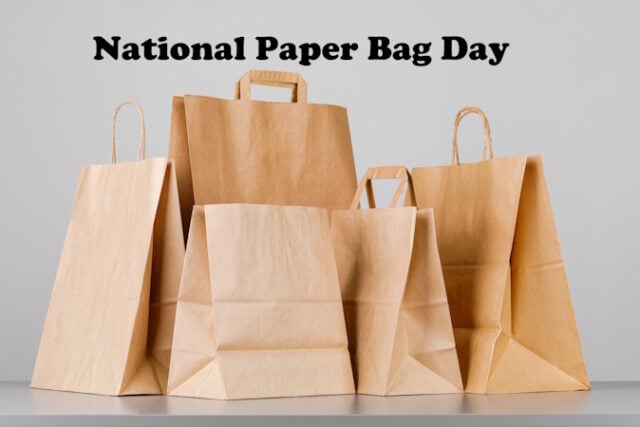
Each July 12th, we recognize the significance of an invention that we take for granted on Paper Bag Day. Millions of people use paper bags every day. Readily recyclable, paper bags have been around for many years.
- 1844 – In Bristol, England, paper bags are manufactured commercially.
- 1852 – Francis Wolle of Bethlehem, Pennsylvania, invents the first machine that makes the archetype of the modern-day paper bag.
- 1867 – Luther Childs Crowell patents a machine that makes square-bottomed paper bags.
- 1870 – Margaret Knight is granted a patent for her paper bag machine, which also makes square-bottomed bags with the cut.
- Help reduce anxiety when hyperventilating – Cover your nose and mouth with the open end of the paper sack and fill the bag with your breath. Breathe in and out until your breathing returns to normal.
- Serve popcorn – When making a large amount of popcorn for a group, serve popcorn in small-sized paper bags. The paper bags also absorb any oil used to season the popcorn so the treat will be less messy.
- Arts and crafts – Paper bags make great puppets, masks, and windsocks. Get decorating with your kids and have fun while doing it, too!
- Gift bags – Recycle and make gift bags. Whether you give homebaked goodies or another thoughtful gift, your gift bag may steal the show.
- Ripen fruit – Don’t wait for green fruit to ripen. Put it in a paper bag and fold the top. This traps the ethylene gas given off by the fruit, which helps it to mature. Want them to ripen even faster? Put an apple in there, too.
- Paper bags are almost 100% recyclable and can decompose within just a month.
- A paper bag can hold around 10-14 items and is quite sturdy.
- It takes less energy to manufacture paper bags than plastic bags.
- Paper bags are safer for pets and other animals.
- Plastic bags are made from petroleum. We use an estimated 12 million barrels of oil each year in the United States alone!
- A trillion plastic bags are used around the world each year.
- The average Australian uses 170 plastic bags every year. 150 million of these end up as litter, only 3% of them are currently being recycled and 200,000 bags are dumped in landfills every hour.
- In China, 3 billion single-use plastic bags are used every day.
- Worldwide, about 2 million plastic bags are used every minute.
- The average time a plastic bag is used is… 12 minutes.
- When paper bags were first made, their size was measured by how many bags of sugar they could hold.
- About 14 grocery items fit in a standard paper bag, whereas a plastic bag holds only about 10.
- Plastic bags are recycled only 1% of the time, whereas Paper Bags are recycled 20% more often than standard poly bags.
- Over 44% of all seabirds have ingested or become entangled in plastic
Sources:
1 Million Women

Pico Bags
Disclaimer
Artificial Intelligence Disclosure & Legal Disclaimer
AI Content Policy.
To provide our readers with timely and comprehensive coverage, South Florida Reporter uses artificial intelligence (AI) to assist in producing certain articles and visual content.
Articles: AI may be used to assist in research, structural drafting, or data analysis. All AI-assisted text is reviewed and edited by our team to ensure accuracy and adherence to our editorial standards.
Images: Any imagery generated or significantly altered by AI is clearly marked with a disclaimer or watermark to distinguish it from traditional photography or editorial illustrations.
General Disclaimer
The information contained in South Florida Reporter is for general information purposes only.
South Florida Reporter assumes no responsibility for errors or omissions in the contents of the Service. In no event shall South Florida Reporter be liable for any special, direct, indirect, consequential, or incidental damages or any damages whatsoever, whether in an action of contract, negligence or other tort, arising out of or in connection with the use of the Service or the contents of the Service.
The Company reserves the right to make additions, deletions, or modifications to the contents of the Service at any time without prior notice. The Company does not warrant that the Service is free of viruses or other harmful components.