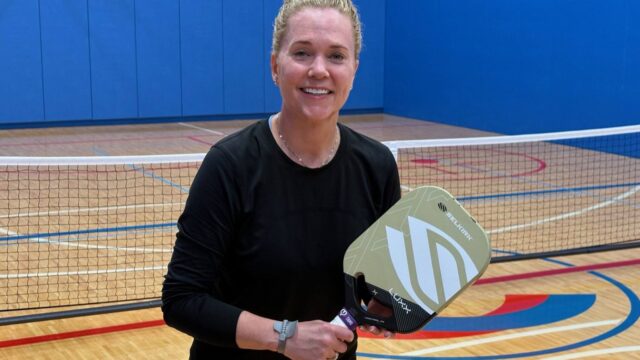
For years, a lifelong athlete was sidelined by chronic wrist pain that took more than just her ability to compete — it took a part of her identity. Now, thanks to an innovative surgical approach at Mayo Clinic, a Minnesota woman is back on the court, returning to the game that means so much to her.
“Being an athlete has always been a part of my life,” says Tami Lucius.

A former college basketball player, the 54-year-old from White Bear Lake, Minnesota, also loved playing tennis. But devastating wrist pain kept her off the court for two decades.
“I didn’t know what it was, but it was always on the outside of my wrist,” she says. “I really had a sense of loss with my life and with that sense of community from not being able to be in sports. And then a girlfriend of mine from high school, out of the blue, said, ‘Hey, come and play pickle with me.’ I knew pickleball was something that I was going to love.”
But unfortunately, almost immediately, Tami’s wrist pain returned.
“It got so bad that I couldn’t even do the acts of daily living. So even making a bed, washing my hair, it didn’t matter what I was doing, the pain was always there and the instability was always there,” she says.
Rather than giving up another sport and a community she loved, Tami came to Mayo Clinic to see Dr. Sanj Kakar, a hand and wrist specialist.
“She was struggling. I think the biggest frustration for her was the pain was affecting not only sport but also activities of daily living,” Dr. Kakar says.
“He was such a kind person, and he knew that, for me, this journey was more than just the pickle, it was part of my life and my identity. And he took the time to really share with me what he felt we needed to do,” Tami says.
“Just by listening to her, examining her, looking at the imaging, we then were able to pinpoint the major causes of her problem,” says Dr. Kakar. “The TFCC, or the triangular fibrocartilage complex, sits right in this area. She had a problem not only with that TFCC, or that sort of shock absorber for that part of the wrist, but also the tendon. So for Tami — especially with sport — hitting tophand, topspin, forehand, backhands — anything with twisting and grip would cause pain in here.”
Wrist surgery
With Tami’s wrist problem diagnosed, Dr. Kakar recommended a novel surgical technique he and his colleagues developed at Mayo Clinic in Rochester, Minnesota.
“It’s what we call the over-the-top TFCC technique, which allows us to more accurately place stitches, or sutures, in the tear exactly where the tear is, in a more minimally invasive manner,” he says. “It’s a very precise method to fixing an area.”
Tears in the TFCC often don’t appear on traditional MRI scans and may only be identified once a camera is placed inside the joint. Dr. Kakar uses a smaller, more flexible camera system, allowing for clearer visualization and more precise diagnosis and treatment.
The technique has several benefits compared to some conventional wrist repair approaches, including faster completion, less radiation exposure and lower fracture risk.
Back on the court
After successful surgery at Mayo Clinic, Tami is now back on the pickleball court, three times a week — pain-free.
“My wrist is the most stable joint on my entire body today,” Tami says. “It does bring tears to my eyes because I didn’t realize how much I missed sports in general. I get such a sense of identity who I am, my passion for competition, my passion for people. Mayo didn’t just give me my wrist back and the ability to play pickle again, Mayo gave me my life back.”
Related post:
Disclaimer
Artificial Intelligence Disclosure & Legal Disclaimer
AI Content Policy.
To provide our readers with timely and comprehensive coverage, South Florida Reporter uses artificial intelligence (AI) to assist in producing certain articles and visual content.
Articles: AI may be used to assist in research, structural drafting, or data analysis. All AI-assisted text is reviewed and edited by our team to ensure accuracy and adherence to our editorial standards.
Images: Any imagery generated or significantly altered by AI is clearly marked with a disclaimer or watermark to distinguish it from traditional photography or editorial illustrations.
General Disclaimer
The information contained in South Florida Reporter is for general information purposes only.
South Florida Reporter assumes no responsibility for errors or omissions in the contents of the Service. In no event shall South Florida Reporter be liable for any special, direct, indirect, consequential, or incidental damages or any damages whatsoever, whether in an action of contract, negligence or other tort, arising out of or in connection with the use of the Service or the contents of the Service.
The Company reserves the right to make additions, deletions, or modifications to the contents of the Service at any time without prior notice. The Company does not warrant that the Service is free of viruses or other harmful components.