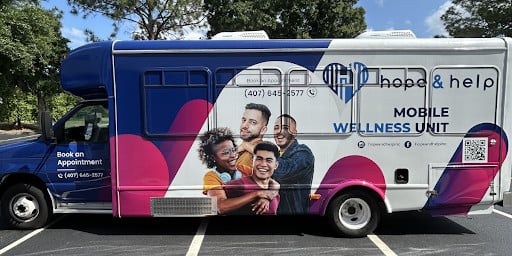
If you’ve attended a health fair, pride event, or community get-together in the Central Florida area, chances are you’ve seen a booth from Hope & Help of Central Florida. The volunteers and health experts with Hope & Help have made it one of their primary missions to provide outreach to at-risk youth in Orlando and beyond, from college campuses to community events.
While starting conversations about HIV, protection, and sexual health can be challenging, the conversations, education, and resources are crucial to stopping the spread of HIV and laying the foundation for a better tomorrow.
For more than 35 years, Hope & Help has been a mainstay in Florida’s public health landscape. Founded at the height of the HIV/AIDS crisis, the nonprofit has seen every advancement in HIV treatment, weathered every setback, and been at the forefront of providing resources, education, and care for the Central Florida area.
“Today, one of our main priorities is reaching young people, especially those most at risk for HIV exposure,” explains Thresa Giles, CEO of Hope & Help.

Together with medical experts, volunteers, and the dedicated Hope & Help staff, Giles seeks to break down the barriers of stigma, limited education, and resources to stem the spread of HIV in Central Florida.
Meeting the young people of Florida where they are
“You can’t wait for the young people to decide to come to you,” Giles explains. “You have to meet them where they are, whether that’s on campus or online.”
This philosophy has radically shaped Hope & Help’s outreach and education platform. Through regular college visits, sponsorships of community events, booths at gatherings, pop-up testing clinics, health fairs, and a robust online presence, Hope & Help has been able to facilitate deep conversation, education, and even widespread free testing for the communities that need them the most.
The pillars of education, outreach, and empowerment drive Hope & Help’s continued success. Though it may seem as if there is a large disconnect between college students and those young people who are living on the streets with few resources, they both may be suffering from a lack of comprehensive education about sexual health, STI protection, and HIV in general.
By approaching the subject in a judgment-free zone and acknowledging the barriers to education that young people today face, Hope & Help is closing the gap between education and HIV prevention.
Holistic support at Hope & Help
“Testing and awareness are key in the fight against HIV,” explains Giles. “But our program extends well beyond that.”
Hope & Help offers a continuum of care for people living with HIV, from medical visits to support groups for patients and families. For young people, education is often the entry point. Through youth-focused programs on college campuses, the organization uses candid dialogue and social media platforms to connect with students. The messaging is inclusive and targets those communities that may face a disproportionate risk of HIV exposure, such as the LGBTQ+ community.
Representation also matters to Hope & Help, and they work hard to send volunteers and staff out into the field who look like the people they are trying to help.
“The real conversations can start when a student or a young person sees someone who looks like them and understands how they feel,” says Giles.
Ending stigma
The stigma surrounding HIV may not be as insidious as it was at the height of the HIV/AIDS crisis, but it persists. Hope & Help considers the work of dismantling stigmas to be some of its most important.
“Young people may still hesitate to ask questions or seek out protection due to stigma,” says Giles. “They are afraid that if they seek testing or ask about protecting themselves, they will be judged.”
Hope & Help counters stigma through approachable, youth-targeted community outreach that may mix culture like music and art with education and resources such as mental health workshops. This approach makes it more comfortable for youth to ask questions, get answers in a group setting, and receive access to free HIV testing or PrEP services without shame.
Building an HIV-free future for youth
Hope & Help of Central Florida’s youth outreach is built around the idea of health equity. “We want to ensure that every young person, regardless of their race, sex, or socioeconomic background, has the knowledge and the tools to stay healthy,” says Giles.
The organization’s mission is not just about equity, education, or prevention; it is about empowerment. For the Hope & Help team, meeting young people where they are and reminding them to take care of themselves in an age where HIV is still prevalent in many communities is the first step in ending HIV within their lifetime.
Disclaimer
Artificial Intelligence Disclosure & Legal Disclaimer
AI Content Policy.
To provide our readers with timely and comprehensive coverage, South Florida Reporter uses artificial intelligence (AI) to assist in producing certain articles and visual content.
Articles: AI may be used to assist in research, structural drafting, or data analysis. All AI-assisted text is reviewed and edited by our team to ensure accuracy and adherence to our editorial standards.
Images: Any imagery generated or significantly altered by AI is clearly marked with a disclaimer or watermark to distinguish it from traditional photography or editorial illustrations.
General Disclaimer
The information contained in South Florida Reporter is for general information purposes only.
South Florida Reporter assumes no responsibility for errors or omissions in the contents of the Service. In no event shall South Florida Reporter be liable for any special, direct, indirect, consequential, or incidental damages or any damages whatsoever, whether in an action of contract, negligence or other tort, arising out of or in connection with the use of the Service or the contents of the Service.
The Company reserves the right to make additions, deletions, or modifications to the contents of the Service at any time without prior notice. The Company does not warrant that the Service is free of viruses or other harmful components.