WASHINGTON, D.C. — In a day of high-stakes testimony and geopolitical brinkmanship, Defense Secretary Pete Hegseth appeared before the House Armed Services Committee on Wednesday, delivering a searing indictment of domestic political opposition while the White House officially rebuffed a ceasefire proposal from Tehran. The fallout from these developments sent shockwaves through global energy markets, as crude oil prices surged and the U.S. Navy prepared to withdraw its flagship aircraft carrier from the Middle Eastern theater.
Hegseth Labels Congress the “Biggest Adversary”
Secretary of Defense Pete Hegseth, testifying alongside General Dan Caine, Chairman of the Joint Chiefs of Staff, did not mince words during his first appearance before lawmakers since the escalation of hostilities in the Persian Gulf. In his opening remarks, Hegseth pivoted from the tactical successes of the war to the political climate in Washington, characterizing dissenting voices in Congress as a strategic threat to the mission.
“The biggest adversary we face at this point are the reckless, feckless, and defeatist words of congressional Democrats and some Republicans,” Hegseth stated. He argued that public skepticism and legislative pushback against the administration’s “maximum pressure” campaign only served to embolden the Iranian regime. Hegseth praised President Donald Trump’s “ironclad” resolve to prevent Iran from obtaining a nuclear weapon, describing the ongoing military campaign as a “gift to the world.”

The hearing served as a forum for the administration to defend its 2027 budget request, which seeks a historic $1.5 trillion in defense spending—the largest such request in decades. Hegseth and Caine argued that the massive influx of capital is necessary to sustain the multi-front conflict and modernize U.S. capabilities in an increasingly volatile region. Despite the administration’s touting of “victory” and “success,” polling data suggests a majority of the American public remains wary of the conflict’s trajectory and cost.
Trump Rejects Iranian Proposal
While Hegseth faced lawmakers on the Hill, President Donald Trump made headlines from the Oval Office by rejecting a peace proposal submitted by Tehran. The Iranian plan reportedly suggested a mutual lifting of blockades in the Strait of Hormuz in exchange for a deferral of negotiations regarding Iran’s nuclear program.
President Trump was categorical in his dismissal. “Iran can’t get their act together,” Trump posted on Social Media. “They don’t know how to sign a nonnuclear deal. They better get smart soon!” The President’s rhetoric was underscored by a visual campaign emphasizing his “No more Mr. Nice Guy” stance, signaling that the U.S. naval blockade of Iranian ports will not be lifted until comprehensive nuclear concessions are secured.
White House officials confirmed that Trump had also discussed the matter via telephone with Russian President Vladimir Putin. During the call, Putin reportedly reiterated an offer to assist in the removal and storage of Iran’s enriched uranium—a condition Trump has insisted upon as a non-negotiable prerequisite for peace.
The USS Gerald R. Ford Sails for Home
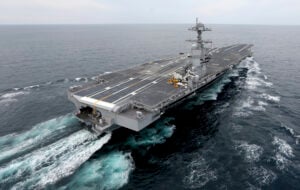
Amid the rising tensions, a significant shift in U.S. naval posture was confirmed on Wednesday. The USS Gerald R. Ford (CVN 78), the Navy’s most advanced aircraft carrier, is slated to depart the Middle East and begin its voyage back to Naval Station Norfolk.
The Ford has been at sea for a record-breaking 309 days, the longest deployment for a modern American carrier. While the departure offers relief to its roughly 4,500 sailors, it also marks a reduction in immediate regional firepower. The ship has faced numerous mechanical challenges during its extended tour, including a laundry room fire that resulted in injuries and recurring plumbing issues. Once back in Virginia, the vessel is expected to undergo extensive maintenance.
The U.S. will maintain a two-carrier presence in the area with the USS George H.W. Bush and the USS Abraham Lincoln. These assets continue to enforce the stringent blockade of the Strait of Hormuz, which has remained largely closed to commercial traffic since March due to Iranian mine-laying operations.
Financial and Economic Impact
The financial toll of the conflict is becoming increasingly apparent. Pentagon officials testified on Wednesday that the direct cost of the Iran war has reached $25 billion to date. This figure does not include the broader economic implications of the blockade or the surge in Foreign Military Sales (FMS).
Data from the first quarter of 2026 shows that the U.S. government approved over $45 billion in potential arms sales, with 81% of that value—roughly $36.6 billion—slated for Middle Eastern allies. Key sales include:
- Saudi Arabia: $9 billion for Patriot PAC-3 MSE missiles.
- Israel: $6.6 billion for attack helicopters and munitions.
- UAE: $8.5 billion for Long Range Discrimination Radar and air-defense systems.
- Kuwait: $8 billion for advanced radar sensors.
While these sales provide a “war dividend” for American defense contractors like Lockheed Martin and RTX, they also reflect the region’s rapid militarization as the conflict shows no sign of abating.
Energy Markets in Turmoil
The combination of the blockade and the rejection of the peace proposal has sent energy prices into a vertical climb. On Wednesday, Brent crude, the international benchmark, surged by over 7% to $119.16 per barrel. Domestic West Texas Intermediate (WTI) futures are currently trading at $106.80, decisively breaking past the $100 threshold as analysts warn of further volatility in the oil futures market.
For American consumers, the impact is felt most acutely at the pump. The American Automobile Association (AAA) reported that the nationwide average for a gallon of gasoline hit $4.229 on Wednesday. This marks a significant daily jump and continues a streak of price increases that has seen fuel costs rise every single day this week, totaling a more than 20-cent-per-gallon increase in just the last seven days. This trend is driven by falling domestic inventories and record-high U.S. crude exports.
Conclusion
As the day concluded, the stalemate between Washington and Tehran appeared more entrenched than ever. With Pete Hegseth positioning the administration against both foreign and domestic “adversaries,” and President Trump doubling down on military pressure, the economic and military costs of the Iran war continue to mount. As the USS Gerald R. Ford begins its long journey home, the world watches the Strait of Hormuz, where the flow of 20% of the world’s energy remains held in the balance of a conflict with no clear end in sight.
Sources Used and Links:
- PBS News: WATCH: Hegseth calls congressional Democrats, some Republicans ‘biggest adversary’ in Iran war
- Middle East Eye: Trump says Iran is ‘choking like a stuffed pig’, as he mulls extending blockade
- Times of Israel: Trump reportedly unhappy with Iran’s proposal to reopen Hormuz but shelve nuclear issue
- The Spokesman-Review: U.S. aircraft carrier to leave Mideast, reducing military might amid Iran war
- CBS News: Live Updates: U.S. aircraft carrier in Iran war expected to leave Middle East with conflict’s estimated cost at $25 billion
- The Center Square / Cities 929: U.S. gas prices at 4-year high as oil exports hit new record
- Forecast International: War Dividends: Potential U.S. Arms Sales to the Middle East Surge in Q1 2026
- Robinhood / ICE: Oil Price (WTI) on Apr 29, 2026 – Prediction Markets
Disclaimer
Artificial Intelligence Disclosure & Legal Disclaimer
AI Content Policy.
To provide our readers with timely and comprehensive coverage, South Florida Reporter uses artificial intelligence (AI) to assist in producing certain articles and visual content.
Articles: AI may be used to assist in research, structural drafting, or data analysis. All AI-assisted text is reviewed and edited by our team to ensure accuracy and adherence to our editorial standards.
Images: Any imagery generated or significantly altered by AI is clearly marked with a disclaimer or watermark to distinguish it from traditional photography or editorial illustrations.
General Disclaimer
The information contained in South Florida Reporter is for general information purposes only.
South Florida Reporter assumes no responsibility for errors or omissions in the contents of the Service. In no event shall South Florida Reporter be liable for any special, direct, indirect, consequential, or incidental damages or any damages whatsoever, whether in an action of contract, negligence or other tort, arising out of or in connection with the use of the Service or the contents of the Service.
The Company reserves the right to make additions, deletions, or modifications to the contents of the Service at any time without prior notice. The Company does not warrant that the Service is free of viruses or other harmful components.