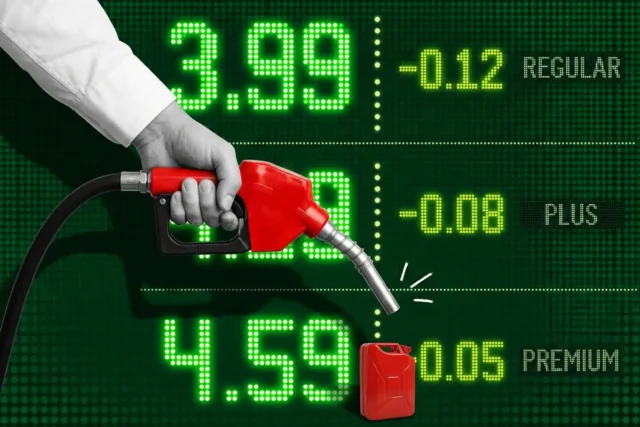
Gas prices are averaging $4.33 a gallon nationwide — still more than $1 higher than a year ago — but drivers could finally see some relief before the end of the year.
The U.S. Energy Information Administration, or EIA, said in its October forecast that it expects prices to gradually decline in the coming months, with the national average falling below $4 in December.
Increased refinery production following season maintenance, combined with lower gasoline consumption during the winter months, should help inventories rebuild in December and ease some pressure on prices.
Must Read
- You’re probably eligible to save money on car insurance. Compare rates for your ZIP code with this free — and fast — tool from Money.
- Rising prices making credit card debt harder to manage? See whether you qualify for debt relief with this free, no-obligation check.*
- Meet your financial goals faster: Take this free, no-obligation quiz to get matched with an advisor today.
A major wild card is the Iran war, which has disrupted oil shipments through the Strait of Hormuz, a critical passage for global energy supplies. Before the conflict began on Feb. 28, the national average for regular gasoline was $2.98 a gallon. Prices climbed to $4.56 in May before dropping below $4 in June as the U.S. and Iran reached a tentative deal to reopen the strait.

That agreement and resulting price relief didn’t last, leading to current prices.
Looking forward, the EIA’s forecast assumes production and exports from the Middle East will gradually increase as alternative shipping routes and other workarounds bring more oil to market.
But drivers may not see relief immediately. The agency expects U.S. gasoline inventories to remain tight, keeping refining margins — the difference between wholesale gasoline prices and the cost of crude oil — higher than usual into early 2027. And even when wholesale prices decline, it can take time for those decreases to reach the pump, where taxes and the cost of distributing and selling fuel also factor into the price consumers ultimately pay.
In an email to Money, the EIA cautioned that its forecast faces “above-average uncertainty.”
Gas price predictions for late 2026, early 2027
While the EIA expects prices to ease, it also warns that tight gasoline supplies could limit the decline seen by the end of the year. Tom Kloza, chief energy advisor at Gulf Oil, is even less bullish on the outlook. He estimates that the national average will be around $4.11 per gallon at the end of December.
“I think U.S. gas prices will stay above $4 a gallon through the midterms, but I wouldn’t be surprised to see something on either side of $4 a gallon by year’s end,” Kloza tells Money. “If I had to bet, I’d bet on a U.S. average above $4 [per gallon] heading into 2027.”
That doesn’t mean prices won’t fall in the meantime.
Kloza notes that gasoline prices typically reach their seasonal lows between mid-December and the end of January, when colder weather and fewer road trips tend to reduce demand. In particular, areas supplied by Gulf Coast refineries may see more substantial relief, while prices in Western states are likely to remain higher.
Patrick De Haan, head of petroleum analysis at GasBuddy, is reluctant to make a year-end prediction at all.
He says ongoing geopolitical tensions involving the U.S. and Iran, as well as Ukraine and Russia, have made gasoline prices particularly difficult to forecast.
“Any escalation could push prices up and any de-escalation could push prices down,” De Haan says. “As a result, due to the current and ongoing geopolitical tensions, it looks like prices this year will be near record levels.”
For consumers, the outlook points to the possibility of some relief in December but not a guarantee that gas will fall below $4 nationwide. The EIA’s forecast depends in part on global oil supplies recovering, while tight gasoline inventories could limit how much prices decline.
And even if the national average dips below $4, drivers may see different prices depending on where they live.
Disclaimer
Artificial Intelligence Disclosure & Legal Disclaimer
AI Content Policy.
To provide our readers with timely and comprehensive coverage, South Florida Reporter uses artificial intelligence (AI) to assist in producing certain articles and visual content.
Articles: AI may be used to assist in research, structural drafting, or data analysis. All AI-assisted text is reviewed and edited by our team to ensure accuracy and adherence to our editorial standards.
Images: Any imagery generated or significantly altered by AI is clearly marked with a disclaimer or watermark to distinguish it from traditional photography or editorial illustrations.
General Disclaimer
The information contained in South Florida Reporter is for general information purposes only.
South Florida Reporter assumes no responsibility for errors or omissions in the contents of the Service. In no event shall South Florida Reporter be liable for any special, direct, indirect, consequential, or incidental damages or any damages whatsoever, whether in an action of contract, negligence or other tort, arising out of or in connection with the use of the Service or the contents of the Service.
The Company reserves the right to make additions, deletions, or modifications to the contents of the Service at any time without prior notice. The Company does not warrant that the Service is free of viruses or other harmful components.