By TOM MARQUARDT and PATRICK DARR
Wine producers everywhere contend with climate change, unpredictable weather, pests, and shrinking consumption. In Lebanon and Syria, these are the easy problems.
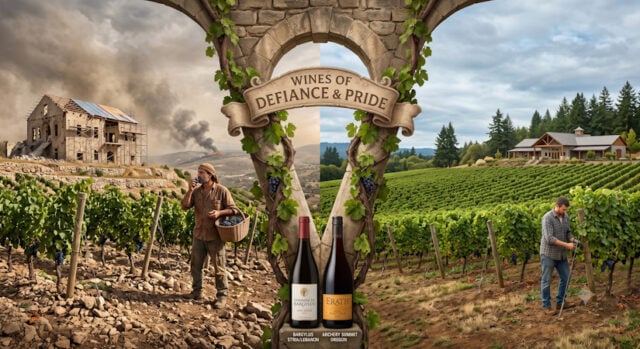
Regime change, political instability, trade tariffs, broken supply chains, and a war that threatens lives and livelihoods have made the work of growing and selling wine something closer to an act of defiance—and pride.
The Saade family is one example. Rodolphe Saade was a Syrian industrialist who had a vision for his country. After his death, his land, estate and companies were confiscated or nationalized under the Nasser regime. In 1997, Johnny R. Saade and his two sons restored their agricultural roots in the region, eventually forming two vineyards: Domaine de Bargylus in their native Syria and Chateau Marsyas in Lebanon’s Beqaa Valley. It was not an easy feat. Unable to return to Syria since the war began in 2011, sons Karim and Sandro, both Syrian-Lebanese nationals, conducted harvest remotely, directing workers by phone and sampling grapes delivered by taxi.

Then, in 2020, a Beirut port explosion nearly ended everything. The family was meeting in offices less than half a mile away when the blast brought their building down around them. Johnny and Sandro, standing only feet apart on the ninth floor, escaped by the emergency stairwell. Johnny spent nearly a month in the hospital. Sandro, on crutches, joined Karim, who was spared injury by a wall, to plan the harvest from his father’s bedside.
Any logical person would have abandoned winemaking long ago, yet the Saade family remains more committed than ever to bringing Middle East wines to foreign shores.
“It’s passion, love, to show what this terroir can do in the worst of conditions,” said Megan Anderson, founder of Pendenza Importers. “They have been making wine forever and they don’t want to stop” because of any war.
History backs them up. The Phoenicians— a seafaring civilization rooted in this very region—were the ones who turned winemaking into commerce, shipping Levantine wine in clay jars across the ancient world and teaching Greeks and Romans how to cultivate the vine. Lebanon’s Temple of Bacchus, erected in the 2nd century AD, still stands as a monument to that deep tradition.
It was the spread of Islam in the 7th century that interrupted it, confining alcohol to religious ceremony alone. Under four centuries of Ottoman rule, what little wine production remained was strangled by restriction and taxation. So, setbacks are nothing new to modern-day winemakers. Yet more than 60 wineries still produce wine in Lebanon’s fertile agricultural regions.
Anderson, whose company brings these wines to the United States, said it’s all about pride in the wines the Saade family is making. As an importer of Domaine de Bargylus and Chateau Marsyas, she is confident that once consumers taste these wines, they will see what level of quality the region can produce.
Consumers are eager to try wines from different regions. Places like Georgia, Croatia and Slovenia have made inroads into the U.S. market recently.
“I see a future,” Anderson said.
Choosing grapes already beloved worldwide has worked in their favor. Rather than championing the indigenous obeideh and merwah varieties for international distribution, the Bordeaux-loving family turned to France’s most celebrated varieties—grapes that demand the kind of temperate climate shaped by both mountain elevation and coastal breezes. Their Syrian vineyards draw a maritime influence from the Mediterranean, while altitudes exceeding 3,000 feet temper the heat of long summer days. The soil beneath runs deep with clay, limestone, and flint.
Lebanon’s climate tells a different story: more continental in character, its mountain range cutting off the cooling breezes from the sea. The soil there shares the clay and limestone but surrenders the flint.
While much of the country, composed mostly of Muslims, doesn’t consume alcohol except for the occasional arak, a distilled spirit flavored with aniseed. With consumption down, it has turned toward the export market recently. Bargylus is the only private, commercially producer wine in Syria and thus the only one sold in the U.S.
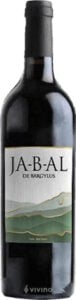
Anderson said the wines are being well-received in finer restaurants, some with Michelin stars, in the seven states where they are so far distributed. “If you want something different, these full-body wines are impressive,” she said.
We tasted several of these wines, most of which benefit from decanting for at least an hour. The 2019 Domaine de Bargylus Jabal Rouge ($30) from Syria, a blend of 60 percent cabernet sauvignon and 40 percent syrah, has ripe blackcurrant and cherry notes with a velvety mouthfeel and fine tannins.
We liked the 2016 Chateau Marsyas Rouge Blend ($42), a blend of cabernet sauvignon, syrah, merlot and petit verdot. From the Bekaa Valley of Lebanon, it is full bodied with black fruit flavors and a dash of spice. The additional bottle age makes this more approachable now.
The 2020 Chateau Marsyas B-Qa Red Blend ($28) is a good value with forward, fresh black cherry flavors and a dose of spice and vanilla. From the Bekaa Valley, it is a blend of cabernet sauvignon, syrah, merlot and petit verdot aged 8 months in French oak barrels.
Oregon wines
Sometimes great natural cataclysms can create terrific ideal growing conditions for grapes millennia later. The amazingly fertile soils of Napa and Sonoma counties are the result of intense volcanic activity as recent as 3-9 million years ago.
In Oregon’s Willamette Valley a series of massive glacial floods 15,000 years ago resulted in the deposit of over a hundred feet of fertile sediment that has proven ideal for the cultivation of agricultural crops including wine grapes.
The modern era of wine growing kicked off in the 1960s with the recognition of pinot noir as the red wine grape with the most potential as well as cool climate white varieties pinot gris and riesling. Today pinot noir dominates plantings in Oregon with about 60 percent of all plantings.
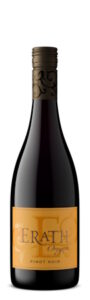
Trying to assess where Oregon fits into the world of pinot noir is difficult, with climate change making pinot noir styles a moving target. However, Oregon appears to fit in somewhere between California (ripest) and Burgundy in the ripeness fruit forward scale from our sampling of their wines.
We recently tasted a limited sampling of Oregon pinot noir that spanned the price spectrum and following are our impressions.
Erath Pinot Noir Oregon Valley 2023 ($15-22). Pretty dark and deep cherry and plum notes with a hint of earthiness.
Willamette Valley Vineyards Estate Willamette Valley Pinot Noir 2023 ($40). A delightful, charming pinot noir with sweet cherry fruit dominating and medium tannins.
Archery Summit Pinot Noir Dundee Hills Willamette Valley 2023 ($65). Ripe cherry, cola, and berry notes with an enticing hint of spices. The most enticing of the three tasted.
Wine picks
Cattleya Chardonnay Sonoma Coast 2024 ($65). Vibrant apple and citrus notes with a thread of minerality to provide some tension.
Vigne Surrau Naracu Cannonau di Sardegna DOC 2024 ($20). From the northeast corner of the island of Sardinia, this unique wine is made from cannonau, the primary wine grown here. Granite soil gives this wine an austere but very interesting wine with forward red fruit and herbal character.
Disclaimer
Artificial Intelligence Disclosure & Legal Disclaimer
AI Content Policy.
To provide our readers with timely and comprehensive coverage, South Florida Reporter uses artificial intelligence (AI) to assist in producing certain articles and visual content.
Articles: AI may be used to assist in research, structural drafting, or data analysis. All AI-assisted text is reviewed and edited by our team to ensure accuracy and adherence to our editorial standards.
Images: Any imagery generated or significantly altered by AI is clearly marked with a disclaimer or watermark to distinguish it from traditional photography or editorial illustrations.
General Disclaimer
The information contained in South Florida Reporter is for general information purposes only.
South Florida Reporter assumes no responsibility for errors or omissions in the contents of the Service. In no event shall South Florida Reporter be liable for any special, direct, indirect, consequential, or incidental damages or any damages whatsoever, whether in an action of contract, negligence or other tort, arising out of or in connection with the use of the Service or the contents of the Service.
The Company reserves the right to make additions, deletions, or modifications to the contents of the Service at any time without prior notice. The Company does not warrant that the Service is free of viruses or other harmful components.