By Julie Ferris-Tillman, Ph.D.
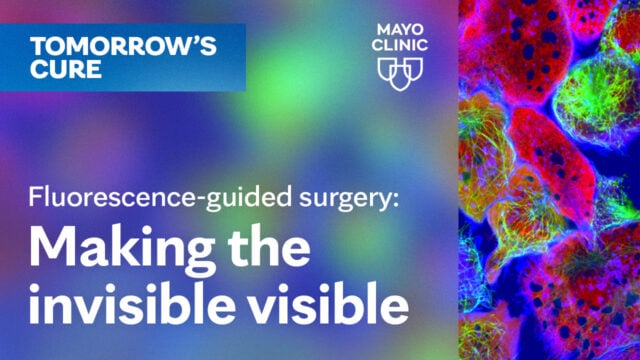
In this episode of “Tomorrow’s Cure,” Lindsay Sievert talks with Stephanie Polites, M.D., a pediatric surgeon at Mayo Clinic, and Timothy Lautz, M.D., a pediatric surgeon and surgical oncologist at Lurie Children’s Hospital of Chicago, about how fluorescent imaging is helping guide safer, more precise surgery.
The approach uses fluorescent agents and specialized cameras to make structures glow on a screen. Depending on the procedure, surgeons may use the technology to assess blood flow, identify bile ducts, locate lymph nodes, protect structures such as the ureter or help find tumors.
“What fluorescence-guided surgery does is essentially make different structures, organs and tumors glow that allows the human eye to see it in a way that wouldn’t otherwise be able to do,” says Dr. Polites.

The technology is especially promising in pediatric cancer surgery. Small tumors or areas where cancer has spread can be difficult to see, particularly during minimally invasive procedures. Fluorescence imaging can provide surgeons with additional information as they work to remove cancer while preserving as much healthy tissue as possible.
Dr. Polites and Dr. Lautz also are studying newer, more targeted fluorescent substances in children. These contrast substances are designed to highlight cancer cells more specifically than earlier dyes. Their clinical trials are evaluating the contrasts’ safety, appropriate dosing and whether the technology helps surgeons identify tumor tissue more accurately.
The physicians describe this as part of a move toward precision surgery, using a child’s tumor biology to guide surgical care. “Different medications are becoming more precise and more tailored to a patient’s individual biology and genetics. We’re doing the same with surgery, and you’re incorporating the individual biology of the different tumors into surgical care. And it just allows us to be more targeted and more precise,” says Dr. Polites.
Although the technology shows promise, fluorescence-guided surgery is not a cure or a replacement for surgical judgment. Instead, it is another tool that may help surgeons operate more safely, remove tumors more completely and reduce the risk of long-term effects for children.
Listen to the latest episode of “Tomorrow’s Cure” wherever you get your podcasts. You can also explore the show’s full library of episodes and guests on the show’s playlist.
Disclaimer
Artificial Intelligence Disclosure & Legal Disclaimer
AI Content Policy.
To provide our readers with timely and comprehensive coverage, South Florida Reporter uses artificial intelligence (AI) to assist in producing certain articles and visual content.
Articles: AI may be used to assist in research, structural drafting, or data analysis. All AI-assisted text is reviewed and edited by our team to ensure accuracy and adherence to our editorial standards.
Images: Any imagery generated or significantly altered by AI is clearly marked with a disclaimer or watermark to distinguish it from traditional photography or editorial illustrations.
General Disclaimer
The information contained in South Florida Reporter is for general information purposes only.
South Florida Reporter assumes no responsibility for errors or omissions in the contents of the Service. In no event shall South Florida Reporter be liable for any special, direct, indirect, consequential, or incidental damages or any damages whatsoever, whether in an action of contract, negligence or other tort, arising out of or in connection with the use of the Service or the contents of the Service.
The Company reserves the right to make additions, deletions, or modifications to the contents of the Service at any time without prior notice. The Company does not warrant that the Service is free of viruses or other harmful components.