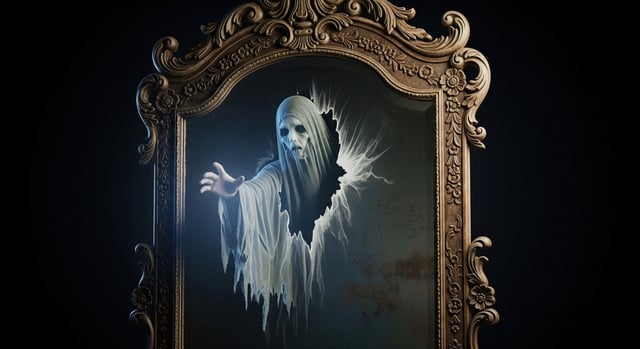
Every October, people tell ghost stories without thinking about where classic monster names originate. In its article GHOULS HAVE NOTHING TO DO WITH GHOSTS: 10 SPOOKY WORDS EXPLAINED, Dictionary Scoop explores these roots. According to Dictionary Scoop, spooky vocabulary blends “etymologies spanning Old English, Gaelic, Latin, and Arabic.” Many familiar horror terms actually started with meanings that had nothing to do with haunted houses. Tracing these words back in time uncovers surprising cultural shifts.
Take the word ghost, which evolved over a thousand years from the Old English term gāst. As Dictionary Scoop notes, it originally meant “vital spark,” “breath,” or “the seat of intelligence.” It described “the living soul inside a human body” rather than a floating apparition. A wraith, meanwhile, carries a much more specific meaning in Scottish folklore. Dictionary Scoop explains that a wraith was “an exact double of a living person” seen before death. This eerie “spirit double” served as an omen of imminent doom.
Despite sharing a similar spelling, ghouls have completely different linguistic roots than ghosts. Dictionary Scoop points out that the word entered English from the Arabic term ghūl in the 1700s. Originally, this creature was a desert “demon known for robbing graves and devouring human flesh.” French translations of One Thousand and One Nights later introduced the term to Western readers. Similarly, the banshee comes from the Gaelic phrase bean sídhe, meaning “woman of fairyland.” In Irish and Scottish legends, her “terrifying wailing” outside a home warns of an approaching family death.
Other familiar words also carry dark historical surprises beneath their modern pop culture images. For example, the verb haunt comes from Old French hanter, meaning “to visit frequently.” Goblin traces back to a Greek word for “rogue,” and John Milton used it for Death itself. Meanwhile, specter stems from Latin spectrum, meaning “an appearance,” while bogeyman comes from Middle English boggart. Even macabre has medieval artistic roots in the French Danse Macabré, or “Dance of Death.”

Understanding these origins shows how folklore and language constantly shape each other across centuries. Words that once described breath, frequent visits, or desert demons gradually merged into our Halloween vocabulary. As Dictionary Scoop demonstrates in GHOULS HAVE NOTHING TO DO WITH GHOSTS: 10 SPOOKY WORDS EXPLAINED, language holds rich history. Looking closely at these everyday terms reveals centuries of global storytelling hidden in plain sight. Next time you hear a ghost story, you will know the true history behind every monster.
Sources
Disclaimer
Artificial Intelligence Disclosure & Legal Disclaimer
AI Content Policy.
To provide our readers with timely and comprehensive coverage, South Florida Reporter uses artificial intelligence (AI) to assist in producing certain articles and visual content.
Articles: AI may be used to assist in research, structural drafting, or data analysis. All AI-assisted text is reviewed and edited by our team to ensure accuracy and adherence to our editorial standards.
Images: Any imagery generated or significantly altered by AI is clearly marked with a disclaimer or watermark to distinguish it from traditional photography or editorial illustrations.
General Disclaimer
The information contained in South Florida Reporter is for general information purposes only.
South Florida Reporter assumes no responsibility for errors or omissions in the contents of the Service. In no event shall South Florida Reporter be liable for any special, direct, indirect, consequential, or incidental damages or any damages whatsoever, whether in an action of contract, negligence or other tort, arising out of or in connection with the use of the Service or the contents of the Service.
The Company reserves the right to make additions, deletions, or modifications to the contents of the Service at any time without prior notice. The Company does not warrant that the Service is free of viruses or other harmful components.