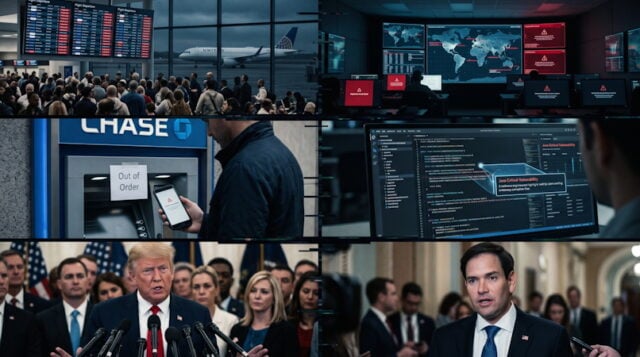
Over the last several days, Americans watched a string of critical systems go dark. Planes stopped flying. Bank accounts froze. Even an intelligence agency network went offline.
The disruptions hit daily life and national security alike. Officials insist these failures are unrelated technical glitches. Still, the timing has fueled intense public anxiety.
Skies Grounded Across the Country
The chaos began on Friday, November 13, when the Federal Aviation Administration ordered a rare nationwide ground stop. Flights halted across the United States for roughly five hours. It was the longest stoppage since September 11, 2001.
Transportation Secretary Sean Duffy blamed the meltdown on a newly installed router. That device overloaded the aging air traffic control communications network. It caused intermittent gaps in radar coverage and pilot radio contact.

Duffy noted that many control towers rely on outdated equipment and crumbling buildings. Following the crisis, he asked Congress for $50.1 billion to modernize aviation infrastructure.
Airline schedules barely recovered before trouble struck again. On Monday, November 16, United Airlines suffered a widespread internal system outage. The glitch lasted about 30 minutes and delayed departing flights. Fewer than 150 flights were directly impacted, though ripple delays lingered through the afternoon.
Banking Delays and Classified Blackouts
Monday also brought turmoil to the financial sector. Thousands of JPMorgan Chase customers could not view balances or clear transfers. Chase traced the problem to a software bug inside an on-premises hardware system.
Because major banks share payment rails, the glitch spilled over. Customers at Bank of America, Wells Fargo, and U.S. Bank also reported delays. Chase resolved the issue by Monday evening.
Then came Tuesday, November 17. An internal National Security Agency network used to share classified information went offline. The agency attributed the blackout to routine software maintenance.
These incidents also followed a major global outage at Microsoft on Thursday, November 12. Microsoft blamed a combination of an old bug, faulty internal connections, and server capacity.
Enter Artificial Intelligence and Java
While officials pointed to routine hardware and software bugs, cybersecurity researchers raised a sharper alarm. On November 17, researchers disclosed a critical flaw in Java nicknamed Java4Shell. Tracked as CVE-2026-114938, the bug lets attackers corrupt memory and seize control of servers.
Researchers found the vulnerability with the help of artificial intelligence. Because Java powers banking apps, cloud networks, and government platforms, the discovery triggered urgent global advisories.
Senator Mark Warner, vice chair of the Senate Intelligence Committee, connected the dots. He stated there is no sign of a coordinated cyberattack. However, he warned that AI finds system flaws at unprecedented speed.
Companies and agencies must rush out emergency patches all at once. That frantic pace puts massive strain on older networks not built for rapid change.
Washington Responds Amid Skepticism
Top administration officials tried to calm public nerves from abroad. Speaking in Manila during an Asian diplomatic trip, President Donald Trump brushed off the Chase outage.
“It’s life,” Trump told reporters. “When you’re big and powerful, and you have all the money, things like that happen. It’s fine.”
Secretary of State Marco Rubio offered a more detailed defense in Manila. Rubio stated there is zero evidence linking the outages or pointing to a foreign adversary. Asked whether AI played a role, Rubio declined to speculate. He noted that each failure is unique and involves separate systems.
Not everyone bought the official reassurances. Right-wing commentator Laura Loomer alleged on social media that leaders were hiding a coordinated cyberattack. Conservative commentator Kylie Jane Kremer demanded transparency and accountability for the cascading failures.
For everyday Americans, the root cause matters less than the disruption. Whether sparked by aging routers, rushed AI-era patches, or simple coding bugs, one truth stands out. Modern society relies on deeply tangled digital networks. When one thread snaps, the whole web shakes.
Sources
- CBS News – Rubio says there’s “zero evidence” recent tech outages are related
- CBS News – Widespread service outages at major U.S. banks appear to be over
- CBS News – United Airlines says it resolved a “widespread system outage,” days after nationwide ground stop
- CBC News – Multiple tech outages have Americans asking: Can somebody fix this?
- Associated Press – Flight delays and cancellations continue after FAA lifts ground stop
- FactCheck.org – Unpacking the Partisan Finger-Pointing Over FAA Funding
- CyberScoop – Researchers disclose critical flaw in Java with help of AI
- The Korea Herald – S. Korea issues cybersecurity advisory after flaws discovered in Java platform
- Newsday – Rubio says there’s ‘zero’ information that US outages are linked or caused by a malign actor
- The Guardian – United Airlines says ‘widespread’ system outage resolved
Disclaimer
Artificial Intelligence Disclosure & Legal Disclaimer
AI Content Policy.
To provide our readers with timely and comprehensive coverage, South Florida Reporter uses artificial intelligence (AI) to assist in producing certain articles and visual content.
Articles: AI may be used to assist in research, structural drafting, or data analysis. All AI-assisted text is reviewed and edited by our team to ensure accuracy and adherence to our editorial standards.
Images: Any imagery generated or significantly altered by AI is clearly marked with a disclaimer or watermark to distinguish it from traditional photography or editorial illustrations.
General Disclaimer
The information contained in South Florida Reporter is for general information purposes only.
South Florida Reporter assumes no responsibility for errors or omissions in the contents of the Service. In no event shall South Florida Reporter be liable for any special, direct, indirect, consequential, or incidental damages or any damages whatsoever, whether in an action of contract, negligence or other tort, arising out of or in connection with the use of the Service or the contents of the Service.
The Company reserves the right to make additions, deletions, or modifications to the contents of the Service at any time without prior notice. The Company does not warrant that the Service is free of viruses or other harmful components.