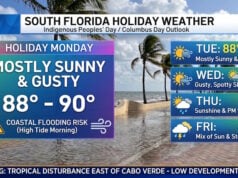
Florida homeowners watching this year’s weather forecasts have likely noticed something different in the language coming out of NOAA. A strong El Niño pattern is in place for the 2026 season, and while that typically means a quieter Atlantic hurricane outlook due to increased wind shear over the tropics, it comes with a tradeoff most Floridians underestimate: significantly more rainfall.
According to NOAA’s Climate Prediction Center, El Niño conditions tend to enhance wet-season and cool-season precipitation across Florida, with the southern half of the state historically seeing well above-average rainfall during strong El Niño years. The combination of more frequent storm systems, heavier downpours, and the everyday reality of Florida’s afternoon thunderstorms means one thing for homeowners: your roof is going to be tested, repeatedly, for months.
And unlike a hurricane, which announces itself days in advance and gives you time to scramble, a leaking roof during a routine summer storm gives you no warning at all.
More Rain Means More Leaks, Especially on Aging Roofs

Hurricanes get the headlines, but the slow, steady damage of a wet season is what actually destroys most Florida roofs. Repeated saturation finds every weak point: cracked flashing, lifted shingles, deteriorated underlayment, clogged valleys. Water doesn’t need 100-mph winds to ruin a ceiling, it just needs a way in and enough time to find it.
This is where roof age becomes critical. Florida’s climate is exceptionally hard on roofing materials. Intense UV radiation, year-round humidity, salt air, and constant thermal cycling cause asphalt shingle roofs to age significantly faster here than in most of the country. A roof that might last 30 years in a milder climate often needs to be replaced in 15 to 20 years in Florida.
The state’s insurance market reflects this reality. Under Florida law (specifically, reforms enacted through SB 4-D in 2022), insurers are generally required to offer coverage for roofs less than 25 years old, but most carriers will require a roof inspection and often decline coverage outright once an asphalt shingle roof passes the 15-year mark. Homeowners with roofs approaching or exceeding 25 years often find themselves either uninsurable in the private market or forced into Citizens Property Insurance Corporation, the state-backed insurer of last resort.
The practical implication is straightforward: if your roof is older than 15 years, it should be professionally inspected before this rainy season; if it’s older than 20 years, you should be actively planning for replacement; and if it’s pushing 25 years, you’re already living on borrowed time, both structurally and from an insurance standpoint.
What a Pre-Season Roof Inspection Should Actually Cover
A storm-season readiness inspection from a qualified roofing contractor should look at far more than just the shingles. The full checklist includes the condition of flashing around chimneys, vents, and skylights, which is where most roof leaks actually begin; soffit and fascia integrity, which affects how a roof handles wind uplift; the underlayment and decking beneath the visible roof surface; attic ventilation, which dramatically influences shingle lifespan in Florida’s heat; and any evidence of prior damage that may have been improperly repaired or missed entirely after past storms.
Homeowners who have been considering adding solar should also know that combining a roof replacement with a solar installation is meaningfully more cost-effective than doing them separately, since removing and reinstalling solar panels on an aging roof later carries significant labor costs.
Choose Your Roofer Before You Need One
The worst time to hire a roofing contractor is the week after a major weather event, when out-of-state storm chasers descend on Florida neighborhoods with door-to-door pitches and promises that often don’t survive the first claim dispute. Established local companies that have weathered multiple Florida storm seasons, like Greentek Roofing & Solar in the Tampa Bay area, tend to be booked solid in the aftermath of any significant storm, leaving unprepared homeowners to choose between long waits and unfamiliar contractors.
Before booking any roofer, verify they are licensed by the Florida Department of Business and Professional Regulation, carry appropriate liability and workers’ compensation insurance, and have a documented history of work in your specific region. Florida’s roofing conditions vary meaningfully by geography, a contractor with deep experience on the Gulf Coast understands different exposure dynamics than one working primarily in southeast Florida and that local knowledge matters when your roof is the only thing between your family and a season’s worth of rain.
The Bottom Line
A strong El Niño doesn’t mean Florida is off the hook this year, it means the threat has shifted from a small number of catastrophic events to a long, sustained season of rainfall that will find every weakness in every aging roof in the state. The homeowners who come out of this season dry will be the ones who acted before the rain started, not after.
If your roof is more than 15 years old, hasn’t been inspected since the last major storm, or shows any visible signs of wear, the time to call a roofer is now. The cost of an inspection is trivial. The cost of replacing a ceiling, flooring, and everything underneath it after a season of leaks is not.
Disclaimer
Artificial Intelligence Disclosure & Legal Disclaimer
AI Content Policy.
To provide our readers with timely and comprehensive coverage, South Florida Reporter uses artificial intelligence (AI) to assist in producing certain articles and visual content.
Articles: AI may be used to assist in research, structural drafting, or data analysis. All AI-assisted text is reviewed and edited by our team to ensure accuracy and adherence to our editorial standards.
Images: Any imagery generated or significantly altered by AI is clearly marked with a disclaimer or watermark to distinguish it from traditional photography or editorial illustrations.
General Disclaimer
The information contained in South Florida Reporter is for general information purposes only.
South Florida Reporter assumes no responsibility for errors or omissions in the contents of the Service. In no event shall South Florida Reporter be liable for any special, direct, indirect, consequential, or incidental damages or any damages whatsoever, whether in an action of contract, negligence or other tort, arising out of or in connection with the use of the Service or the contents of the Service.
The Company reserves the right to make additions, deletions, or modifications to the contents of the Service at any time without prior notice. The Company does not warrant that the Service is free of viruses or other harmful components.