The geopolitical landscape of the Middle East shifted dramatically this week as the Trump administration signaled a move from intermittent military skirmishes to a permanent state of economic and maritime containment against the Islamic Republic of Iran. On Tuesday, reports emerged from the White House indicating that President Trump has instructed his senior national security and economic advisors to prepare for an “extended blockade” of Iranian ports and shipping lanes—a move that sent global energy markets into a tailspin and caused domestic gasoline prices to see their sharpest one-day jump in nearly three years.
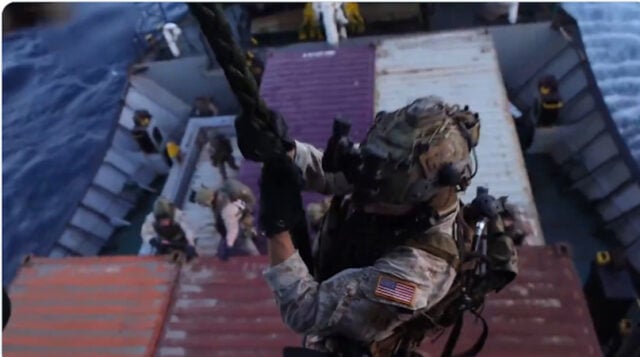
Earlier today in the Arabian Sea, U.S. Marines from the 31st Marine Expeditionary Unit boarded M/V Blue Star III, a commercial ship suspected of attempting to transit to Iran in violation of the U.S. blockade of Iranian ports. U.S. forces released the vessel after conducting a… pic.twitter.com/UFx329OsHj
— U.S. Central Command (@CENTCOM) April 28, 2026
The Shift to Permanent Containment
According to a detailed report by the Wall Street Journal, the administration’s strategy has evolved from the “maximum pressure” campaigns of the past into a structured, long-term maritime encirclement. The President’s directive emphasizes that the United States must be prepared to maintain this posture for years, rather than months, to ensure that Tehran is completely decoupled from the global financial and energy systems.
“President Trump tells aides to prepare for an extended blockade of Iran,” the Wall Street Journal reported, citing officials familiar with the discussions. The report suggests that the administration is no longer looking for a quick diplomatic “grand bargain” but is instead committed to a total attrition strategy. This shift reflects a belief within the inner circle that the Iranian government’s resilience can only be broken by a sustained, physical interruption of its remaining oil exports and illicit trade networks.

The Strait of Hormuz, a narrow waterway through which approximately 20% of the world’s petroleum passes, has become the primary theater for this new directive. By instructing the Pentagon to prepare for an “extended” presence, the administration is signaling to both allies and adversaries that the U.S. Navy’s role in the region will expand from patrolling to active interdiction of vessels suspected of carrying Iranian crude or sanctioned materials.
Tuesday’s Market Shock
The impact of the announcement was felt almost instantly at the pump. Across the United States on Tuesday morning, gasoline prices jumped an average of 14 to 22 cents per gallon in several regions. In California and the Northeast, the spike was even more pronounced as traders priced in the risk of a “hot war” in the Persian Gulf.
Market analysts noted that while the U.S. is less dependent on Middle Eastern oil than in previous decades, the global nature of crude pricing means that any threat to the Strait of Hormuz immediately drives up prices. Brent Crude futures surged past $95 a barrel on the news, with some analysts predicting a move toward $110 if the blockade is fully implemented and met with Iranian retaliation.
The “Tuesday Spike,” as it is being called on Wall Street, reflects deep-seated fears that an extended blockade will lead to a “tit-for-tat” conflict. If Iran follows through on its historical threats to close the Strait, the resulting supply shock could dwarf previous energy crises. For the Trump administration, the domestic political risk of high gas prices is being weighed against the strategic goal of neutralizing Tehran’s regional influence.
The Military Logistics of a Multi-Year Blockade
Preparing for an extended blockade is a massive logistical undertaking for the U.S. Navy and the Department of Defense. It requires a sustained carrier strike group presence, an increase in littoral combat ships for shallow-water interdiction, and a sophisticated intelligence, surveillance, and reconnaissance (ISR) network to track “dark fleet” tankers.
Aides have reportedly been told to draft plans for rotating maritime assets to ensure that the blockade does not suffer from “readiness fatigue.” This involves coordinating with regional partners, such as Saudi Arabia and the United Arab Emirates, to utilize their ports for refueling and maintenance, thereby reducing the time U.S. vessels spend away from the blockade line.
The military dimension also includes the deployment of advanced drone technology. The administration is reportedly looking at using autonomous sea vessels to monitor the vast reaches of the Gulf of Oman, allowing the manned fleet to focus on high-stakes interceptions. This “high-tech siege” is designed to be more cost-effective than traditional carrier-led operations, making the “extended” nature of the blockade more sustainable for the U.S. taxpayer.
Diplomatic and Global Repercussions
The international community has reacted with a mixture of support and alarm. While Israel and several Gulf states have privately welcomed the tougher stance, European allies have expressed concern over the legality and the potential for a humanitarian crisis within Iran.
The UN Security Council is expected to hold an emergency session later this week to discuss the maritime restrictions. Critics argue that a full-scale blockade constitutes an act of war under international law, while the administration maintains that these are “enhanced enforcement measures” of existing sanctions.
China, the largest remaining purchaser of Iranian oil, remains the wild card. If the U.S. Navy begins interdicting Chinese-flagged tankers or vessels bound for Chinese ports, the Iran-U.S. conflict could quickly spiral into a broader trade and military standoff between Washington and Beijing. Reports suggest that Trump’s directive to aides includes a specific section on “secondary interdiction,” which would penalize ports and shipping companies that facilitate Iran’s shadow trade.
The Iranian Response and the “War” Context
Tehran has responded with defiant rhetoric, with the Revolutionary Guard (IRGC) warning that “no oil will leave the Gulf” if Iran’s exports are completely zeroed out. The “Iran War,” which many analysts have described as a “gray-zone conflict” for the past several years, is now threatening to break out into open hostilities.
The extended blockade strategy assumes that Iran will eventually be forced to the negotiating table due to internal economic collapse. However, history suggests that such measures often embolden hardliners within the regime. The risk of asymmetric warfare—using mines, fast-attack boats, and drone swarms—remains at an all-time high.
Economic Outlook and Domestic Politics
For the American consumer, the immediate concern remains the cost of living. The administration has hinted at potentially tapping the Strategic Petroleum Reserve (SPR) to offset the gas price hike, but experts warn that this is a temporary fix for a long-term strategy. If the blockade is indeed “extended,” the U.S. economy may have to adjust to a “new normal” of higher energy costs, balanced by increased domestic production from the Permian Basin.
As the administration moves forward, the focus will be on maintaining domestic support for a strategy that could take years to yield results. By framing the blockade as a necessary step for national security and regional stability, the President is betting that the long-term benefit of a neutered Iranian regime will outweigh the short-term pain at the pump.
Sources:
- The Wall Street Journal: Trump Tells Aides to Prepare for Extended Blockade of Iran
- U.S. Energy Information Administration (EIA): Daily Price Tracking and Market Analysis.
- Department of Defense: Maritime Strategy and Readiness Briefings (2026).
- Reuters: Global Oil Market Reaction Reports (April 2026).
Disclaimer
Artificial Intelligence Disclosure & Legal Disclaimer
AI Content Policy.
To provide our readers with timely and comprehensive coverage, South Florida Reporter uses artificial intelligence (AI) to assist in producing certain articles and visual content.
Articles: AI may be used to assist in research, structural drafting, or data analysis. All AI-assisted text is reviewed and edited by our team to ensure accuracy and adherence to our editorial standards.
Images: Any imagery generated or significantly altered by AI is clearly marked with a disclaimer or watermark to distinguish it from traditional photography or editorial illustrations.
General Disclaimer
The information contained in South Florida Reporter is for general information purposes only.
South Florida Reporter assumes no responsibility for errors or omissions in the contents of the Service. In no event shall South Florida Reporter be liable for any special, direct, indirect, consequential, or incidental damages or any damages whatsoever, whether in an action of contract, negligence or other tort, arising out of or in connection with the use of the Service or the contents of the Service.
The Company reserves the right to make additions, deletions, or modifications to the contents of the Service at any time without prior notice. The Company does not warrant that the Service is free of viruses or other harmful components.