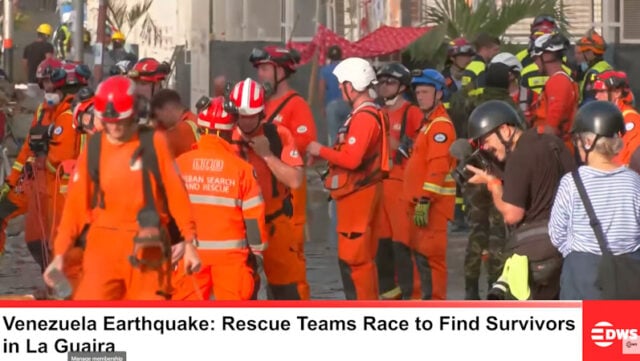
CARACAS — The silence that falls over a disaster zone is heavier than the concrete itself. Across northern Venezuela, international rescue workers stand motionless, hands raised to pause the roaring excavators and chainsaws. They press specialized acoustic microphones into crevices of pulverized stone and yell down into the darkness, instructing anyone trapped to knock three times. For a few agonizing seconds, thousands of people hold their breath, praying for an echo.
A week after a devastating pair of twin earthquakes tore through the nation’s northern coastline, the dual realities of catastrophe are unfolding simultaneously. The official death toll has climbed rapidly to 1,943 people, with more than 10,000 injured and tens of thousands still unaccounted for. Yet, even as authorities prepare for the grim reality of a soaring casualty list, a series of miracle recoveries has injected a stubborn, fierce pocket of hope into an otherwise heartbreaking landscape.
A Rising, Unforgiving Toll
The tragedy began at 6:04 p.m. on June 24, when back-to-back earthquakes measuring 7.2 and 7.5 magnitude struck within less than a minute of each other. The epicenters were located west of Caracas in Yaracuy state, but the catastrophic energy rippled violently across seven states, catching families as they prepared dinner or returned home from work.

The hardest-hit region, La Guaira state, which hugs the Caribbean coastline, looks as though it has been systematically dismantled. According to a preliminary satellite analysis conducted by NASA, an estimated 58,870 buildings were likely damaged or destroyed across the affected zones. Entire multi-story apartment complexes collapsed into pancake-style layers, trapping hundreds of residents within the structural voids.
Gianluca Rampolla, the United Nations Resident and Humanitarian Coordinator in Venezuela, warned that the recorded fatalities represent only the beginning of a long and painful accounting process. To prepare for the worsening numbers, the UN and Venezuelan authorities have already moved to procure 10,000 body bags. The environmental conditions have only exacerbated the danger; more than 500 aftershocks have rattled the unstable ruins, and an approaching tropical wave threatens to trigger heavy rainfall, turning fields of debris into treacherous mudslides.
Miracles in the Dust
Despite the closing window of survival—well past the critical 72-hour mark—the human spirit has proved remarkably resilient. Over 2,000 elite first responders from 27 different countries, working alongside 160 highly trained search dogs, have extended their operations due to persistent signs of life buried deep within the rubble.
Among the most astonishing stories of survival emerged from Caraballeda, a coastal town roughly 40 kilometers north of Caracas. Nearly four days after their home collapsed, a father and his teenage son were pulled out alive by a combined force of French and American urban search and rescue (USAR) specialists. Shaded from the scorching heat by a collapsed structural slab that left just enough breathing room, the pair survived on sheer willpower until heavy lifting equipment could tunnel through to their position.
Just a day later, UN officials confirmed that seven more individuals were successfully extracted alive from another collapsed site on a single Sunday. Interim President Delcy Rodríguez praised the relentless determination of the search crews, stating firmly that these efforts would not be suspended because the nation “always holds on to hope.” Each successful extrication is met with cheers and tears from the exhausted volunteers, providing a brief respite from the grueling work.
The Desperate Search Continues
For every miracle, however, there are thousands of agonized families waiting for news by the edges of the safety cordons. In towns like Catia La Mar and Tanaguarena, desperate residents have used their bare hands, shovels, and simple iron bars to dig through mounds of shattered brick, frantic to reach trapped relatives.
At one site, an American rescue task force from Fairfax, Virginia, worked systematically through the skeletal remains of an apartment building. They were approached by Miguel Coello, a local father begging for them to search for his 22-year-old daughter, trapped inside along with 13 others. Coello’s words reflected the bittersweet resolve shared by so many across the country:
“Fourteen people inside—maybe they are not alive, all of them. But at the end of the story, we need to recover our bodies, you know.”
Josh Morrison, a rescue worker with the American team, noted that while the passage of time makes the mission exponentially more difficult, the crews treat every single site as if it were day one. “We will work until we get no more signs of life,” Morrison emphasized, acknowledging the invisible clock ticking against them.
The United Nations Development Programme (UNDP) has deployed its Rapid Digital Analysis tool (RAPIDA) to map the destruction via satellite imagery, pinpointing severe infrastructure failures and widespread power outages across Carabobo, Aragua, and the Distrito Capital. The preliminary physical damage is estimated at $6.7 billion—roughly six percent of Venezuela’s gross domestic product—underlining a long-term reconstruction crisis that will persist long after the dust settles. For now, the focus remains entirely human: clearing one piece of concrete at a time, looking for the living among the ruins.
Sources and Links:
- UN News: Venezuela earthquake death toll passes 1,700 as UN continues to scale up response
- The Guardian: Venezuela earthquake: father and son found alive in rubble after four days as death toll nears 1,500
- UN News: Venezuela earthquakes: International rescue teams join the search for survivors as death toll surpasses 1,400
- CBS News: Race to find Venezuela earthquake survivors as satellite images show thousands of buildings damaged or destroyed
- WXXI News (NPR): Untold casualties and humanitarian needs: What to know a week from Venezuela’s quakes
- UN News: Venezuela earthquakes LIVE: Death toll rises amid recovery and rescue efforts
Disclaimer
Artificial Intelligence Disclosure & Legal Disclaimer
AI Content Policy.
To provide our readers with timely and comprehensive coverage, South Florida Reporter uses artificial intelligence (AI) to assist in producing certain articles and visual content.
Articles: AI may be used to assist in research, structural drafting, or data analysis. All AI-assisted text is reviewed and edited by our team to ensure accuracy and adherence to our editorial standards.
Images: Any imagery generated or significantly altered by AI is clearly marked with a disclaimer or watermark to distinguish it from traditional photography or editorial illustrations.
General Disclaimer
The information contained in South Florida Reporter is for general information purposes only.
South Florida Reporter assumes no responsibility for errors or omissions in the contents of the Service. In no event shall South Florida Reporter be liable for any special, direct, indirect, consequential, or incidental damages or any damages whatsoever, whether in an action of contract, negligence or other tort, arising out of or in connection with the use of the Service or the contents of the Service.
The Company reserves the right to make additions, deletions, or modifications to the contents of the Service at any time without prior notice. The Company does not warrant that the Service is free of viruses or other harmful components.