Most construction problems that show up years after a project is finished were there on day one, hidden in the soil. A foundation that cracks, a slab that settles unevenly, a basement that floods after every heavy rain are usually failures of investigation more than failures of construction. The crew may have built well on ground that nobody fully understood.
For Cody Fortier, whose companies deliver heavy civil and marine construction across the Gulf South, geotechnical investigation is the most consequential early decision in a project’s life, not a box to check.
Soil testing isn’t glamorous. It shows no visible progress, adds cost before anything gets built, and rarely excites a client who’s eager to break ground. Skipping it or cutting corners is how avoidable disasters start.
The Ground Is Never What It Looks Like
A site can look perfectly buildable and still hide serious problems. Two neighboring parcels may have completely different load-bearing capacities, water tables, and soil compositions. The surface says almost nothing about what sits ten or twenty feet down, where foundations actually transfer their loads.

Cody Fortier has seen that gap repeatedly in excavation, drainage, and site work across Louisiana, where soft clays, high groundwater, and old fill can lie beneath ground that looks firm. Testing replaces guesswork with data before any design decision is locked in.
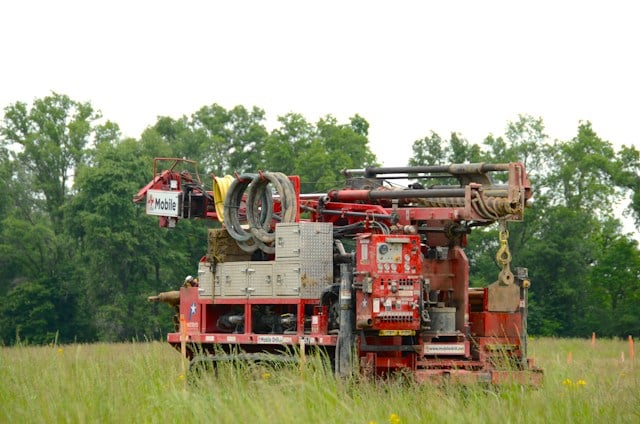
Borings and samples tell a site’s layered story, showing where stable strata lie, where weak ones hide, how deep competent ground sits, and how water moves through it all. Without that picture, an engineer designs blind, and every assumption could prove expensively wrong.
What Soil Testing Actually Measures
Geotechnical investigation answers a handful of questions that quietly govern everything built afterward. The first is bearing capacity, meaning how much weight the soil can support before it deforms or fails. A high-rise and a single-story warehouse put very different demands on the ground, and the soil has to match the load.
The second is settlement behavior. All ground compresses to some degree under weight, but the danger is uneven settlement, where one part of a structure sinks faster than another and cracks start to appear.
Fortier argues that a structure can often tolerate uniform settlement, while differential settlement tears buildings apart, and only investigation shows which one a site is prone to.
Testing also examines moisture content, the water table’s position and seasonal movement, soil chemistry that can corrode buried steel and concrete, and expansive clays that swell and shrink with the seasons. Each of these changes the engineering response, and you can’t see any of them without sampling.
Soil Types and the Problems They Carry
No two soils behave the same way, and knowing their tendencies is central to building safely. Sandy soils drain fast and resist swelling but can shift and erode, undermining foundations if they aren’t properly confined. Clay holds water, swells when wet, and shrinks when dry, causing seasonal movement that cracks slabs where clay dominates. Silt drains poorly and loses strength when saturated, and organic soils, full of decomposing material, are among the worst for building because they compress unpredictably over time.
Rocky ground comes with its own complications. It resists excavation, can be costly to work, and may hide voids or old fill that compromise stability. Cody Fortier makes a practical point that often gets lost in technical reports: no soil is universally good or bad. What matters is whether a soil has been correctly understood and matched to the right foundation, or assumed to be something it isn’t.
Soil Data and Excavation Safety
Investigation shapes how crews dig safely as much as it shapes what gets built. Federal OSHA excavation standards classify soil as stable rock or as Type A, B, or C, with Type C being the least stable. That classification determines how steeply a trench wall can be sloped or whether shoring and trench boxes are required. In general, a trench five feet deep or more needs a protective system unless it’s cut entirely in stable rock.
Fortier knows this territory well, since his companies perform hydro excavation work, including potholing, trenching, and sloping. Potholing, which uses pressurized water and a vacuum to expose buried utilities, counts as an investigation in its own right because it confirms what’s underground before heavier equipment goes to work.
Paired with a geotechnical report, it lets a crew plan cuts, haul-off, and dewatering around actual conditions. Excavations in poorly understood soil are more likely to collapse, and a cave-in can happen in seconds, which makes good data one of a project’s most effective safety tools.
From Report to Design Decision
A geotechnical report works as a set of instructions for how to build, and once the data is in hand, it drives the project’s most basic choices. The foundation type follows directly from what the soil can bear. Strong, shallow soil may allow a simple spread footing, while weak upper layers may call for deep foundations, such as piles or piers, that reach competent ground far below.
The report shapes site preparation as well. It determines whether existing soil can be compacted and reused, whether it has to be removed and replaced with engineered fill, and what drainage measures will keep water away from foundations.
For heavy civil work, the same data informs soil stabilization, on-site cut and fill, imported fill, and subsurface drainage, all of which depend on knowing how the native soil will behave once it’s disturbed. In Cody Fortier’s experience, contractors who avoid expensive surprises keep using the geotechnical report throughout the build instead of filing it away after permitting.
The Cost of Skipping the Step
The urge to save money on investigation is understandable, and it’s almost always a mistake. Testing takes up a small fraction of a project’s budget, while the failures it prevents can cost many times that much to fix.
Underpinning a settling foundation, tearing out and replacing a cracked slab, or correcting drainage after the fact are among the most expensive construction repairs, and they often require disturbing finished work to reach the source.
Schedules take a hit too. Soft soil, groundwater, or buried debris discovered mid-excavation can halt work for days while engineers redesign and crews wait.
The economics favor doing the work up front and paying a modest, predictable cost early instead of a large, unpredictable one later. A thorough investigation protects the budget along with the people who build the structure and eventually occupy it.
Building on Knowledge Instead of Hope
Everything here comes back to a mindset shift. The most reliable projects start with humility about the ground, accepting that the surface reveals little and that confidence has to be earned through data.
Cody Fortier often comes back to the idea that the strongest structures are those whose foundations are designed for the soil that’s actually there, whatever their above-ground engineering looks like.
Soil testing turns the riskiest variable in any build into a known quantity. Engineers can design with precision, contractors can plan with confidence, and clients get a structure that performs as intended for decades instead of developing problems nobody saw coming. In a field where so much depends on what you can’t see, knowing the ground before you break it remains a project’s surest investment.
About Cody Fortier
Based in Opelousas, Louisiana, Fortier is a construction company owner and CEO whose firms provide heavy civil infrastructure, hydro excavation, and marine construction services to public and private clients. His work spans infrastructure projects across the Gulf South, from ports, harbors, bridges, and jetties to drainage, soil stabilization, and site development, supported by a fleet of earth-moving equipment and custom-built heavy machinery. He places a strong emphasis on safety, OSHA compliance, and the crews and subcontractors who carry out the work in the field.
Disclaimer
Artificial Intelligence Disclosure & Legal Disclaimer
AI Content Policy.
To provide our readers with timely and comprehensive coverage, South Florida Reporter uses artificial intelligence (AI) to assist in producing certain articles and visual content.
Articles: AI may be used to assist in research, structural drafting, or data analysis. All AI-assisted text is reviewed and edited by our team to ensure accuracy and adherence to our editorial standards.
Images: Any imagery generated or significantly altered by AI is clearly marked with a disclaimer or watermark to distinguish it from traditional photography or editorial illustrations.
General Disclaimer
The information contained in South Florida Reporter is for general information purposes only.
South Florida Reporter assumes no responsibility for errors or omissions in the contents of the Service. In no event shall South Florida Reporter be liable for any special, direct, indirect, consequential, or incidental damages or any damages whatsoever, whether in an action of contract, negligence or other tort, arising out of or in connection with the use of the Service or the contents of the Service.
The Company reserves the right to make additions, deletions, or modifications to the contents of the Service at any time without prior notice. The Company does not warrant that the Service is free of viruses or other harmful components.