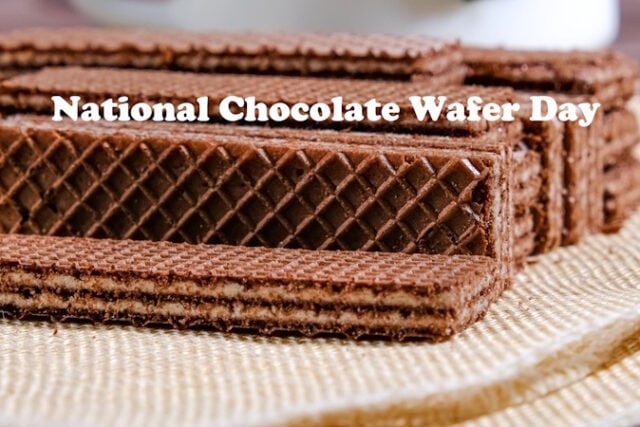
If you love chocolate, National Chocolate Wafer Day on July 3rd lets you indulge in a delicately sweet cookie with a rich history. Have one for breakfast, lunch or dinner!
- 15th Century – The Aztecs use chocolate as a currency.
- 1847 – A Bristol company, J.S. Fry & Sons, makes the first bar of chocolate.
- 1800s – Also called sugar wafers, these delicate snacks melt in your mouth. Made since the mid-1800s in the United States, makers called the cookies many names; wafer cookies, sugar wafers, sugar biscuits, fairy wafers.
- 1894 – The earliest known record of an ice cream sandwich occurred in 1894. The recipe calls for ice cream slathered between two slices of sponge cake. Today, it’s most commonly placed between chocolate wafers or cookies.
- 1898 – Manner, an Austrian company, makes the first chocolate wafers.
- 1912 – Magic happened on March 6, 1912, when two decoratively embossed chocolate-flavored wafers met up with a rich crème filling. Today, Oreo is the world’s top-selling cookie.
- 1924 – While cookies and pastries containing cocoa have been produced for centuries, the commercial version of the chocolate wafer got its start back in 1924, when the National Biscuit Company (now known as Nabisco) began selling them in tins along with sugar wafers and ginger wafers.
- 1935 – KitKat is launched, beginning production in the U.K.
- A wafer is a crisp, often sweet, very thin, flat, and dry biscuit, often used to decorate ice cream.
- Wafers can also be made into cookies with cream flavoring sandwiched between them.
- Ancient Aztecs believed chocolate had magical powers, such as giving them strength.
- The ancient Aztecs consumed chocolate as a frothy beverage, somewhat like the hot chocolate we drink today.
- Chocolate contains over 300 mineral properties that are beneficial to your health.
- Chocolate comes from a Theobroma cacao plant, meaning “Food of the Gods”.
- Dark chocolate has more antioxidants than green tea and just as many as blueberries.
- Oreo Way is a New York street formerly known as West 15th (between 9th and 10th Avenues). The street was renamed to honor where the very first cookie was made and where the very first Nabisco factory was located.
- There are factories that make Oreo cookies in 18 countries worldwide. These factories help produce 40 billion cookies every year. If stacked together, these cookies would circle the Earth five times!
- It takes 120 minutes to produce an Oreo cookie.
- A single-serving chocolate bar takes two to four days to make.
- Thin Mints are crispy chocolate wafers dipped in a mint chocolate coating, and are the Girl Scouts’ most popular selling cookie, accounting for 25% of sales.
- Probably the most prominent example of chocolate wafers is the now-famous Kit Kat bars, which are composed of three layers of wafers covered in chocolate and divided into two to four “fingers.” They’re crispy, crunchy, chocolatey, and just about impossible not to like.
- Chocolate wafers influenced desserts like icebox cakes, popularized in the 1920s.
- In Japan, KitKat wafers are exchanged as good luck charms during exams.
- The name sounds like “kitto katsu,” meaning “surely win” in Japanese. Special flavors like matcha and sakura blossom add cultural flair.
Sources:

Food Network
Disclaimer
Artificial Intelligence Disclosure & Legal Disclaimer
AI Content Policy.
To provide our readers with timely and comprehensive coverage, South Florida Reporter uses artificial intelligence (AI) to assist in producing certain articles and visual content.
Articles: AI may be used to assist in research, structural drafting, or data analysis. All AI-assisted text is reviewed and edited by our team to ensure accuracy and adherence to our editorial standards.
Images: Any imagery generated or significantly altered by AI is clearly marked with a disclaimer or watermark to distinguish it from traditional photography or editorial illustrations.
General Disclaimer
The information contained in South Florida Reporter is for general information purposes only.
South Florida Reporter assumes no responsibility for errors or omissions in the contents of the Service. In no event shall South Florida Reporter be liable for any special, direct, indirect, consequential, or incidental damages or any damages whatsoever, whether in an action of contract, negligence or other tort, arising out of or in connection with the use of the Service or the contents of the Service.
The Company reserves the right to make additions, deletions, or modifications to the contents of the Service at any time without prior notice. The Company does not warrant that the Service is free of viruses or other harmful components.