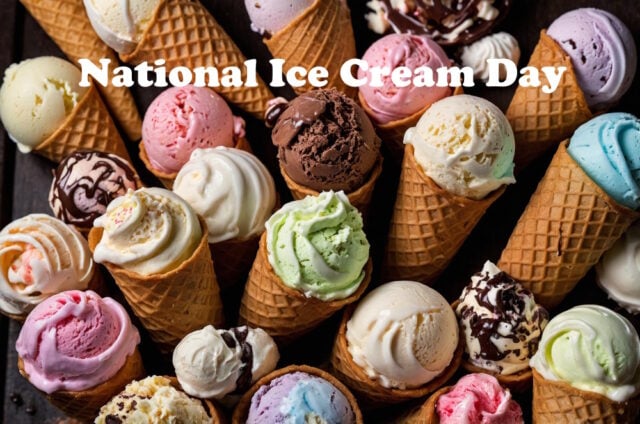
Dish or cone? That’s all we need to know. National Ice Cream Day on the 3rd Sunday in July offers up every flavor on the menu to honor the day! The holiday also lands in the middle of National Ice Cream Month.
- 400 BC – Persians invent an ice cream recipe for their royal families made from saffron, iced rose water, vermicelli and fruit.
- 697 AD – The Chinese, under the Tang Dynasty, took to freezing dairy with salt and ice.
- 1642 – Frozen treats point to Naples, Italy, as the birthplace of the first ice cream.
- 1744 – Colonists from Scotland bring an ice cream recipe to North America.
- 1770s – Ben Franklin, George Washington and Thomas Jefferson enjoyed ice cream.
- 1780s – Thomas Jefferson’s recipe for Old Fashioned Vanilla Ice Cream is believed to be the oldest ice cream recipe in the USA.
- 1813 -First Lady Dolley Madison served ice cream at the Inaugural Ball.
- 1832 – African American confectioner Augustus Jackson created multiple ice cream recipes as well as a superior technique to manufacture ice cream.
- 1843 – Philadelphian Nancy Johnson received the first U.S. patent for a small-scale hand-cranked ice cream freezer.
- 1851 – Industrial production of ice cream began in Boston, United States.
- 1851 – The Father of Commercial Ice Cream: In the winter of 1851 to 1852, a Quaker named Jacob Fussell in Baltimore, Maryland, started making ice cream to use up extra milk.
- 1904 – Ice cream cones were invented during the 1904 World’s Fair in St. Louis when a great demand forced ice cream vendors to find help from nearby waffle vendors. Together they made history.
- 1920 – Harry Burt puts the first ice cream trucks on the streets.
- 1927 – A song written by Howard Johnson popularized the phrase “I scream, you scream, we all scream for ice cream”. Billy Moll and Robert King produced the song
- 1939 – American mass production of ice cream is launched to boost the morale of Allied troops in Europe, popularizing the lovable dish worldwide.
- 1970s – The production of pre-packaged ice cream is flourishing in supermarkets and ice cream parlors.
- 1984 – We have President Reagan to thank for National Ice Cream Day. He wanted to commemorate the treat that more than 90 percent of the population in the United States enjoys, and so he decided he would decree a day for ice cream.
- 1990s – One of the most unusual ice cream flavors is hot dog-flavored ice cream, which was created in Arizona
- 2016 – China holds the record for the most ice cream consumed
- Tutti frutti is widely regarded as one of the most forgotten and lost Old-School Ice Cream Flavor staples
- The United States produces the most ice cream in the world.
- The most popular flavor of ice cream is vanilla. After it comes chocolate, strawberry, cookies n’ cream, and others.
- The most profitable day for ice cream sellers is almost always Sunday.
- Most favorite ice cream topping is chocolate syrup.
- One cone of ice cream can be finished off in 50 licks.
- It takes 12 gallons of milk to create one gallon of ice cream.
- John Harrison, whose job is to taste ice cream for Dreyer’s, has his tongue insured.
- One in ten ice cream eaters admits to letting their pet lick the bowl when they’re finished.
- Citizens of Omaha, Nebraska, consume more ice cream per capita than citizens of any other city.
- Hawaiian Punch originated as an ice cream topping!
- Research shows that ice cream makes people feel safe and comfortable..
- 50% of the volume found in ice cream is air.
- Butter-flavored ice cream is sold by a chocolate emporium in Maine.
- By the numbers:
- 48 pints – the amount of ice cream consumed by the average person in the U.S. every year.
- 90% – the percentage of households in America that consume ice cream.
- 24 tons – the weight of the biggest ice-cream sundae made in Alberta, Canada.
- 250 years – the time it took for the recipe for ice cream to come to North America.
- 9000 – the gallons of ice cream that can be made by the milk produced by a cow in its lifetime.
- 12,096 pounds – the weight of the world’s largest ice cream cake.
- 50 – the average number of licks it takes to finish one ice cream.
- 3 – the number of levers on a standard ice-cream machine.
Sources:

Strasburg
Disclaimer
Artificial Intelligence Disclosure & Legal Disclaimer
AI Content Policy.
To provide our readers with timely and comprehensive coverage, South Florida Reporter uses artificial intelligence (AI) to assist in producing certain articles and visual content.
Articles: AI may be used to assist in research, structural drafting, or data analysis. All AI-assisted text is reviewed and edited by our team to ensure accuracy and adherence to our editorial standards.
Images: Any imagery generated or significantly altered by AI is clearly marked with a disclaimer or watermark to distinguish it from traditional photography or editorial illustrations.
General Disclaimer
The information contained in South Florida Reporter is for general information purposes only.
South Florida Reporter assumes no responsibility for errors or omissions in the contents of the Service. In no event shall South Florida Reporter be liable for any special, direct, indirect, consequential, or incidental damages or any damages whatsoever, whether in an action of contract, negligence or other tort, arising out of or in connection with the use of the Service or the contents of the Service.
The Company reserves the right to make additions, deletions, or modifications to the contents of the Service at any time without prior notice. The Company does not warrant that the Service is free of viruses or other harmful components.