WASHINGTON — In a dramatic escalation of tensions that has sent shockwaves through global energy markets, President Donald J. Trump declared on Monday that the weeks-long ceasefire between the United States and Iran is on “massive life support.” Speaking from the Oval Office during a scheduled event for maternal healthcare, the President delivered a blistering rejection of Tehran’s latest peace proposal, dismissing it as a “piece of garbage” and a “stupid” attempt to stall for time.
The President’s remarks, delivered with characteristic bluntness, immediately extinguished the flickering hopes that a diplomatic resolution to the ten-week-old conflict was within reach. Within minutes of his comments hitting the news wires, Brent crude oil prices surged by more than 3.5%, climbing to a session high of $105.99 a barrel. The global economy, already reeling from the effective closure of the Strait of Hormuz since the war began on February 28, 2026, braced for a new wave of inflationary pressure.
“I would call it the weakest right now, after reading that piece of garbage they sent us,” Trump told a pool of reporters. “I didn’t even finish reading it. It’s on life support. You understand these are all medical people—Dr. Oz, life support is not a good thing. Do you agree? I would say the ceasefire is on massive life support where the doctor walks in and says, ‘Sir, your loved one has approximately a 1% chance of living.'”
The “Garbage” Document and the Uranium Dispute
The core of the President’s frustration appears to be a sudden reversal in what he described as a verbal commitment from Iranian negotiators. According to Trump, Tehran had indicated just days ago that they would allow American or international teams to enter the country to help extract its highly enriched uranium stockpile—a key demand for both Washington and Jerusalem.

“They said they were going to give us the ‘nuclear dust,’ as I call it,” Trump said, referring to the enriched uranium gas. “They told our people they’d let us in to take it out. But when the paper arrived, it wasn’t there. They changed their mind because they didn’t put it in the paper. I’m not going to waste my time reading it.”
The administration’s “Maximum Pressure 2.0” strategy has consistently demanded a total moratorium on uranium enrichment, the removal of all existing stockpiles, and the dismantling of the Natanz, Fordow, and Isfahan facilities. The Iranian counterproposal, however, reportedly focused on an immediate lifting of the U.S. naval blockade and the unfreezing of billions in Iranian assets held in foreign banks, while deferring nuclear discussions to a 30-day “confidence-building” period.
Iran’s 14-Point Plan: Sovereignty and Compensation
In Tehran, Foreign Ministry spokesperson Esmaeil Baghaei defended the 14-point proposal as “reasonable, responsible, and generous.” Speaking at a news conference, Baghaei accused the United States of “maritime piracy” and “illegal and bullying actions.”
The Iranian document, which was submitted through Pakistani mediators on Sunday, made several far-reaching demands that the White House characterized as non-starters. Chief among them was the formal recognition of Iranian sovereignty and “management” over the Strait of Hormuz. Since the outbreak of hostilities, Iran has effectively shuttered the waterway, allowing only a trickle of shipping to pass while allegedly attempting to charge tolls in Iranian rials.
Tehran is also demanding war reparations for the damage inflicted by the U.S.-Israeli bombing campaign that targeted its infrastructure and leadership in late February and early March. The conflict has taken a massive toll; reports indicate that thousands have been killed, including dozens of high-ranking Iranian officials.
The $105 Barrel: A Global Economy Under Siege
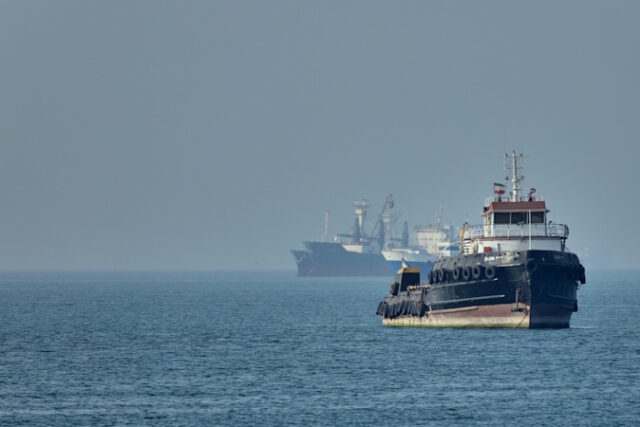
The diplomatic stalemate has left the world’s most vital energy artery in a state of paralysis. The Strait of Hormuz normally carries one-fifth of the world’s oil and gas supply. With it closed, the International Energy Agency (IEA) has warned of a supply catastrophe.
Brent crude’s climb to $105 marks a painful milestone for a global market that had briefly found optimism last week, when prices dipped on rumors of a breakthrough. Instead, the “escalatory narrative” has returned. Florence Schmit, an energy strategist at Rabobank, noted that the market is beginning to price in the “reality of the supply situation” rather than the hope of a quick fix.
The impact is being felt acutely in the United States, where gasoline prices have surged past $4.50 a gallon in many states. A recent Reuters-Ipsos poll suggests that two-thirds of Americans now blame the Trump administration for the rising costs, and the President’s approval rating has dipped to 36%. In a bid to provide relief, Trump suggested on Monday that he would support a suspension of the federal gas tax—approximately 18 cents per gallon—though such a move would require Congressional approval.
The Israeli Stance and “60 Minutes”
Adding to the sense of a return to open warfare were comments from Israeli Prime Minister Benjamin Netanyahu. In an interview with CBS’s 60 Minutes that aired on Sunday night, Netanyahu asserted that the “war is not over.”
“There is still nuclear material, enriched uranium, that has to be taken out of Iran,” Netanyahu said. “There are still enrichment sites that have to be dismantled. If that can’t be accomplished with negotiations, Israel and the U.S. agree we can reengage them militarily.”
The Israeli military has continued to exchange blows with Iran-backed Hezbollah militants in southern Lebanon. The Lebanese health ministry updated its death toll on Monday to 2,869 people killed since the Israeli campaign began on March 2. The humanitarian situation in the region remains dire, as civilian populations are caught in the crossfire of the broader geopolitical struggle.
The Road to Beijing: Pressure on Xi Jinping
With the ceasefire failing, the focus of the crisis now shifts to China. President Trump is scheduled to arrive in Beijing on Wednesday for a high-stakes meeting with President Xi Jinping. China remains the single largest buyer of Iran’s sanctioned crude oil, providing a vital financial lifeline to the regime in Tehran.
Trump is expected to lean heavily on Xi to use this leverage to force concessions from the Iranians. “China has the capability. Only the U.S. and China have the capability to get that material out,” Trump said, referring again to the nuclear stockpile.
However, Beijing’s response remains uncertain. While China has a vested interest in lower energy prices, it has also criticized U.S. “unilateralism” and sanctions. Iranian officials have suggested that China could use the summit to warn the U.S. about the “consequences of its illegal actions on regional peace.”
Internal Friction and the “Economic Fury”
As the diplomatic front crumbles, the U.S. Treasury Department has ramped up its “Operation Economic Fury.” On Monday, Secretary Scott Bessent announced a new round of sanctions targeting 12 individuals and companies in Hong Kong and Dubai that have allegedly enabled the shipping of Iranian oil.
“Operation Economic Fury will continue to deprive the regime of funding for its weapons programs, terrorist proxies, and nuclear ambitions,” Bessent said.
The pressure is exacerbating internal divisions within Iran. While President Masoud Pezeshkian has occasionally struck a more pragmatic tone, hardliners within the Islamic Revolutionary Guard Corps (IRGC) and the Iranian Parliament remain defiant. Parliament speaker Mohammad Baqer Qalibaf warned on Monday that “Iran’s armed forces are ready to respond decisively to any act of aggression,” claiming there is “no alternative” but to accept the Iranian proposal.
The regime has also maintained a brutal internal crackdown. On Monday, reports surfaced of the execution of Erfan Shakourzadeh, a 29-year-old postgraduate student in Tehran, on fabricated charges of espionage. The move is seen as a signal of the regime’s intent to maintain absolute control even as its economy and infrastructure face collapse.
Conclusion: A Precarious Status Quo
As of Monday evening, the nominal ceasefire technically remains in place, having been in effect since April 7. However, with the President assigning it a “1 percent chance” of survival and global oil prices spiking, the “life support” looks increasingly thin.
The world now watches Beijing. If the Trump-Xi summit fails to produce a roadmap for the removal of Iran’s nuclear stockpile and the reopening of the Strait of Hormuz, the region may witness the end of diplomacy and the resumption of what some fear will be a much wider, more devastating conflict. For now, the global economy remains hostage to a “garbage” document and the high-stakes brinkmanship of a President who says he is finished reading it.
Sources Used and Links
- Associated Press: https://apnews.com/live/trump-administration-updates-05-11-2026
- PBS News: https://www.pbs.org/newshour/politics/watch-trump-says-iran-ceasefire-is-on-life-support
- The Guardian: https://www.theguardian.com/world/live/2026/may/11/middle-east-crisis-iran-us-israel-donald-trump-rejects-iran-peace-proposal-latest-news-updates
- Reuters / Investing.com: https://www.investing.com/news/commodities-news/oil-jumps-as-us-and-iran-fail-to-reach-agreement-on-peace-proposal-4674871
- Financial Times: https://www.ft.com/content/f66186e7-8e14-466d-b4de-114ee70c3e62?syn-25a6b1a6=1
- Middle East Eye: https://www.middleeasteye.net/news/ceasefire-life-support-trump-says-he-rejects-stupid-iranian-peace-offer
- WTHR (AP Wire): https://www.wthr.com/article/news/nation-world/attack-on-iran/ceasefire-iran-united-states-war-nuclear-uranium-strait-of-hormuz/507-3b56bd0d-43ad-4e3f-9e95-e0460eb43192
- BOE Report: https://boereport.com/2026/05/11/trump-says-iran-ceasefire-on-life-support-after-rejecting-tehrans-response/
Disclaimer
Artificial Intelligence Disclosure & Legal Disclaimer
AI Content Policy.
To provide our readers with timely and comprehensive coverage, South Florida Reporter uses artificial intelligence (AI) to assist in producing certain articles and visual content.
Articles: AI may be used to assist in research, structural drafting, or data analysis. All AI-assisted text is reviewed and edited by our team to ensure accuracy and adherence to our editorial standards.
Images: Any imagery generated or significantly altered by AI is clearly marked with a disclaimer or watermark to distinguish it from traditional photography or editorial illustrations.
General Disclaimer
The information contained in South Florida Reporter is for general information purposes only.
South Florida Reporter assumes no responsibility for errors or omissions in the contents of the Service. In no event shall South Florida Reporter be liable for any special, direct, indirect, consequential, or incidental damages or any damages whatsoever, whether in an action of contract, negligence or other tort, arising out of or in connection with the use of the Service or the contents of the Service.
The Company reserves the right to make additions, deletions, or modifications to the contents of the Service at any time without prior notice. The Company does not warrant that the Service is free of viruses or other harmful components.