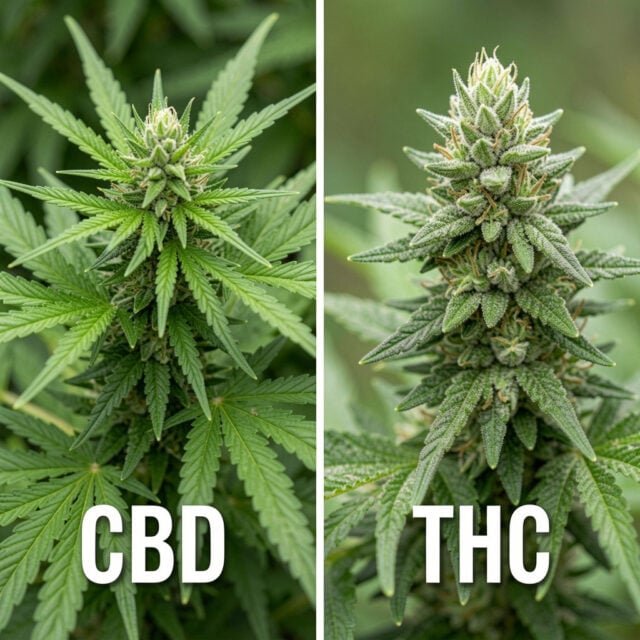
CBD and THC come from the same plant, get talked about in the same breath, and sit side by side on most dispensary shelves. Yet they behave very differently once they reach your body, and confusing the two is one of the easiest ways to end up with a product that does not match what you were hoping for.
Part of the trouble is that people use the names almost interchangeably. Someone wants to feel calmer without feeling altered, picks up the wrong product, and is surprised by the result. The names look similar on a label, but the experiences they offer can be worlds apart.
This article breaks down what CBD and THC actually are, how they differ in practical terms, the forms you will run into, and how to choose which fits your goals. The aim is clarity, not medical advice, so you can walk into a store knowing the right questions to ask.
What CBD and THC Actually Are
Both CBD and THC are cannabinoids, natural compounds found in the cannabis plant. They share a similar chemical makeup, which is part of why they are so often mentioned together, but small structural differences lead to noticeably different effects.

The Two Most Talked-About Cannabinoids
THC, short for tetrahydrocannabinol, is the compound most associated with the cannabis “high.” It is the dominant intoxicating ingredient in the plant. CBD, or cannabidiol, is generally considered non-intoxicating, meaning it does not produce that same altered feeling on its own.
That single distinction shapes almost everything else. When people talk about wanting the effects of cannabis without the high, they are usually describing the difference between THC and CBD.
How They Interact With the Body
Both compounds interact with the body’s endocannabinoid system, a network involved in things like mood, appetite, and how we perceive discomfort. THC binds more directly to certain receptors, which helps explain its stronger, more noticeable effects.
CBD interacts with the same system in a gentler, more indirect way. Researchers are still studying exactly how these interactions work, so the science is evolving rather than settled. That is a useful reminder to treat sweeping claims, in either direction, with caution.
The Key Differences That Matter to You
Once you understand that one is intoxicating and one generally is not, the practical differences start to make sense. These are the points worth weighing before you buy.
Choosing Where to Buy Matters First
Whichever compound interests you, the source matters as much as the label. Products from a licensed, regulated retailer come with testing information and clear labeling, so you actually know what you are getting. A reputable Somerset dispensary like Silverleaf carries lab-tested CBD and THC products and has staff who can explain the difference in person before you commit to anything.
Buying from an unverified source is where most problems start, because the contents and potency may not match the marketing. Transparency is the feature to look for, and a good retailer makes that information easy to find.
The High Versus No High
The clearest difference is the experience. THC can change how you think and feel in the moment, which some people seek and others prefer to avoid. CBD typically does not, which is why it appeals to people who want to stay clear-headed.
This is also why dosing habits differ. With THC, going slowly matters more, since the effects are stronger and easier to overshoot. CBD tends to be more forgiving, though that does not mean amount is irrelevant.
How Long Effects Tend to Last
Timing also separates the two in practice. THC’s noticeable effects often arrive faster and fade within a few hours, depending on how it is consumed. CBD’s effects are subtler and harder to pin to a clear window, which is why people describe it as a background sensation rather than an event.
Common Forms You’ll Find on the Shelf
CBD and THC do not just differ in effect, they also come in a range of formats. The form you choose changes how fast something works, how long it lasts, and how easy it is to dose.
Oils and Tinctures
Oils and tinctures are liquids you place under the tongue or add to food and drinks. They make it relatively easy to measure a consistent amount, which is why many newcomers start here. The onset is usually slower than inhaling but faster than a capsule.
Because the dose is measured in drops or a marked dropper, these formats reward patience. Start small and give it time before adjusting.
Edibles and Capsules
Edibles and capsules are swallowed, so they pass through your digestive system before taking effect. That means they are slower to begin but tend to last longer, which suits people who want a steady, low-maintenance experience.
The trade-off is timing. Because effects take a while to appear, it is easy to assume nothing is happening and take more too soon. Waiting is the simplest way to avoid a surprise.
Flower, Vapes, and Topicals
Inhaled flower and vapes act quickly, which makes them easy to gauge in real time, while topicals are applied to the skin for localized comfort rather than a whole-body effect. Each format has a different rhythm, so matching the form to your goal matters as much as choosing the cannabinoid. If you are unsure which suits you, knowledgeable staff can help you narrow the options.
Which One Is Right for You?
There is no universal answer here, only the option that fits your goal for a given moment. The honest approach is to start with what you want, then let the product follow.
If You Want to Stay Clear-Headed
If your priority is feeling steady and unaltered, CBD-forward products are the usual starting point. Many people choose them for everyday use precisely because they do not produce a high.
It is worth noting that the U.S. Food and Drug Administration has not approved CBD as a dietary supplement and cautions against products that make unproven health claims, so treat bold promises on packaging with healthy skepticism.
If You Want Stronger Effects
If you are specifically after the traditional cannabis experience, THC is the relevant compound. Newer users do well to start with a very small amount and wait, since the effects can build more than expected.
Many products also blend both compounds in a stated ratio, which some people find offers a more balanced feel. Reading that ratio, rather than just the headline number, tells you more about what to expect.
Common Myths and Misunderstandings
A lot of confusion around CBD and THC comes from half-truths that get repeated until they sound official. Clearing a few up makes shopping much less intimidating.
“More THC Is Always Better”
A higher THC number is not automatically a better product. Potency interacts with your tolerance, the format, and how much you actually consume, and chasing the biggest number is a common way to overdo it. The right amount is the one that matches your goal, not the strongest option on the shelf.
“CBD Does Nothing” or “CBD Cures Everything”
CBD tends to attract two opposite myths. Some dismiss it as having no effect, while others treat it as a cure-all. The honest middle ground is that effects are typically subtle and vary from person to person, and research is still ongoing. Be wary of any product promising dramatic, guaranteed results.
Tips for First-Time Buyers
A little preparation makes the whole process easier and far less intimidating. These habits apply no matter which compound you choose.
Start Low and Read the Label
Begin with a modest amount and give it time before deciding whether you want more. Check the label for cannabinoid content, serving size, and a test date, since those details tell you more than any marketing line.
Ask Questions Before You Buy
Do not hesitate to ask staff how a product is meant to be used. A good budtender will ask about your goals and point you toward something sensible rather than the strongest option on the shelf.
Keep Track of What Works
Jot down what you tried, how much, and how it felt. Over a few experiences, your own notes become more reliable than any label, because they reflect how your body actually responds rather than how a product is marketed.
Final Thoughts
CBD and THC are not rivals so much as different tools. CBD tends to suit people who want the plant’s qualities while staying clear-headed, and THC suits those seeking its more noticeable effects. Neither is “better” in the abstract, only better or worse for a particular person and purpose.
The smartest move is to define your goal, buy from a transparent and licensed source, start with a small amount, and stay curious rather than rushed. Treat your first few experiences as gentle experiments, and the difference between these two compounds quickly stops being confusing and starts being useful. If you are ever unsure, especially about health concerns or medications, a conversation with a healthcare professional is always worthwhile.
Disclaimer
Artificial Intelligence Disclosure & Legal Disclaimer
AI Content Policy.
To provide our readers with timely and comprehensive coverage, South Florida Reporter uses artificial intelligence (AI) to assist in producing certain articles and visual content.
Articles: AI may be used to assist in research, structural drafting, or data analysis. All AI-assisted text is reviewed and edited by our team to ensure accuracy and adherence to our editorial standards.
Images: Any imagery generated or significantly altered by AI is clearly marked with a disclaimer or watermark to distinguish it from traditional photography or editorial illustrations.
General Disclaimer
The information contained in South Florida Reporter is for general information purposes only.
South Florida Reporter assumes no responsibility for errors or omissions in the contents of the Service. In no event shall South Florida Reporter be liable for any special, direct, indirect, consequential, or incidental damages or any damages whatsoever, whether in an action of contract, negligence or other tort, arising out of or in connection with the use of the Service or the contents of the Service.
The Company reserves the right to make additions, deletions, or modifications to the contents of the Service at any time without prior notice. The Company does not warrant that the Service is free of viruses or other harmful components.