A fast electric bike can make some South Florida commutes easier, especially when the route is too long to walk comfortably but short enough that driving, traffic and parking feel unnecessary.
The main advantage is not simply higher speed. It is able to maintain a useful pace over longer stretches, get more assistance on hills or during acceleration, and arrive without turning every commute into a workout.
For South Florida riders, however, speed is only useful when the rest of the bike fits the trip. Battery range, braking, comfort, storage, road conditions and local e-bike rules can matter just as much as the number on the display.
When Does Extra E-Bike Speed Actually Help?
Higher assistance is most useful on longer sections of a commute where riders are not constantly stopping.

Someone traveling several miles between neighborhoods may benefit from maintaining a stronger pace with less physical effort. The advantage becomes smaller on crowded paths or routes filled with intersections, pedestrians and traffic lights.
That is why commuters should treat speed as an available capability rather than a target.
The goal is not to ride as fast as possible through South Florida traffic. It is to make longer everyday distances feel more manageable when conditions allow.
Does Range Matter More Than Top Speed?
For most commuters, yes.
A bike may be capable of faster assisted riding, but that performance is not very useful if the rider becomes worried about reaching home.
Someone commuting eight miles each way needs enough battery for at least 16 miles, plus errands, detours and a comfortable reserve. Real-world range can vary with assistance level, rider and cargo weight, tire pressure, repeated acceleration, weather and other riding conditions.
Higher assistance can also increase energy use.
Instead of shopping only by the largest range figure, commuters should ask whether the battery can comfortably cover the normal round trip.
A removable battery can make that routine easier. Riders who cannot park beside an electrical outlet may be able to remove the battery and charge it indoors according to the manufacturer’s instructions.
For everyday transportation, convenient charging is often more important than chasing the largest possible battery.
Can a Fast E-Bike Replace Some Car Trips?
For the right routes, it can.
Think about trips that sit awkwardly between walking and driving: a six-mile commute, a grocery store several neighborhoods away or a destination where parking is difficult.
An e-bike can fill that middle ground.
It will not replace every car trip. Heavy rain, passengers, large cargo and roads without suitable cycling infrastructure can still make driving the practical option.
The more realistic goal is replacing some routine trips.
If an e-bike becomes useful for commuting three days a week, visiting a nearby store or getting to a weekend destination without moving the car, it has already changed the rider’s transportation options.
How Important Are Tires on South Florida Routes?
Tire choice affects how confidently a bike handles changing road surfaces.
Urban rides may include smooth pavement, cracked streets, construction zones, rough shoulders and occasional gravel or uneven access routes.
A fat tire electric bike can feel more planted when those surfaces become inconsistent. Wider tires also give riders more flexibility if the same bike is used for weekday commuting and weekend recreation.
The trade-off is weight and size.
Someone riding only on smooth bike lanes may prefer a lighter setup. Riders who regularly move between pavement and rougher surfaces may find wider tires more useful.
The best choice depends on the whole week, not just the fastest section of the commute.
Can a Step-Through Frame Make Commuting Easier?
Yes. A step through electric bike lowers the frame area riders need to cross when getting on and off.
That can be helpful during stop-and-go city riding, especially when carrying a work bag, groceries or something on the rear of the bike.
The difference becomes more noticeable with heavier e-bikes.
Swinging a leg over a high top tube may be easy on a lightweight bicycle but less convenient when the bike includes a large battery, motor and wider tires.
For a commuter who mounts and dismounts several times each day, easier access can have more practical value than a feature used only on occasional rides.
What Does a Fast Mixed-Surface E-Bike Look Like?
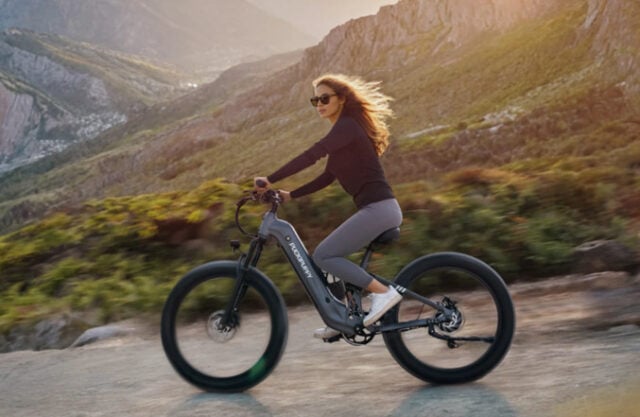
The Puckipuppy Boxer ST is one example of a bike that combines high-speed pedal assistance with features designed for both everyday roads and rougher recreational surfaces.
Puckipuppy lists the Boxer ST with a 750W rated motor and 960W peak output, throttle operation up to 20 mph and pedal assistance up to 28 mph. Its removable 48V 20Ah battery carries a stated range of 40 to 80 miles depending on riding conditions.
The bike also uses a low-entry frame, 26-by-4-inch tires and full suspension, including a 130mm adjustable front fork. Hydraulic disc brakes and a 400-pound maximum load capacity support a setup intended for riders who may encounter different surfaces during the week.
That versatility comes with a trade-off: the Boxer ST weighs 84.6 pounds.
For someone who stores the bike in a garage and rides directly from home, that may be manageable. For a commuter who needs to carry the bike upstairs or lift it onto a vehicle rack, weight becomes a much bigger part of the decision.
The Boxer ST also illustrates why riders should not assume that performance specifications automatically determine where an e-bike can legally be used. Florida’s statutory definition of an electric bicycle currently refers to a motor of less than 750 watts, while Puckipuppy lists the Boxer ST at 750W rated output. Riders should therefore confirm the model’s classification and the rules that apply to their intended public routes before commuting with it.
Why Do Brakes Matter More on Faster E-Bikes?
A commuter needs to control speed as confidently as the bike builds it.
Traffic lights change. Cars turn across bike routes. Wet pavement and loose surfaces can reduce available grip.
Those situations become more important as bike weight, rider weight and speed increase.
Hydraulic disc brakes are common on performance-oriented e-bikes because they can provide strong, progressive braking with manageable lever effort.
Riders still need to leave enough stopping distance and adjust speed to conditions. Better hardware does not replace good judgment.
For everyday commuting, predictable braking is often more valuable than another small increase in top speed.
What About South Florida Heat and Weather?
South Florida weather can change the way an e-bike commute feels.
Electric assistance can reduce physical effort during hot rides, making longer commutes more manageable than on a conventional bicycle.
But assistance does not eliminate heat exposure.
Riders still need water, appropriate clothing and realistic expectations about how long they will spend outside. Morning commuting may feel very different from riding during the hottest part of the afternoon.
Rain also matters. Braking distances and visibility can change quickly on wet roads, while standing water can hide potholes or surface damage.
Weather should be part of route planning, not something riders think about only after leaving home.
What Do Florida E-Bike Rules Mean for Commuters?
Florida law generally gives qualifying electric bicycles the same rights and duties as conventional bicycles and allows them in many places where bicycles are permitted. Local governments and agencies, however, can regulate or restrict their use in areas under their control.
The state also uses the familiar three-class framework, including Class 3 pedal assistance up to 28 mph, but the statutory definition of an electric bicycle includes additional technical requirements.
For South Florida commuters, the practical takeaway is straightforward: check the exact bike and the exact route.
A city street, multiuse path, beach area and park trail may not all operate under identical rules.
That matters particularly with higher-performance models. Available motor assistance should never be treated as proof that the same performance is permitted everywhere.
Is a Fast E-Bike Right for Every South Florida Commuter?
No.
Someone riding two flat miles through a dense neighborhood may be better served by a lighter city bike that is easier to store and carry.
A rider covering a longer suburban route may place much more value on stronger assistance, additional range and comfort over rough pavement.
The decision should begin with the commute itself.
Consider distance, traffic, road quality, charging, storage and what needs to be carried. Then decide how much speed and battery capacity actually improve that routine.
A fast e-bike can make South Florida commuting easier when its extra performance solves a real distance or effort problem. When the battery, brakes, frame and tires also match the route, the bike becomes more than a faster way to ride.
It becomes another practical way to get around.
Disclaimer
Artificial Intelligence Disclosure & Legal Disclaimer
AI Content Policy.
To provide our readers with timely and comprehensive coverage, South Florida Reporter uses artificial intelligence (AI) to assist in producing certain articles and visual content.
Articles: AI may be used to assist in research, structural drafting, or data analysis. All AI-assisted text is reviewed and edited by our team to ensure accuracy and adherence to our editorial standards.
Images: Any imagery generated or significantly altered by AI is clearly marked with a disclaimer or watermark to distinguish it from traditional photography or editorial illustrations.
General Disclaimer
The information contained in South Florida Reporter is for general information purposes only.
South Florida Reporter assumes no responsibility for errors or omissions in the contents of the Service. In no event shall South Florida Reporter be liable for any special, direct, indirect, consequential, or incidental damages or any damages whatsoever, whether in an action of contract, negligence or other tort, arising out of or in connection with the use of the Service or the contents of the Service.
The Company reserves the right to make additions, deletions, or modifications to the contents of the Service at any time without prior notice. The Company does not warrant that the Service is free of viruses or other harmful components.