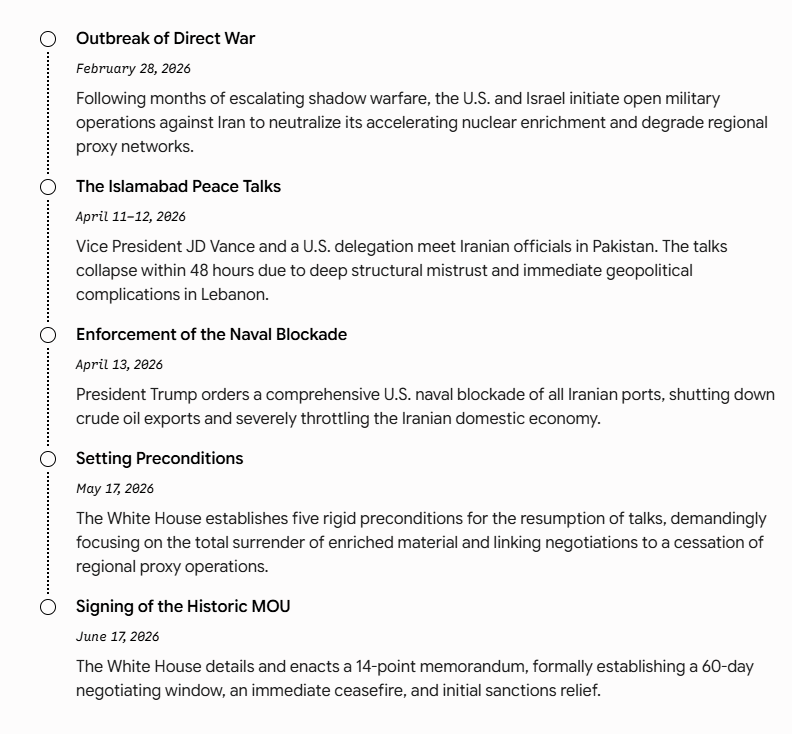
The White House has officially released the full text of a sweeping 14-point Memorandum of Understanding (MOU) between the United States and the Islamic Republic of Iran. Digitally signed by U.S. President Donald Trump at the G7 summit in France and Iranian President Masoud Pezeshkian in Tehran, the interim agreement implements an immediate ceasefire, outlines the lifting of a grueling maritime blockade, and initiates a high-stakes 60-day diplomatic sprint to forge a permanent nuclear pact.
While hailed by the administration as a historic breakthrough capable of averting a “worldwide depression,” the text reveals major concessions from both Washington and Tehran, sparking intense debate worldwide and exposing profound rifts between the U.S. and its closest Middle Eastern ally, Israel.
Inside the 14-Point Plan: The Core Terms
The newly released memorandum operates primarily as a structured roadmap rather than a finalized treaty. It seeks to freeze military activities, restore vital trade corridors, and establish baseline parameters for subsequent, granular negotiations. The central pillars of the 14-point framework include:
1. Permanent Cessation of Hostilities on All Fronts
Paragraph one mandates an immediate and permanent termination of military operations between the U.S., Iran, and their respective allies. Crucially, the text explicitly extends this ceasefire to Lebanon. Both nations and their coalition partners undertake a binding commitment to refrain from the threat or use of force against one another from this point forward.

2. Reopening the Strait of Hormuz
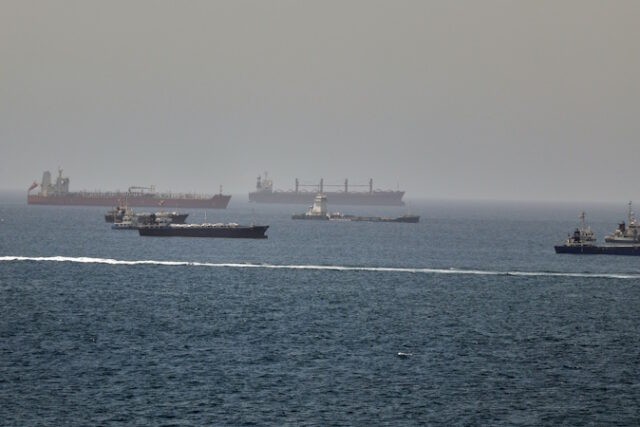
In what economists view as the most time-sensitive victory, Iran has committed to utilizing its “best efforts” to guarantee the safe, unhindered passage of commercial vessels through the Strait of Hormuz. For the initial 60 days of the agreement, transit will be entirely toll-free. The text gives Tehran 30 days to clear technical and military obstacles, including maritime demining operations. Future administrative frameworks for the strait will be negotiated via bilateral dialogue between Iran and the Sultanate of Oman.
3. Dismantling the Naval Blockade and Troop Drawdowns
In direct reciprocity for the reopening of the shipping lanes, the United States will immediately begin dismantling its naval blockade of Iranian ports, with a mandate for complete removal within 30 days. Furthermore, Washington has pledged to remove its military forces from the immediate proximity of the Islamic Republic within 30 days following the ratification of a final, permanent deal.
4. Immediate Oil Export Waivers and Asset Mobility
While broad international sanctions will remain in place until a final deal is signed, the U.S. Department of the Treasury will immediately issue sweeping waivers. These waivers legalize the export of Iranian crude oil, petroleum products, and derivatives, alongside providing crucial financial, insurance, and banking channels to facilitate those transactions. Additionally, restricted or frozen Iranian financial assets held abroad are slated to be made “fully available” to Tehran, subject to strict implementation metrics worked out over the next two months.
5. The $300 Billion Reconstruction Fund
In one of the plan’s most ambitious clauses, the United States has committed to partnering with regional states to develop a comprehensive economic development and reconstruction plan for Iran. The framework guarantees a baseline of at least $300 billion in targeted capital investment. The exact oversight, funding mechanisms, and execution pipelines for this massive fund are to be finalized during the 60-day negotiation window.
6. Immediate Nuclear Performance and Down-Blending
On the strategic front, Iran explicitly reaffirms in the text that it will not procure or develop nuclear weapons. As an immediate show of performance, the framework requires Iran to begin down-blending its highly enriched uranium stockpile—estimated by intelligence agencies to sit at roughly 440 kilograms—on-site under the direct supervision of the International Atomic Energy Agency (IAEA).
Comprehensive Analysis: Pros and Cons of the White House Strategy
The release of the memorandum has divided the foreign policy establishment. While proponents argue that the deal represents a masterclass in pragmatic crisis management, detractors view it as a dangerously lopsided agreement that surrenders vital leverage prematurely.
Pros
- Prevention of Global Economic Collapse: By securing the immediate reopening of the Strait of Hormuz, the agreement averts an impending energy catastrophe. Prior to the signing, maritime shipping firms had entirely halted liquefied natural gas (LNG) and crude transport through the corridor, triggering an acute energy crisis that President Trump noted could have caused a “worldwide depression.”
- Immediate Material Reduction of Nuclear Threat: Unlike purely diplomatic ceasefires, this framework extracts a tangible, immediate security concession from Tehran. Forcing the on-site down-blending of Iran’s 440-kilogram stockpile of highly enriched uranium drastically extends Iran’s “breakout time,” preventing them from rapidly processing that material into weaponized isotopes while talks occur.
- Structured Enforcement Mechanism with Military Backing: The White House has maintained an explicit “trust but verify” posture. The agreement gives the U.S. the flexibility to walk away or immediately re-impose economic and military pressure if compliance falters. As President Trump starkly warned at the G7 summit, “If it doesn’t get done in 60 days… we go right back to bombing.”
- Regional De-escalation and Humanitarian Relief: The formal inclusion of Lebanon under the ceasefire canopy offers a vital reprieve to populations caught in the crossfire of the regional war, halting expansive air campaigns and ground incursions that threatened to destabilize neighboring states.
Cons
- Premature Loss of Economic Leverage: Critics argue that by granting immediate U.S. Treasury waivers for crude oil exports and unfreezing assets up front, Washington has abandoned its strongest bargaining chips before securing long-term structural limits on Iran’s nuclear infrastructure.
- Incentivizing Revisionist Maritime Tactics: Iranian officials, including parliament speaker Mohammad Bagher Ghalibaf, have already publicly stated that the Strait of Hormuz will not return to pre-war conditions and that Tehran intends to impose transit fees on commercial vessels after the 60-day toll-free window expires. Detractors note this effectively normalizes Iran’s ability to weaponize international waterways for financial gain.
- Severe Alienation of Israel: The agreement has created a historic rift between Washington and Jerusalem. Israeli Prime Minister Benjamin Netanyahu was reportedly excluded from reviewing the final text of the memorandum. Israel has openly rejected the deal’s long-term implications for Lebanon, asserting its right to maintain a physical buffer zone and continue military operations against Hezbollah regardless of U.S.-Iran consensus.
- Omission of Long-Term Structural Protections: The 14 points leave the most complex, foundational questions unaddressed. The framework lacks definitive clauses outlining permanent limits on domestic uranium enrichment, the future status of advanced centrifuges, ballistic missile development restrictions, or long-term funding networks for regional paramilitary proxies.
Geopolitical Fallout and the 60-Day Clock
The international community has responded to the White House announcement with a mixture of profound relief and deep skepticism. At the G7 summit, European leaders issued a joint statement offering conditional support, framing the memorandum as a historic opportunity to steer the Middle East away from total war. Conversely, regional analysts warn that the structural incentives within Washington, Tehran, and Jerusalem make the second phase of negotiations exceptionally volatile.
“An MOU, without any follow-on deal, will be volatile and impossible to sustain on its own. There will likely be a significant delta between the aspirations outlined in the MOU and what emerges in a final deal.” — Nate Swanson, Director of the Iran Strategy Project at the Atlantic Council
Domestically, the Trump administration faces an uphill battle with skeptics in Congress who note that this interim framework offers Iran far more immediate financial carrots than the 2015 Joint Comprehensive Plan of Action (JCPOA)—a deal President Trump famously dismantled during his first term as “one-sided.” Administration officials have countered this criticism by emphasizing that all sanctions relief under the 2026 framework is temporary, strictly conditional, and backed by a forward-deployed military presence ready to resume offensive operations at a moment’s notice.
As the 60-day countdown begins, the immediate focus shifts to the International Atomic Energy Agency’s deployment to Iranian enrichment facilities and the resumption of commercial maritime traffic through the heavily mined waters of the Strait of Hormuz. Whether this memorandum serves as the foundation for a durable regional peace or merely a temporary pause in an unavoidable war depends entirely on the grueling diplomatic negotiations scheduled to unfold over the coming weeks.
Sources and Links:
- The Guardian: US releases text of Iran peace plan as Trump says deal averts ‘worldwide depression’
- The Guardian Live: Middle East crisis live: agreement signed by US-Iran presidents
- PBS NewsHour: What’s in the agreement to end the U.S. war in Iran, according to a U.S. official
- Associated Press (AP News): US and Iran sign initial deal to end war, ease sanctions and open strait as nuclear talks continue
- CBS News: Live Updates: Trump formally signs U.S.-Iran deal as questions linger about nuclear program
- NOTUS: White House Details Iran Deal, But Trump Warns Bombs Could Still Fall
- Atlantic Council: Experts react: The US and Iran just announced an interim peace deal. Here’s what we know so far.
- Wikipedia: 2025–2026 Iran–United States negotiations
- The White House: U.S. Counterterrorism Strategy 2026
Disclaimer
Artificial Intelligence Disclosure & Legal Disclaimer
AI Content Policy.
To provide our readers with timely and comprehensive coverage, South Florida Reporter uses artificial intelligence (AI) to assist in producing certain articles and visual content.
Articles: AI may be used to assist in research, structural drafting, or data analysis. All AI-assisted text is reviewed and edited by our team to ensure accuracy and adherence to our editorial standards.
Images: Any imagery generated or significantly altered by AI is clearly marked with a disclaimer or watermark to distinguish it from traditional photography or editorial illustrations.
General Disclaimer
The information contained in South Florida Reporter is for general information purposes only.
South Florida Reporter assumes no responsibility for errors or omissions in the contents of the Service. In no event shall South Florida Reporter be liable for any special, direct, indirect, consequential, or incidental damages or any damages whatsoever, whether in an action of contract, negligence or other tort, arising out of or in connection with the use of the Service or the contents of the Service.
The Company reserves the right to make additions, deletions, or modifications to the contents of the Service at any time without prior notice. The Company does not warrant that the Service is free of viruses or other harmful components.